
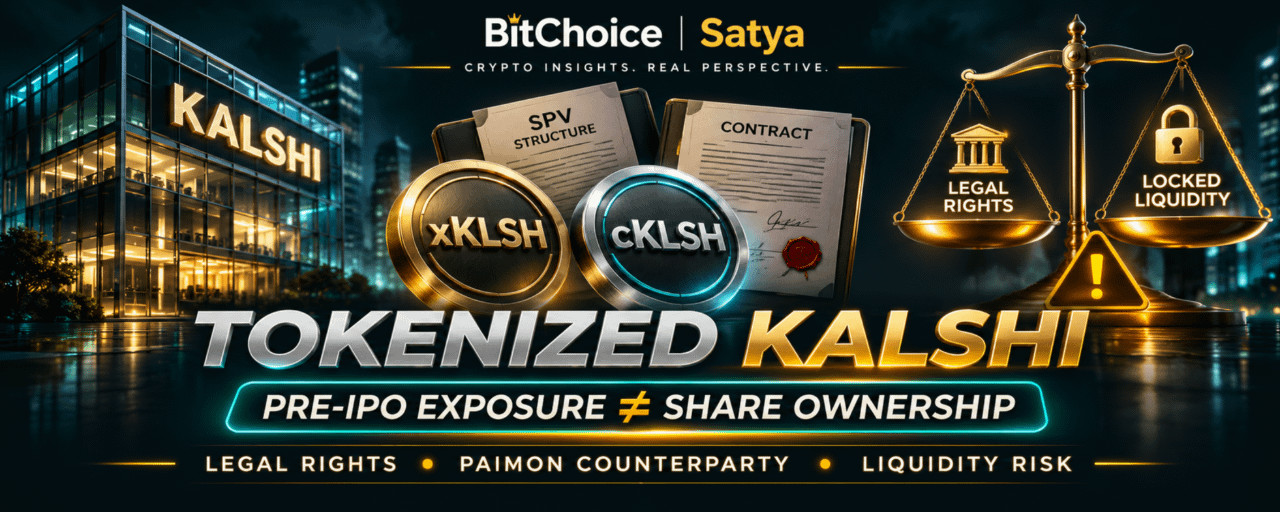

BitChoice | Satya — RWA & Market Structure Intelligence
November 2, 2026
Private-Market Exposure Is Not the Same as Share Ownership
The race to tokenize traditional financial assets is expanding beyond publicly traded stocks and ETFs.
LBank has introduced a Pre-IPO offering linked to Kalshi, the US prediction-market company, through two instruments:
xKLSH — a product designed for earlier trading access.
cKLSH — a locked product with a conditional conversion mechanism.
At first glance, these instruments appear to offer access to the potential future value of a private company.
But the central question is more complicated:
What exactly does a tokenholder legally own?
The answer matters much more than the token's price.
1. What LBank Actually Offers
According to LBank's October 26 announcement, the Kalshi-linked subscription includes two structures.
xKLSH — Unlock Mode
Subscription price: 39 USDT
Intended for spot trading on LBank
Expected trading launch: November 3, 2026, at 09:00 UTC
Liquidity and execution prices are not guaranteed.
cKLSH — Lock Mode
Subscription price: 28 USDT
Subject to lock-up conditions
Potential conversion into 1.4 xKLSH per cKLSH, according to the published terms
Conversion depends on the applicable contractual conditions.
The combined subscription allocation is capped at 500,000 USDT.
The published subscription window runs from October 29 to November 2, 2026.
Importantly, these are subscription terms — not guaranteed future market valuations.
2. The Most Important Detail: These Are Not Kalshi Shares
LBank explicitly states that subscribing to these instruments does not create direct ownership of Kalshi shares or standard shareholder rights.
That means holders should not assume they receive:
Direct voting rights in Kalshi
Ordinary shareholder status
Direct ownership of company equity
Guaranteed access to an eventual IPO
Guaranteed conversion into publicly traded shares.
Instead, the structure provides contractual economic exposure through a third-party arrangement.
The named issuing and managing entity is Paimon Limited.
LBank acts as a distribution and platform-services provider.
The distinction is fundamental: exposure to a company's value is not the same as ownership of that company.
3. Who Actually Owes the Investor?
The legal structure introduces additional parties between the investor and the underlying company.
A simplified chain looks like this:
Investor → LBank platform → Paimon product → SPV-linked economic exposure → Kalshi
Each layer has a different role.
LBank provides platform access and associated services.
Paimon is responsible for issuing and managing the product under its contractual documentation.
The SPV arrangement is intended to connect the token's economic exposure with underlying private-market interests.
But the existence of a token does not eliminate contractual, custody or counterparty risk.
If an issuer or intermediary fails to perform its obligations, the tokenholder's recovery depends on the enforceability of the relevant agreements and the status of underlying assets.
This is why understanding the legal issuer matters more than recognizing the company name featured in the marketing.
4. The cKLSH Lock-Up Deserves Special Attention
A longer holding period is often presented as the price of accessing a lower entry valuation.
But investors should examine the precise conditions.
LBank's announcement describes the lock-up as extending until six months after Kalshi's IPO.
The Paimon product website, however, describes a six-month locked tranche.
These descriptions are not obviously equivalent.
The final, binding product documents must determine which condition applies to a specific purchase.
If an IPO is delayed, never occurs or triggers alternative settlement provisions, the exit process may differ significantly from what a simplified promotional description suggests.
A fixed six-month lock-up and an IPO-dependent lock-up can create radically different liquidity risks.
That difference should be resolved before treating the product as a conventional short-term investment.
5. Does the 1.4× Conversion Mean a 40% Profit?
No.
The published conversion ratio concerns token quantities, not guaranteed investment returns.
Imagine a hypothetical position converting into 1.4 times as many tokens.
The economic result still depends on the market price of those tokens when conversion becomes available.
If the value per token falls sufficiently, receiving more tokens does not prevent a loss.
Other factors may include costs, settlement conditions, redemption limitations and the time value of locked capital.
More tokens do not automatically mean more money.
The conversion mechanism must be evaluated together with the expected underlying value and the contractual risks.
6. xKLSH: Tradable Does Not Mean Liquid
The unlocked product is intended to provide earlier access to secondary-market trading.
But there is an important difference between a token being listed and a token having a functional market.
Consider a product with a quoted price of 39 USDT.
A trader might assume that a position worth 3,900 USDT can be sold at that valuation.
In reality, the order book may contain very little buying interest near that price.
A market sell order could execute substantially lower.
Alternatively, there may be insufficient liquidity to close the full position promptly.
Important metrics include:
Bid and ask spread
Order-book depth
Trading volume
Available market makers
Price impact for meaningful order sizes
Concentration of token holdings.
LBank's announcement also states that deposits and withdrawals are not supported for the event assets.
This creates an additional limitation: users cannot assume that they can transfer the instrument to another exchange or personal wallet through LBank.
A token can be tradable within one platform while remaining difficult to exit economically.
7. What Happens if Kalshi Never Goes Public?
This is one of the most important unresolved investment scenarios.
There is no guaranteed IPO date.
A private company can remain private for longer than investors expect.
Its valuation can change substantially.
Corporate restructurings, financing rounds and regulatory developments can affect the economics of a structured exposure product.
LBank's master agreement describes a potential repurchase opportunity if no IPO or other agreed exit event occurs within twelve months after the relevant Paimon closing date.
However, this is not a guaranteed redemption.
Paimon may offer repurchase only under the applicable conditions, and the proceeds depend on actual realization of the underlying interests.
LBank explicitly disclaims any guarantee of a repurchase, minimum quantity or price.
That means investors should not treat the twelve-month provision as an unconditional maturity date or a guaranteed route back to USDT.
8. The Hidden Valuation Problem
Private-market assets lack the continuous, transparent price discovery associated with highly liquid public shares.
A token can reference an estimated company valuation, while its own secondary-market price reflects a different set of forces.
These may include:
Private-company valuation risk
The reference valuation may be uncertain or change before an eventual liquidity event.
Token liquidity premium or discount
A tradable instrument may trade above or below the value implied by its contractual exposure.
Issuer and settlement risk
The market must assess whether the promised economic relationship can be fulfilled.
Information asymmetry
Public investors may have less access to financial disclosures than investors in conventional public equity markets.
Consequently, a rising token price does not necessarily prove that the underlying company has increased in value.
And a falling token price does not always measure a corresponding change in the company's fundamentals.
9. Can Tokenized Pre-IPO Products Improve Market Access?
Potentially, yes.
Tokenization can simplify distribution, introduce smaller subscription amounts and provide alternative market structures for eligible users.
LBank's published minimum subscription is 10 USDT, subject to allocation and eligibility rules.
That lowers the nominal entry threshold compared with many traditional private-market opportunities.
But reducing the minimum amount does not eliminate structural complexity.
A product can be easier to access while remaining difficult to value, verify or exit.
For these instruments to develop into credible financial infrastructure, several conditions matter:
Transparent legal documentation
Verifiable underlying exposure
Clear investor rights
Independent custody and valuation controls
Reliable secondary-market liquidity
Predictable conversion and settlement mechanisms
Enforceable investor protections.
Accessibility without clarity is not necessarily financial progress.
10. What Serious Investors Should Verify
Before evaluating any tokenized private-company exposure, the relevant questions are:
Who is the legal issuer?
The issuer is not necessarily the private company named in the product.
What is the underlying claim?
Does it represent shares, an SPV interest or a contractual promise linked to economic performance?
Who holds the underlying assets?
What evidence supports the stated holdings, and who can independently verify it?
What happens if a counterparty fails?
Which entity is responsible for settlement, and what legal remedies are available?
What does "liquid" actually mean?
Is there deep executable demand, or merely an exchange listing?
How does the product terminate?
What happens after an IPO, without an IPO or during an issuer-level failure?
Without clear answers, the token's headline price tells only a small part of the story.
Final Perspective: The Wrapper Is Part of the Investment
The Kalshi-linked offering illustrates both the promise and complexity of tokenized private markets.
Investors may gain new methods of accessing economic exposure associated with private companies.
But these arrangements can introduce multiple layers of counterparty, legal, valuation and liquidity risk.
For xKLSH and cKLSH, the key issue is not simply whether Kalshi's business grows.
It is whether the product's contractual structure can reliably translate that growth into an enforceable economic outcome for the tokenholder.
Tokenized exposure ≠ direct equity ownership.
A quoted price ≠ guaranteed liquidity.
A conversion ratio ≠ guaranteed profit.
The future of RWA tokenization will depend on closing the gap between the financial asset being promoted and the legal rights investors actually receive.
Discussion
Would you prefer direct equity ownership with limited access — or easier tokenized access with additional issuer and liquidity risks?
Sources
LBank — LBank Announces Kalshi Pre-IPO Product Subscriptions, October 26, 2026.
LBank — Pre-IPO Locked Product Subscription & Platform Services Master Agreement, October 28, 2026.
Paimon Finance — Paimon Kalshi SPV Token Product Documentation.
Editorial disclosure: The product is issued and managed by a third party. Its contractual rights, underlying holdings, lock-up conditions and settlement procedures are governed by the applicable binding documents. Inconsistent descriptions of lock-up terms require clarification; neither future liquidity nor an IPO is guaranteed.
Educational and informational content only. Not financial or investment advice.