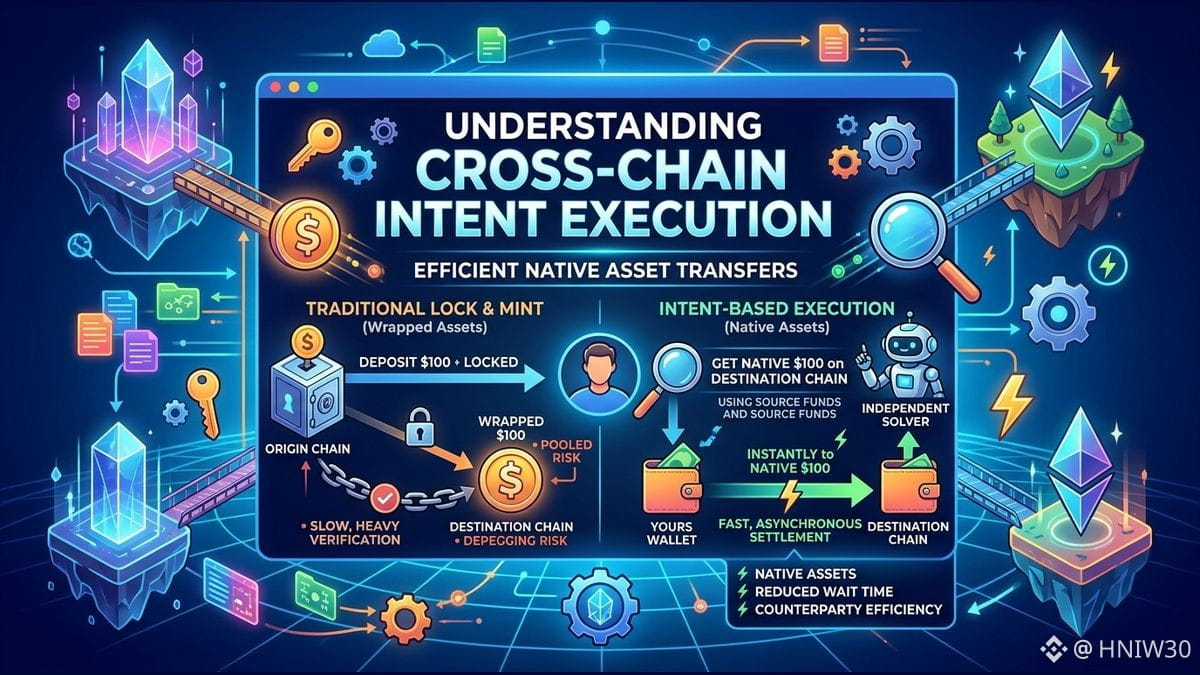
Cross-chain transfers traditionally relied on lock-and-mint structures, where assets are locked in collateral vaults on an origin network to mint synthetic representations on a destination chain. Under that framework, collateral concentrations create pool exposure, and participants face the risk of holding unbacked tokens if underlying vaults are compromised. Settlement speed also remains constrained by underlying block finality and verification across networks.
An alternative mechanism relies on intent-based routing and off-chain fulfillment. Instead of locking assets in shared pools and waiting for cross-network message verification, a user defines an intended outcome, specifying inputs on the source chain and expected native assets on the destination. Independent solvers or market makers fulfill the request directly by providing native inventory on the target chain. Settlement and reimbursement to the solver occur asynchronously on the source chain according to protocol rules.
This design shifts counterparty and execution dynamics. Because the recipient receives native assets rather than synthetic representations, the risk of holding depegged wrapped tokens is reduced. Execution latency can also decrease, as the user is not required to wait for multi-chain message settlement before accessing target-network liquidity.
However, intent architectures introduce distinct trade-offs. Solvers incorporate inventory costs, rebalancing expenses, and capital lockup into their quotes, which can widen spreads during volatile market conditions. If solver participation is limited on specific routes, requests may encounter execution delays or remain unfilled. Evaluating whether a transfer mechanism uses pooled liquidity, private fulfillment, or native messaging is an essential consideration for assessing structural risk and net transaction costs.