

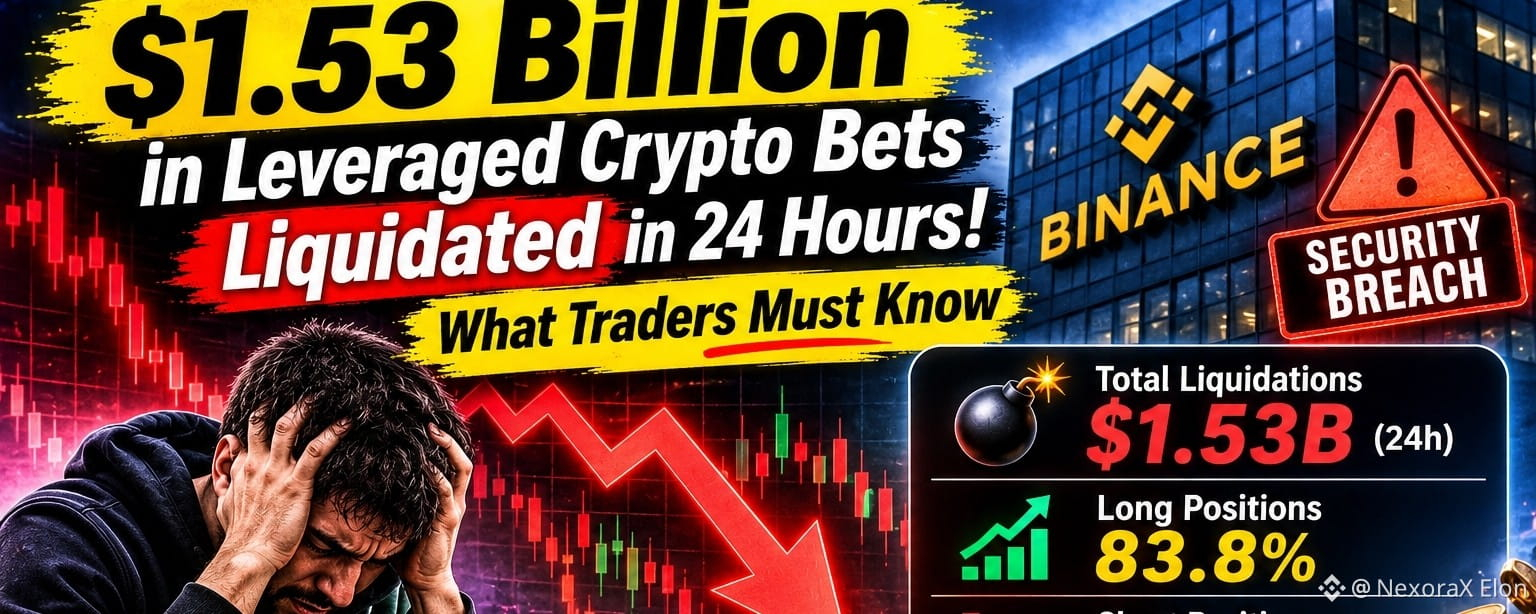

#$1.5BInLeveragedCryptoBetsLiquidated
The crypto market just delivered a painful reminder about the risks of leverage ⚠️. In only 24 hours, **$1.53 billion in leveraged trades were liquidated**, and the vast majority of them were traders betting on higher prices 😰. Let's break down what happened, why it matters, and what lessons traders can take from it 👇
## 📊 The Numbers at a Glance
- 💣 **Total liquidations:** $1.53 billion in 24 hours
- 📈 **Long positions liquidated:** about **83.8%**
- 📉 **Short positions liquidated:** the remaining share
- 🔐 **Reported trigger:** the aftermath of a **security breach at Binance**
That means roughly **5 out of every 6 dollars** liquidated came from traders who expected prices to rise 🐂. When the market moved the other way, these positions were wiped out almost instantly 💨.
## 💸 Important: This Is Not Cash Leaving Pockets
One detail is often misunderstood 🧠. The **$1.53 billion figure measures the total value of the positions that were closed**, not the actual money lost by investors 💡.
For example, a trader using high leverage might control a $10,000 position with only $500 of their own money. If that position is liquidated, the headline counts **$10,000**, while the trader's real loss is the **$500 collateral** 🧮.
So the real money lost is much smaller than the headline number. Still, for the traders involved, losing their entire collateral is a serious blow 😓.
## ⚙️ How Leverage and Liquidation Work
Leverage is like **opening a larger trade with a small amount of money** 🔧. It can multiply profits when the market moves in your favor, but it multiplies losses just as fast ⚡.
Here is the process step by step:
- 🔹 A trader deposits a small amount as **collateral**
- 🔹 The exchange lends extra funds so the trader can open a **much larger position**
- 🔹 If the price moves against the trader far enough, the collateral is **no longer sufficient**
- 🔹 The exchange **forcibly closes the position** automatically 🤖
This forced closing is called a **liquidation**. It happens without asking the trader, and it cannot be undone ❌.
## 🌊 The Domino Effect: When Liquidations Fuel the Fall
Liquidations do not only reflect a price drop. They can **make the drop worse** 🔄.
Here is how the chain reaction works:
- 📉 Prices fall and some leveraged longs get liquidated
- 🛒 The exchange **sells those positions** on the market to close them
- 💥 These forced sales add **more selling pressure**, pushing prices lower
- 🪜 Lower prices trigger **even more liquidations**
This loop is often called a **liquidation cascade** 🌪️. It is one reason crypto can fall very sharply in a short time ⏱️.
## 🔐 The Binance Security Breach Connection
According to the report, this wave of selling is linked to the **aftermath of a security breach at Binance** 🚨. Security incidents at large exchanges can quickly damage market confidence 😟.
When traders worry about the safety of a major platform, many choose to:
- 🏃 **Reduce exposure** and move to the sidelines
- 💼 **Withdraw funds** to self-custody wallets
- 📤 **Close positions early** to avoid risk
Because Binance is one of the largest exchanges in the world 🌍, any security concern there can spread fear across the whole market, not just one platform.
## 🔄 The Other Side: Short Squeezes on the Rebound
The story did not end with the drop 🎢. **When prices recovered, some "short" positions, which bet on a decline, were liquidated in turn** 🔁.
This is how it works:
- 📈 Prices bounce back up
- ⚠️ Short sellers face losses and get **liquidated**
- 🛍️ To close a short, the exchange must **buy** the asset
- 🚀 This **buying pressure pushes prices even higher**
This effect is known as a **short squeeze** 🍋. It shows how liquidations can feed volatility in **both directions**, creating sharp swings up and down ↕️.
## 🪙 Coins in the Spotlight
Several tokens were mentioned in connection with this market movement: **$LSK**, **$IDOL**, and **$Q** 👀. During high-volatility events, smaller and mid-cap tokens often see bigger price swings than major coins, because their liquidity is thinner 🌊. That creates both opportunity and risk for active traders.
## 🧘 Key Lessons for Traders
- 🎯 **Use leverage carefully.** High leverage leaves almost no room for error.
- 🛡️ **Always use a stop-loss** and keep risk per trade small.
- 💰 **Keep extra margin** so a small dip does not wipe out your position.
- 🧠 **Do not trade emotionally.** Panic and greed cause most liquidations.
- 🔐 **Avoid keeping all funds on one exchange.** Spread risk and consider self-custody for long-term holdings.
- 📚 **Understand the headline numbers.** Liquidation totals show position size, not actual losses.
## 🎯 Final Thoughts
The **$1.53 billion liquidation event** shows how fast the crypto market can turn when leverage, fear, and a security scare collide 🌪️. Longs took most of the damage, and shorts felt the pain on the rebound. It was a two-way squeeze that punished overconfident traders on both sides ⚖️.
For long-term investors, moments like this can be uncomfortable but also educational 📖. For leveraged traders, they are a loud warning that **risk management matters more than any prediction** 🔑.
Stay safe, trade smart, and always do your own research (DYOR) 📚. This article is for information only and is **not financial advice** ⚠️.
---
## 🏷️
#CryptoLiquidations #Binance #Leverage #CryptoMarket #Write2Earn
#UniswapA16zSeekDeFiExemptionFromIllinoisCryptoTax #HKDollarStablecoinHKDAPToLaunchOnSolana #TrezorSaysCryptoBilisSoldWalletMayContainMaliciousComponents #KOSPIFalls3.53%BackBelow6000