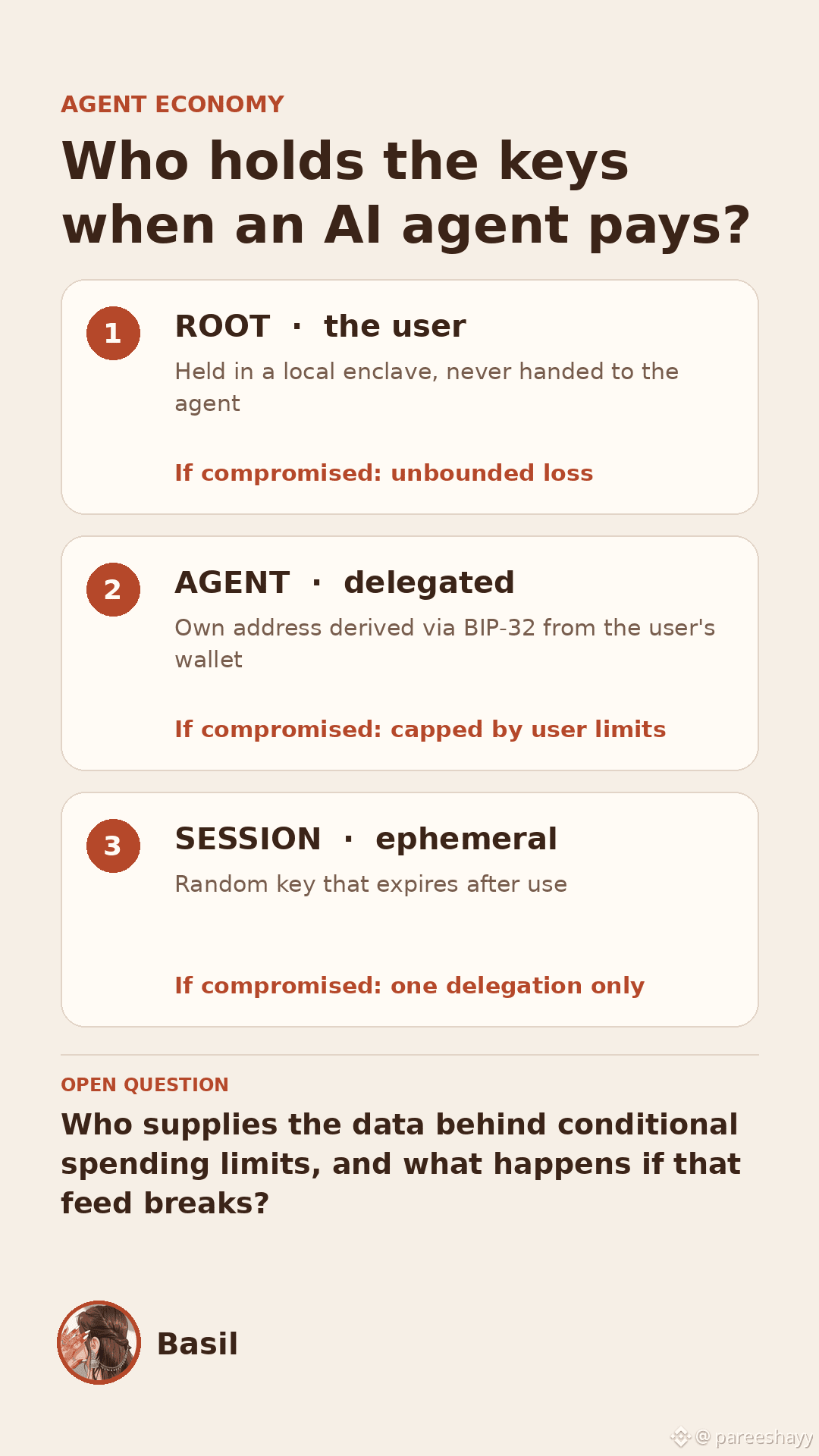
Today I read Kite’s developer docs end to end, and the part that stayed with me wasn’t speed or fees. It was how authority is split into three layers. The user holds root authority, each agent gets its own address derived from the user’s wallet via BIP-32, and every session runs on a random key that expires after use. Compromise a session and you lose one delegation. Compromise an agent and the damage stays inside the limits the user set. Only the root key carries unbounded loss, which is why the docs keep it in a local enclave.
The payment design follows the same logic. Instead of settling every request on-chain, two parties open a channel, exchange thousands of signed updates off-chain, and close it with a second transaction.
The docs cite sub-100ms latency at roughly $1 per million requests.
Here is where I’d push back on my own enthusiasm. The docs also describe conditional rules, like cutting an agent’s limit when volatility spikes. A rule like that needs an outside data input, and I couldn’t find who supplies it or what happens if that feed is wrong. Also, the large testnet figures (hundreds of millions of transactions) came from a testing environment, so they say little about recurring demand on mainnet, which launched April 30, 2026.
What I’m tracking from here: the number of active Agent Passports on KiteScan, the share of agent transactions that are real service payments rather than test traffic, and whether the docs name the data source behind conditional spending limits.
An agent economy only works if a person can hand over a wallet and still sleep. That depends less on how fast agents pay and more on what the rules do when their inputs break.
#KiteBBW $KITE @KITE AI 中文 #KiteBBW