
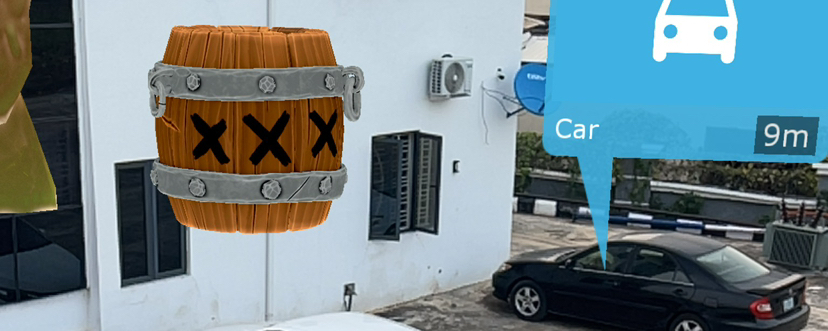

The internet still mostly lives on screens. Decisions, discoveries, and experiences happen in physical places like streets, venues, cities, and events. tagSpace is building the infrastructure that connects the two.
What is TagSpace?
tagSpace is Spatial Intelligence infrastructure. It delivers AI-curated digital experiences anchored to real-world locations, so the right content reaches the right place at the right time. Creators and businesses can publish location-based experiences in minutes with high precision and little technical overhead.
The platform’s AI prioritizes, ranks, and lays out content dynamically, turning venues, cities, and events into personalized, measurable layers.
The result is a global distribution layer for place-based experiences that can be measured and monetized.
What the Platform Does
tagSpace combines several technologies:
→ Artificial Intelligence: 3D generative AI, agentic content curation, AI voice chat, and predictive positioning that fuses sensors, SLAM, GPS, and spatial maps for high accuracy.
→ Spatial Computing: Mixed-reality engine with real-world occlusion and lighting, support for MR glasses, and tools that convert 2D web content into 4D spatial experiences.
→ DePIN elements: Open-source spatial content protocol, mobile edge compute, and decentralized peer-to-peer compute.
→ Blockchain: Cross-chain capabilities, Real-World Digital Assets (RWdA), locational smart contracts, location-based NFT marketplaces, and fractional revenue sharing.
The consumer app (available on iOS and Android, with early mixed-reality glasses prototypes) lets people explore spatial content left at real places. tagStudio gives creators and brands tools to publish. The system has moved from primarily enterprise use to broader public experiences, with new spatial content added regularly.
Let’s talk about the coin $TAGAI
$TAGAI: The Utility Token
$TAGAI is the native utility and governance token of the tagSpace ecosystem, live on Base CA: 0xa3c285b49fdc0a5498fddb629f975cb40aecabd4.
Total supply is fixed at 100 billion tokens.
It functions as the settlement layer for transactions, rewards, and value flows across the network. Core utility includes:
• Creators earn $TAGAI based on engagement their spatial content generates.
• Creators spend $TAGAI to boost visibility and reach (creating a flywheel where more engagement leads to more rewards).
• Support for incentives, in-app rewards, location-based NFTs, RWdA marketplaces, and fractional revenue sharing from experiences.
Tokenomics emphasize ecosystem growth, long-term alignment, and sustainable distribution. Allocations include a significant Community Fund (around 22%) for campaigns, rewards, and governance, and a large Treasury (around 26%) as an operational reserve. Initial circulating supply at launch was low (roughly 2.67%), with gradual unlocks.
The token has traded on platforms such as Aerodrome on Base. As of late October 2026, the project has noted ongoing weekly buybacks and continued development after a period of lower activity.
Why It TagSpace is important.
Most digital experiences remain screen-bound. tagSpace aims to make places themselves programmable and discoverable a spatial layer where content, brands, creators, and users interact in the physical world with ownership, moderation, privacy considerations, and measurable engagement built in.
It is still early in the broader spatial computing and AI-onchain narrative. The combination of an existing app, creator tools, enterprise history, AI + spatial stack, and a utility token positions it as infrastructure rather than a pure narrative play. Execution on creator adoption, real-world usage, and sustainable token utility will determine how far the layer extends.
For more, the official site is [tagspace.com](https://tagspace.com).