



Market participants frequently follow derivatives turnover alongside open contracts, yet these indicators capture entirely different dimensions of market activity. Trading volume records the cumulative sum of contracts exchanged over a defined time window, such as one day. Open interest instead counts unsettled contracts active at an exact moment.
Every derivative contract requires two opposing sides, consisting of exactly one long and one short position. Because both sides always balance across the entire system, aggregate open interest cannot identify whether buyers or sellers are more numerous. A higher figure shows expanded outstanding commitment, not an imbalance of market sentiment.

The mechanics of trade matching explain why volume and open contracts do not move in lockstep. When a new buyer transacts with a new seller, fresh risk enters the market and open interest expands by one contract. When an existing buyer sells to an existing seller who is covering, that contract is extinguished, lowering open interest alongside new volume.
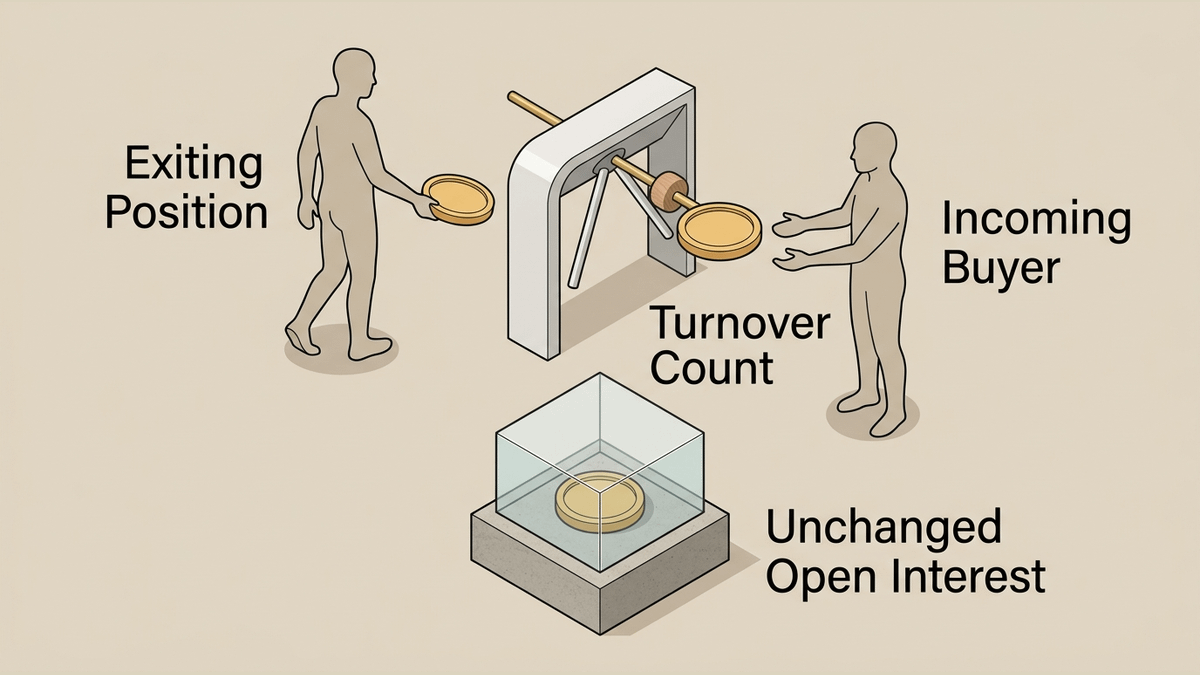
Volume can also accumulate without altering total open contracts. When an incoming buyer purchases a contract from an existing long who is exiting, trading volume increases by one unit while aggregate open interest remains unchanged. In fast markets, rapid contract turnover between active traders can produce elevated volume while open contracts stay flat.
Measurement units introduce additional distinctions across market feeds. Exposures may be quoted in native coins, contract counts, or nominal dollar values. Dollar-denominated totals fluctuate automatically with underlying spot price changes even when no positions change. Observers must separate valuation shifts from genuine changes in market positioning.
Accurate analysis requires strict alignment across reporting venues, contract terms, snapshot times, and observation windows. Comparing twenty-four-hour turnover against a single point-in-time snapshot merges a cumulative flow metric with an inventory balance. Distinguishing the window of trading activity from remaining exposure prevents distorted interpretations.
In Bitcoin perpetual markets, neither open interest nor trading volume offers a reliable directional forecast on its own. Rising open contracts denote growing capital commitment, whereas heavy turnover indicates fast trade execution. Each metric describes structural mechanics rather than price trajectory, serving as descriptive context rather than a trading signal.
