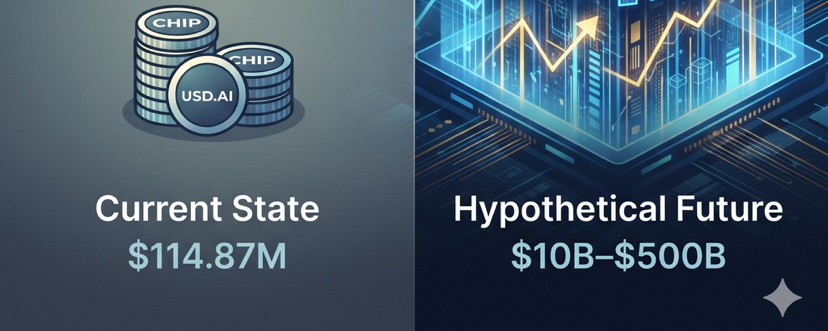


Everyone Is Watching CHIP… But Almost No One Understands What a $10B–$500B Market Cap Would Actually Mean
CHIP, the governance and utility token of USD.AI, sits at the intersection of two major narratives: artificial intelligence infrastructure and decentralized finance. While many crypto users focus on its price, the bigger question is how valuable CHIP could become if USD.AI scales into a major financing layer for GPU-backed AI infrastructure.
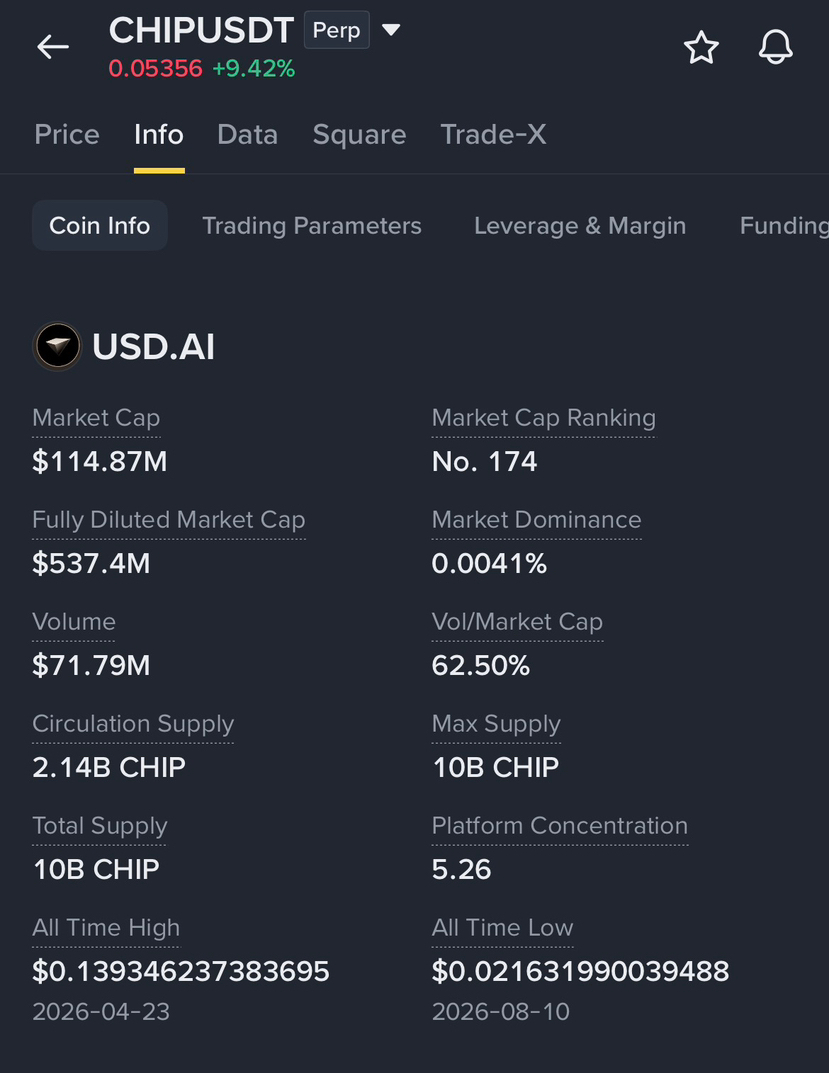
According to the supplied screenshot, CHIP was trading at $0.05356, with a market cap of $114.87M, a fully diluted valuation (FDV) of $537.4M, and a maximum supply of 10 billion tokens. Its circulating supply was approximately 2.14 billion CHIP.
Here is what different market-cap scenarios would mean:
• $10B market cap → approximately $4.67 per CHIP
• $25B market cap → approximately $11.68 per CHIP
• $50B market cap → approximately $23.36 per CHIP
• $100B market cap → approximately $46.73 per CHIP
• $250B market cap → approximately $116.82 per CHIP
• $500B market cap → approximately $233.64 per CHIP
These are hypothetical calculations using the screenshot’s 2.14 billion circulating tokens, held constant. They are not forecasts, and actual prices would depend on circulating supply at the time.
But what could justify such valuations?
USD.AI is designed to connect AI-compute operators seeking financing with capital providers funding GPU-backed lending. CHIP holders can participate in governance over collateral standards, loan eligibility, interest rates, fees, and protocol upgrades. The project has also introduced staking-related utility, including a backstop mechanism, subject to its rules. Official documentation makes one crucial distinction: CHIP does not represent equity or a contractual claim on protocol assets or revenue.
That distinction matters. Growing AI infrastructure demand does not automatically translate into profits for CHIP holders. A larger lending business could strengthen the token’s utility, but valuation would still depend on adoption, governance demand, token distribution, risk management, and the actual economic benefits available to token participants.
The biggest challenge is token supply. With 10 billion CHIP tokens at maximum supply, a $10B circulating market cap would imply a $100B fully diluted valuation if all tokens were valued at $1 each. At a $500B circulating market cap, the corresponding fully diluted valuation would be approximately $2.34 trillion, assuming the same 2.14B circulating supply. Unlocks could substantially change these calculations.
My interpretation: the $10B scenario is already an extremely ambitious valuation relative to the screenshot’s starting point. The $100B–$500B scenarios require extraordinary adoption, deep liquidity, durable token utility, and a valuation that the market is willing to sustain. They should be treated as speculative scenarios, not expected outcomes.
CHIP has an interesting narrative because AI infrastructure needs financing, and financing needs risk assessment, collateral rules, and capital coordination. But a strong narrative alone cannot establish a token’s intrinsic value.
The real question is not whether AI will grow. It is whether CHIP can capture durable economic value from the growth of AI financing.
Would you consider a $10B market cap a plausible long-term scenario for CHIP, or do you think token economics will become the biggest obstacle?