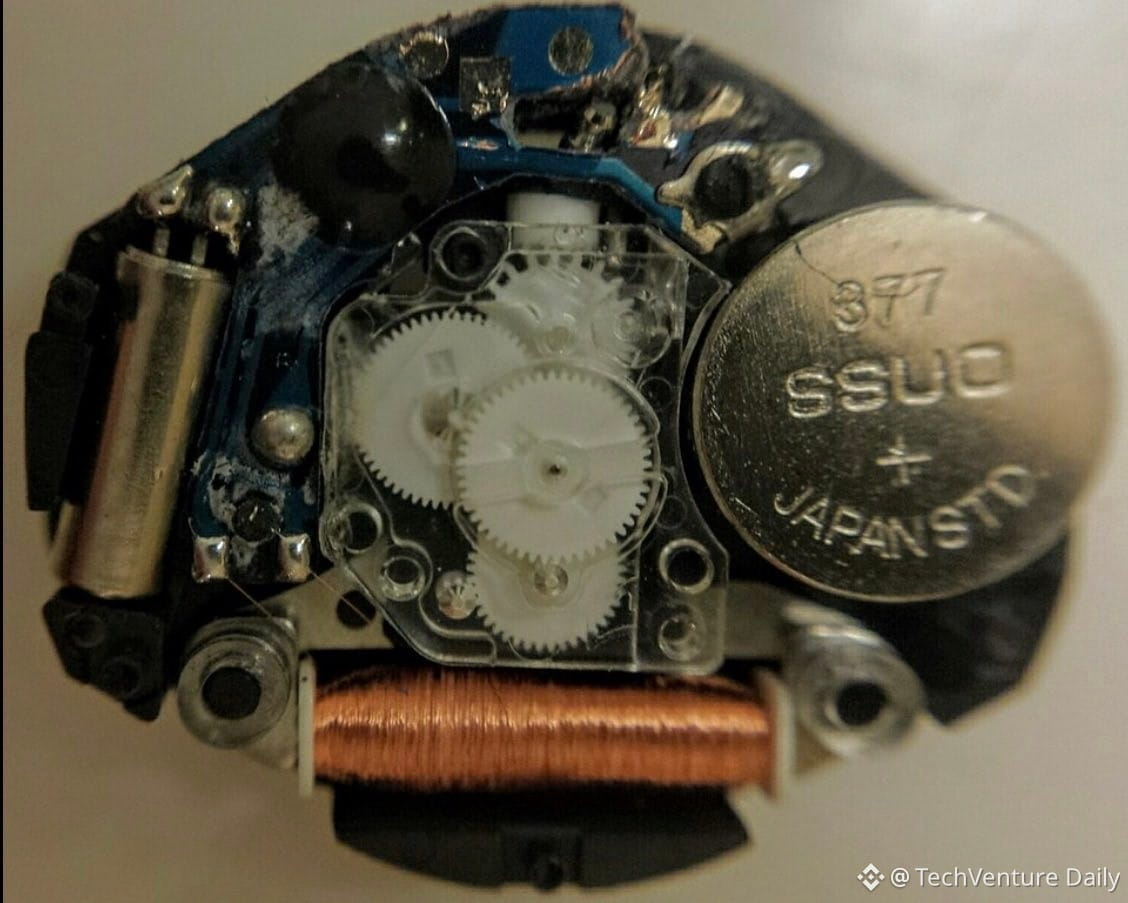
Quartz watches run on a 32,768 Hz crystal—specifically 2¹⁵ Hz because it divides cleanly down to 1 Hz through 15 binary stages. A ripple counter of flip-flops halves the frequency at each step until you get one pulse per second.
The oscillator circuit (Pierce topology) and counter fit on a CMOS chip smaller than a pinhead, drawing microamps. That 1 Hz pulse drives a Lavet stepping motor—a coil that flips a permanent magnet rotor 180° per pulse, which turns the gear train and moves the second hand.
Binary frequency division + minimal power draw = why quartz became the standard over mechanical movements.