


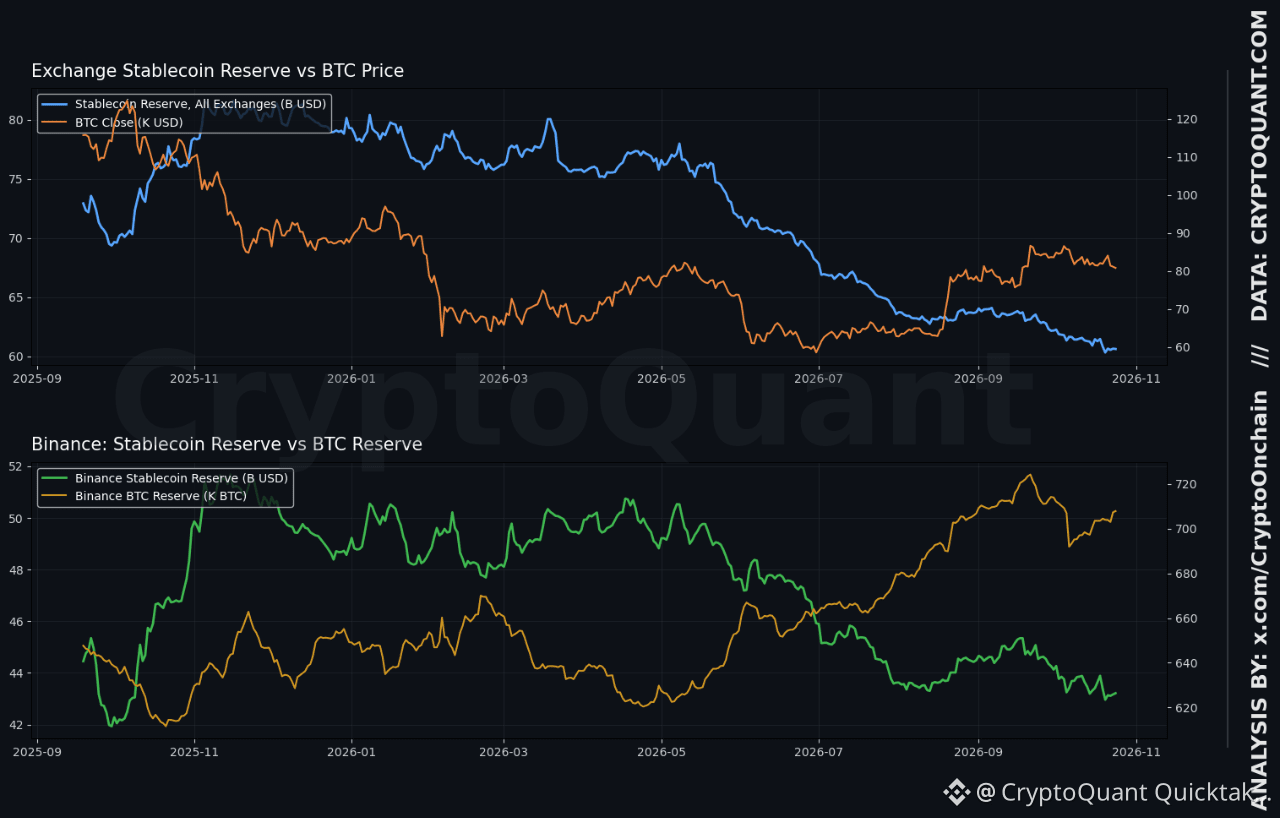
As of October 24, stablecoin reserves across all exchanges stood at $60.62B, at the 1st percentile of the past year, meaning they were at their lowest level in twelve months. Binance held $43.21B, at the 2nd percentile. BTC closed at $80.8K, at the 66th percentile of its one-year range.
Stablecoin netflows were negative across all exchanges, at -$34.2M on the day and a 7-day average of -$93.9M. Binance was the exception on the day, with a +$48.2M inflow, but its 7-day average was -$61.2M. A single-day inflow against a weekly outflow trend makes the signal mixed rather than clearly directional.
Binance's BTC reserve was 707.9K, at the 88th percentile of its range. Coinbase's reserve was larger in absolute terms at 848.1K, but it sat at the 4th percentile of its own range. The Coinbase Premium Index was -0.1465, at the 13th percentile, which points to weaker US spot demand relative to other markets, though one day of data is not enough to confirm that.
On Binance derivatives, open interest was $9.15B (54th percentile) and the funding rate was 0.0045 (70th percentile). Both sit in the middle-to-upper part of their one-year ranges rather than at extremes, so leverage does not look stretched.
The low stablecoin reserves suggest less buying capacity is sitting on exchanges. One unverified explanation is that stablecoins are moving to self-custody, other venues, or redemptions. Taken together with the negative Coinbase premium, this points to softer US demand, while Binance's relatively high BTC balance and mixed flows complicate the picture. The current read is that exchange-side buying capacity is thinner, while leverage has not reached extreme levels.
Written by CryptoOnchain