



#earningsseason 🌍#PositiveMindsGlobalResults | Binance Square | October 24, 2026
What happens when some of the world's most influential companies deliver strong financial results, yet investors remain uncertain about what comes next?
That is the central question facing the US stock market as the third-quarter 2026 earnings season develops.
Microsoft (MSFT), Visa (V), Amazon (AMZN), Alphabet (GOOGL), Tesla (TSLA), Meta Platforms (META), and Eli Lilly (LLY) represent different sectors of the global economy, including cloud computing, digital advertising, consumer payments, electric vehicles, artificial intelligence, and pharmaceutical innovation.
Their financial results could influence not only individual share prices but also broader expectations for corporate profitability, consumer demand, AI investment, economic resilience, and market valuations.

However, a strong earnings report does not automatically guarantee a rising share price. Investors must also consider future guidance, profit margins, cash flow, investment costs, and the expectations already reflected in market prices.
The central question is whether these companies can turn financial performance into sustainable growth or whether rising costs and demanding valuations will limit their upside.
This analysis examines the bullish, bearish, and mixed scenarios for all seven companies, identifies potential market-wide outcomes, and explores the possible implications for Bitcoin, Ethereum, and BNB.
1. The Market Backdrop: Strong Earnings, More Difficult Questions
The earnings season presents a significant challenge for investors. Corporate profits can remain healthy even as the market becomes increasingly selective about which companies deserve higher valuations.
According to the earnings-season figures cited in the original analysis, approximately 24.2 percent of S&P 500 companies had reported results through October 23. Aggregate earnings among reporting companies were up 31.5 percent year over year, revenue had increased 12.2 percent, and 80.7 percent had exceeded earnings-per-share estimates.
However, the reported earnings growth figure was heavily influenced by Micron's unusually large increase in profits. These aggregate figures should therefore not be interpreted as proof that every sector or company is experiencing equally strong growth.
Investors need to examine three important forces.
Artificial intelligence and capital expenditure
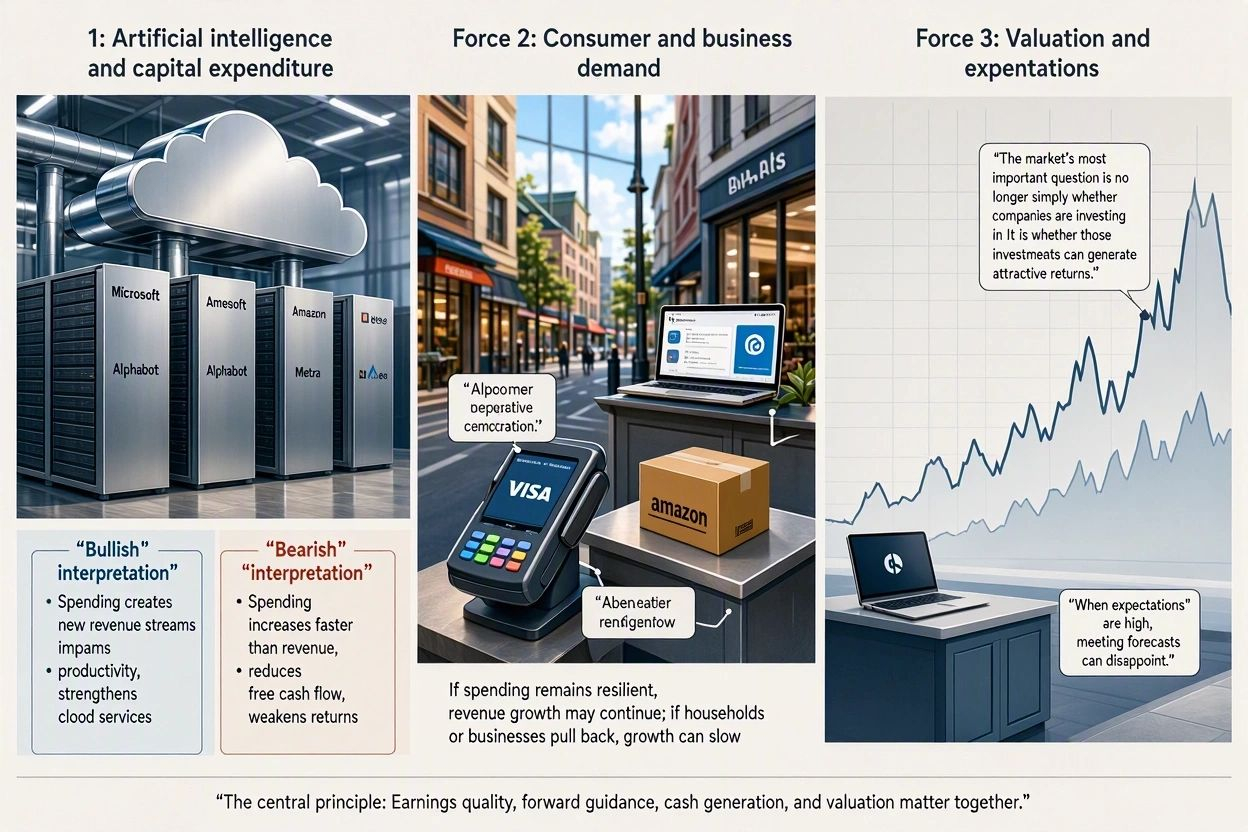
Microsoft, Amazon, Alphabet, and Meta are investing heavily in computing infrastructure, data centers, chips, cloud services, and AI applications.
The bullish argument is that these investments could create new revenue streams, improve productivity, strengthen customer relationships, and establish long-term competitive advantages.
The bearish argument is that spending could increase faster than revenue, reducing free cash flow and weakening returns on invested capital.
The decisive question is not simply how much companies spend on AI. It is whether that spending produces measurable commercial returns.
Consumer and business demand
Visa offers insight into payment activity, while Amazon reflects retail and cloud demand. Alphabet and Meta provide important information about digital advertising budgets.
Resilient consumer spending and business investment could support revenue growth. Conversely, weaker household demand or reduced corporate advertising budgets could put pressure on earnings.
Valuation and market expectations
Even an excellent earnings report can disappoint investors if the share price already reflects exceptional future growth.
A company that narrowly beats expectations may experience selling pressure if management provides cautious guidance. Another company might rise despite missing estimates if investors had anticipated an even worse outcome.
The key principle is straightforward: Earnings quality, future guidance, cash generation, and valuation must be considered together.
2. Microsoft: Can Azure and AI Deliver the Next Growth Chapter?

Microsoft is a major indicator of enterprise technology spending. Its business combines Azure cloud computing, Microsoft 365, enterprise software, cybersecurity, and AI services.
According to the earnings preview cited in the original analysis, Microsoft was scheduled to report its fiscal first-quarter 2027 results on October 28, after the US market closed. The cited expectations were approximately 4.72 dollars in earnings per share and 90.7 billion dollars in revenue.
Microsoft had previously indicated a quarterly revenue outlook of 89.85 billion to 90.95 billion dollars and Azure growth of approximately 45 percent at constant exchange rates.
These figures are forecasts cited in the original analysis, not confirmed results. Current company disclosures should be checked before publication.

Bullish scenario: Cloud growth exceeds expectations
Microsoft could attract renewed buying interest if Azure demand remains strong, enterprise AI adoption expands, and management demonstrates that AI services are generating meaningful recurring revenue.
Important bullish indicators include:

Azure growth meeting or exceeding management expectations.
Strong demand for AI infrastructure and enterprise AI tools.
Continued Microsoft 365 subscription growth.
Healthy operating margins despite infrastructure costs.
Constructive guidance for cloud demand into 2027.
Evidence that AI investment is contributing to sustainable revenue and profit growth.
Potential market reaction: Shares could rise if investors gain confidence that Microsoft's AI strategy is generating attractive financial returns.

Bearish scenario: AI spending grows faster than returns
The bearish outlook would strengthen if cloud growth slows, infrastructure costs accelerate, or AI services fail to generate sufficient incremental revenue.
Warning signs include weaker Azure growth, rising depreciation expenses, deteriorating free cash flow, slower enterprise spending, and disappointing forward guidance.
Potential market reaction: Microsoft could decline even after beating earnings estimates if investors conclude that future growth will require increasingly expensive investment.
Mixed scenario: Strong earnings without a major breakout
Microsoft could exceed earnings and revenue expectations while maintaining a cautious outlook on margins or infrastructure spending.
The stock might initially rally before losing momentum, or it could trade sideways as investors reassess its valuation.
What to watch: Azure growth, remaining performance obligations, AI monetization, capital expenditure, operating margins, and free cash flow.
Directional assessment: Bullish if cloud growth and profitability strengthen together. Bearish if growth slows while costs accelerate.
3. Visa: A Test of Consumer Resilience

Visa operates a global payments network that benefits from transaction activity, consumer purchases, international travel, and the expansion of digital payments.
Its performance can provide useful insight into consumer resilience. However, transaction growth alone does not reveal the full condition of the economy.
According to the original analysis, Visa was scheduled to report during the week beginning October 26. Its actual results and management guidance should be compared with analyst expectations before drawing conclusions.
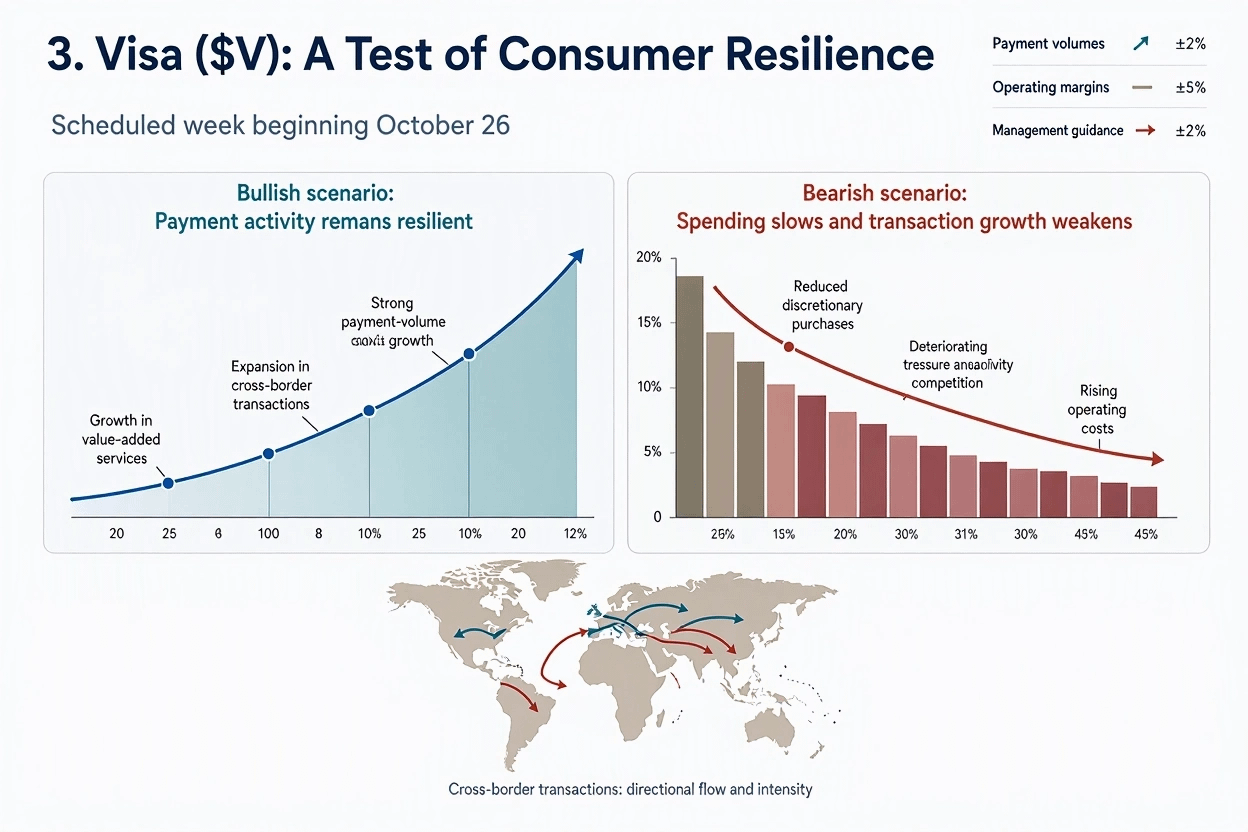
Bullish scenario: Payment activity remains resilient
Visa could benefit if consumer spending remains healthy, international travel supports cross-border transactions, and digital payments continue expanding.
Positive indicators include:
Strong payment-volume growth.
Continued expansion in cross-border transactions.
Stable or improving operating margins.
Growth in value-added services.
Constructive guidance for transaction activity.
Evidence that consumers continue spending despite economic uncertainty.

🌍 PositiveMindsGlobalResults | Binance Square | October 24, 2026
Potential market reaction: Shares could strengthen if Visa demonstrates that payment activity remains resilient and its business continues generating profitable growth.
Bearish scenario: Spending and transaction growth weaken
The downside case would become more convincing if households reduce discretionary spending, international travel slows, or economic uncertainty affects payment activity.
Other risks include regulatory pressure, competition from alternative payment systems, and rising operating expenses.
Potential market reaction: Visa could face selling pressure if transaction growth weakens or management lowers expectations, even if reported earnings exceed estimates.
Mixed scenario: Healthy spending but weaker margins
Visa might report strong payment volumes while facing higher expenses or slower growth in certain services.
Investors could remain confident in the underlying business but become less optimistic about its ability to expand profitability.
What to watch: Payment volumes, cross-border transactions, processed transactions, operating expenses, regulatory developments, and management's assessment of consumer demand.
Directional assessment: Bullish if transaction growth and profitability remain strong. Bearish if consumer activity weakens materially.
4. Amazon: The Battle Between AI Infrastructure and Cash Flow

Amazon combines e-commerce, advertising, logistics, subscriptions, and Amazon Web Services.
Its diversified business model provides several potential growth engines. However, strong cloud performance can coexist with pressure on retail margins, while infrastructure investment can reduce near-term cash generation.
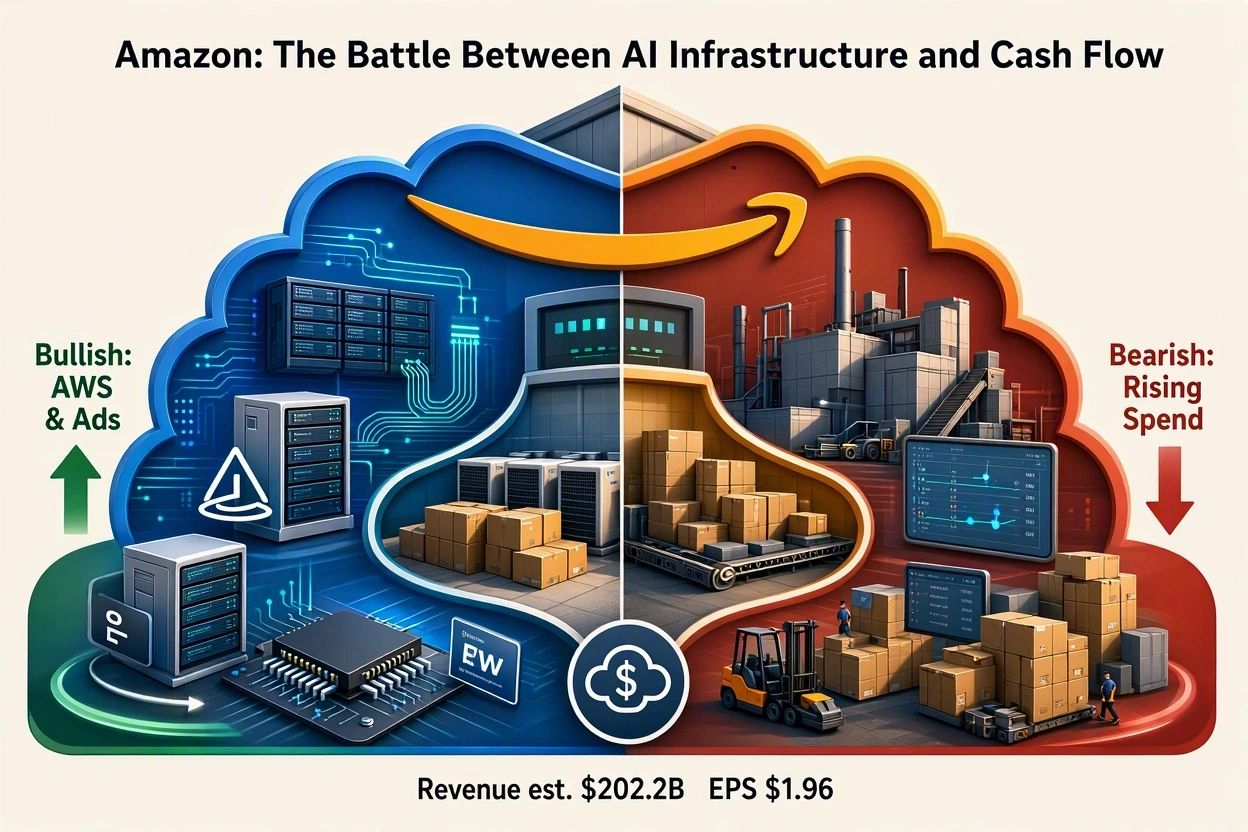
The original analysis cited October 29 as Amazon's scheduled third-quarter 2026 reporting date, with analyst expectations of approximately 202.2 billion dollars in revenue and 1.96 dollars in earnings per share.
These are estimates, not confirmed results, and should be checked against current company disclosures.
Bullish scenario: AWS and advertising strengthen profitability
The strongest bullish outcome would combine resilient cloud demand, expanding advertising revenue, and improved retail efficiency.
Potential catalysts include:
AWS growth exceeding expectations.
Strong demand for AI-related cloud services.
Advertising revenue expanding faster than operating costs.
Improved fulfillment and logistics efficiency.
Better operating margins across retail and cloud businesses.
Evidence that capital expenditure is generating measurable commercial returns.
Amazon does not need every business segment to accelerate simultaneously. Stronger profitability in AWS and advertising could help offset weaker performance elsewhere.
Potential market reaction: Shares could rise if investors conclude that infrastructure investments are strengthening Amazon's future earnings power.

Bearish scenario: Rising spending weakens cash generation
Amazon may need to invest heavily in data centers, networking equipment, chips, and other infrastructure before the corresponding revenue becomes visible.
The bearish case would strengthen if AWS growth disappoints, retail margins weaken, or capital expenditure increases without a convincing improvement in future returns.
Additional risks include wage inflation, transportation expenses, competition, and weaker consumer demand.
Potential market reaction: Shares could decline despite an earnings beat if free cash flow deteriorates or management signals that infrastructure spending will remain elevated.
Mixed scenario: Revenue growth without sufficient profit improvement
Amazon could report strong sales while operating margins remain under pressure.
In that situation, investors would need to determine whether incremental revenue is generating enough additional operating income to justify the company's investment requirements.
What to watch: AWS revenue growth, operating income by segment, advertising performance, capital expenditure, free cash flow, and forward guidance.
Directional assessment: Bullish if cloud growth translates into stronger cash generation. Bearish if investment requirements continue to outpace the financial benefits.
5. Alphabet: Can Google Turn AI Competition Into Profitable Growth?

Alphabet's business spans Google Search, YouTube advertising, Google Cloud, subscriptions, and AI services.
Its challenge is particularly important because AI creates both opportunities and risks. New AI products could improve customer engagement and cloud demand, but AI-powered search could also change how users access information and how advertising revenue is generated.
According to the original analysis, Alphabet was scheduled to report third-quarter 2026 results on October 28. The cited analyst preview estimated revenue of approximately 128.1 billion dollars and earnings per share of 3.02 dollars.
These figures should be treated as estimates until verified against actual company disclosures.

Bullish scenario: AI strengthens Alphabet's existing business
The bullish case depends on AI improving commercial performance rather than simply producing technological advances.
Positive indicators include:
Continued growth in Google Cloud.
Strong advertising demand across Search and YouTube.
AI features that improve engagement and commercial intent.
Higher cloud profitability as infrastructure utilization improves.
Evidence that AI services generate additional revenue.
Successful monetization without materially weakening established search economics.
Potential market reaction: Shares could rise if Alphabet demonstrates that AI is strengthening its established businesses while creating new sources of growth.
Bearish scenario: AI threatens established revenue economics
The downside case would strengthen if AI-generated answers weaken profitable search activity, cloud competition intensifies, or infrastructure costs increase faster than revenue.
Other risks include weaker advertising demand, regulatory developments, and uncertainty surrounding the long-term economics of AI-powered search.
Potential market reaction: Shares could decline if investors believe Alphabet must spend more to defend existing revenue while new AI services remain difficult to monetize.
Mixed scenario: Strong cloud performance but uncertain search economics
Google Cloud could deliver impressive growth while advertising performance remains steady rather than accelerating.
This combination could support Alphabet's long-term business outlook without triggering an immediate share-price breakout.
What to watch: Search and YouTube advertising, Google Cloud growth and margins, AI monetization, capital expenditure, and management's comments on competition.
Directional assessment: Bullish if AI strengthens advertising and cloud profitability. Bearish if rising costs coincide with pressure on established revenue streams.
6. Tesla: Can Future Technology Outweigh Present-Day Margin Pressure?

Tesla's investment case differs from that of the major cloud and advertising companies. Its valuation reflects vehicle sales alongside expectations for autonomous driving, robotics, AI, energy, and software-based revenue.
The original analysis cited Tesla's third-quarter 2026 results as approximately 28.05 billion dollars in revenue and adjusted earnings per share of 0.48 dollars, above the cited analyst consensus of approximately 0.44 dollars.
It also reported operating income of 718 million dollars, down 56 percent year over year, alongside free cash flow of approximately 1.5 billion dollars.
These figures illustrate why investors must distinguish positive cash-flow performance from pressure on operating profitability. The reported numbers should be verified against Tesla's official earnings release before publication.
Bullish scenario: Autonomy and AI become credible growth engines
Tesla's bullish case depends on demonstrating that its investments can produce commercially meaningful results.
Potential catalysts include:
Improving vehicle demand and production efficiency.
Stabilizing or strengthening automotive margins.
Growing adoption of autonomous-driving services.
Tangible progress toward commercially viable robotaxis.
Evidence of real demand for robotics and AI products.
Sustainable free cash flow despite elevated investment.

🌍 PositiveMindsGlobalResults | Binance Square | October 24, 2026
A particularly important development would be a credible path toward recurring software revenue that reduces Tesla's dependence on vehicle sales.
Potential market reaction: Shares could strengthen if investors see measurable progress toward a more diversified business with higher-margin revenue opportunities.
However, announcements and demonstrations are not equivalent to commercial execution. Investors should distinguish achieved milestones from future promises.
Bearish scenario: Automotive profitability deteriorates further
Tesla's downside risk increases if its established automotive business generates insufficient profit to support the cost of its future ambitions.
Warning signs include:
Falling operating margins.
Weak vehicle deliveries or pricing pressure.
Rising research and development expenses.
Higher capital expenditure without sufficient returns.
Delays in autonomous-driving commercialization.
Lower profitability in energy generation and storage.
Potential market reaction: Shares could face selling pressure if investors place greater emphasis on current financial performance rather than distant technological opportunities.

Mixed scenario: Positive cash flow but weaker operating performance
Tesla could continue generating positive free cash flow while automotive profitability remains under pressure.
Investors focused on financial resilience might view the cash generation positively, while those concerned about operating margins might remain cautious.
The result could be substantial volatility without a sustained bullish trend.
What to watch: Vehicle deliveries, automotive margins, free cash flow, autonomous-driving milestones, capital expenditure, and the commercial performance of newer businesses.
Directional assessment: Bullish if future technology opportunities develop alongside sustainable automotive profitability. Bearish if current profitability weakens faster than new revenue streams emerge.
7. Meta Platforms: Advertising Strength Versus the Cost of AI Ambition
financial performance depends heavily on its advertising business, while its long-term strategy includes substantial investment in AI infrastructure and products.
The original analysis cited third-quarter 2026 revenue of 64.60 billion dollars, representing 26 percent year-over-year growth and exceeding an analyst estimate of approximately 63.34 billion dollars.
It also cited fourth-quarter revenue guidance of 73 billion to 76 billion dollars and a revised 2026 capital expenditure forecast of 135 billion to 145 billion dollars.
The same analysis reported a 9.89 billion dollar legal-settlement-related charge and a 37 percent year-over-year decline in operating income.
These figures require confirmation against the company's official disclosures. If accurate, they illustrate the difference between strong revenue growth and the costs that can affect reported profitability.
Bullish scenario: AI improves advertising and creates new revenue
Meta's established advertising business provides a potential financial foundation for its AI ambitions.
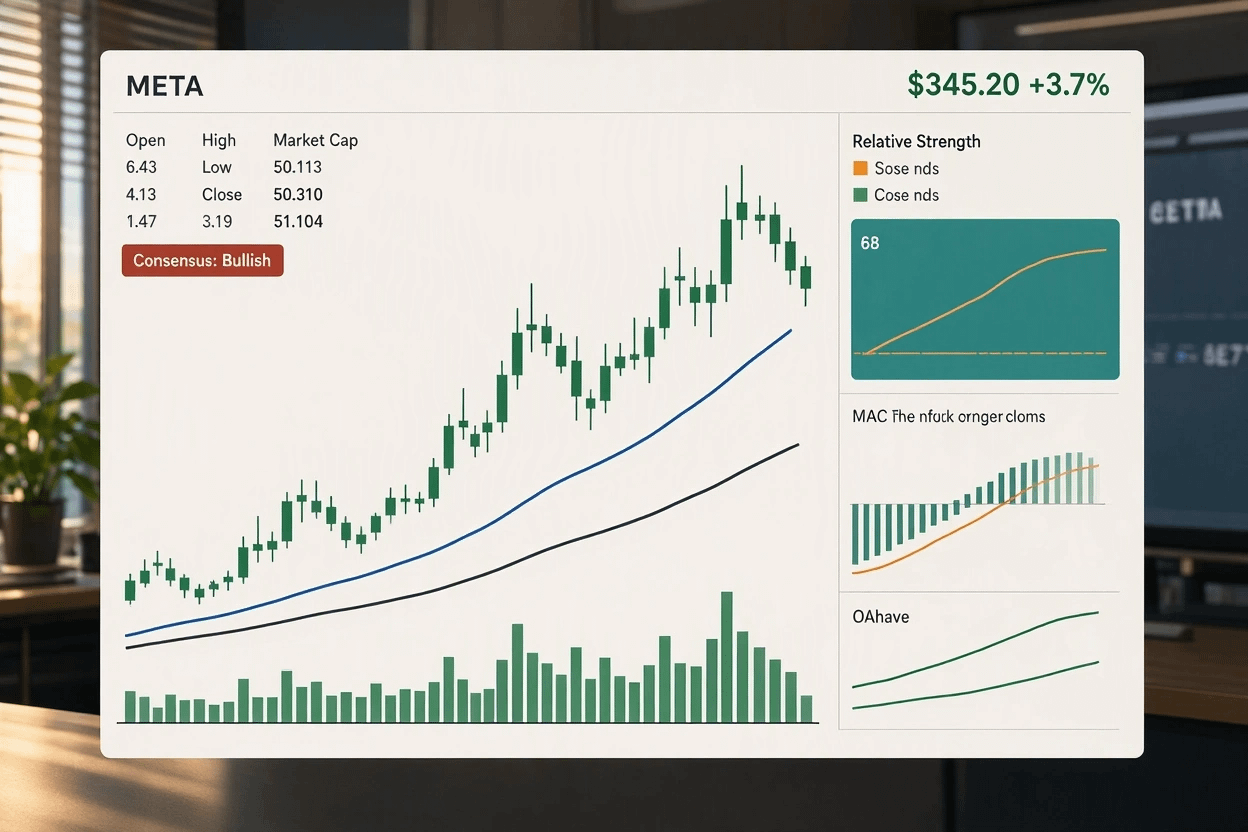
The bullish case would strengthen if:
Advertising revenue continues growing.
Improved targeting and recommendations increase advertiser returns.
User engagement remains resilient.
AI products attract active users and paying customers.
Management demonstrates a credible monetization strategy.
Future investment generates sufficient incremental revenue.
Meta's large user base could help it distribute AI products without having to build an entirely new consumer audience.
Potential market reaction: Shares could rise if investors conclude that AI is improving the existing advertising business while creating additional commercial opportunities.
Bearish scenario: AI spending and legal risks overwhelm growth
The main concern is that investment requirements could increase faster than the profits generated by new products.
Potential negative catalysts include rising capital expenditure, higher infrastructure expenses, uncertain AI monetization, further legal or regulatory costs, slower advertising demand, and weakening free cash flow.
Legal charges also require careful interpretation. A one-time expense can distort a quarter's results, but the underlying legal and regulatory risks should not automatically be dismissed.
Potential market reaction: Shares could decline despite strong revenue growth if investors lose confidence in the returns on AI investment.
Mixed scenario: Strong advertising but expensive AI expansion
Meta could maintain impressive revenue growth while spending aggressively on infrastructure.
Investors might agree that the core business is healthy while questioning whether the scale of investment is justified.
What to watch: Advertising growth, operating income, capital expenditure, free cash flow, AI engagement, monetization, and regulatory developments.
Directional assessment: Bullish if advertising strength translates into durable profits and AI investment produces attractive returns. Bearish if rising costs and legal risks erode financial performance.
8. Eli Lilly: Can Pharmaceutical Innovation Sustain Growth?

Eli Lilly introduces a healthcare dimension to this group of companies. Its performance depends on product demand, treatment adoption, manufacturing capacity, pricing, competition, regulatory developments, and clinical progress.
Unlike the technology companies, Lilly's investment case is not primarily a test of AI infrastructure returns or advertising budgets. Its results can nevertheless influence sentiment toward healthcare growth stocks and companies whose valuations depend on successful product development.
The original analysis placed Lilly's expected earnings announcement during the week beginning October 26. Current reporting dates and analyst expectations should be checked before publication.
Bullish scenario: Strong demand and successful execution
The bullish case would be supported by continued demand for key medicines, increased manufacturing capacity, and constructive guidance for future product sales.
Potential catalysts include:
Strong prescription and sales growth.
Improved product availability.
Successful manufacturing expansion.
Favorable clinical-trial developments.
Positive regulatory decisions.
Stronger-than-expected forward guidance.

🌍 PositiveMindsGlobalResults | Binance Square | October 24, 2026
Potential market reaction: Shares could rise if sales growth and management guidance demonstrate that demand can translate into sustainable future earnings.
Bearish scenario: Competition, pricing, or execution disappoints
Pharmaceutical companies face risks even when demand for their products remains substantial.
Potential downside factors include slower product sales, manufacturing bottlenecks, pricing pressure, reimbursement changes, stronger competition, disappointing clinical results, regulatory setbacks, and valuations that already assume exceptional growth.
Potential market reaction: Lilly shares could weaken if guidance disappoints or investors become less willing to pay a premium for future growth.
Mixed scenario: Strong sales but demanding valuation
Lilly could deliver healthy revenue growth while investors remain concerned about future pricing, competition, manufacturing costs, or the sustainability of exceptional growth.
In this situation, the share-price reaction might be less positive than the headline results suggest.
What to watch: Product-level revenue, demand trends, manufacturing capacity, pricing, regulatory updates, clinical milestones, and full-year guidance.
Directional assessment: Bullish if demand and execution exceed expectations. Bearish if growth slows or future earnings expectations become less achievable.
9. The Seven-Stock Scenario Matrix
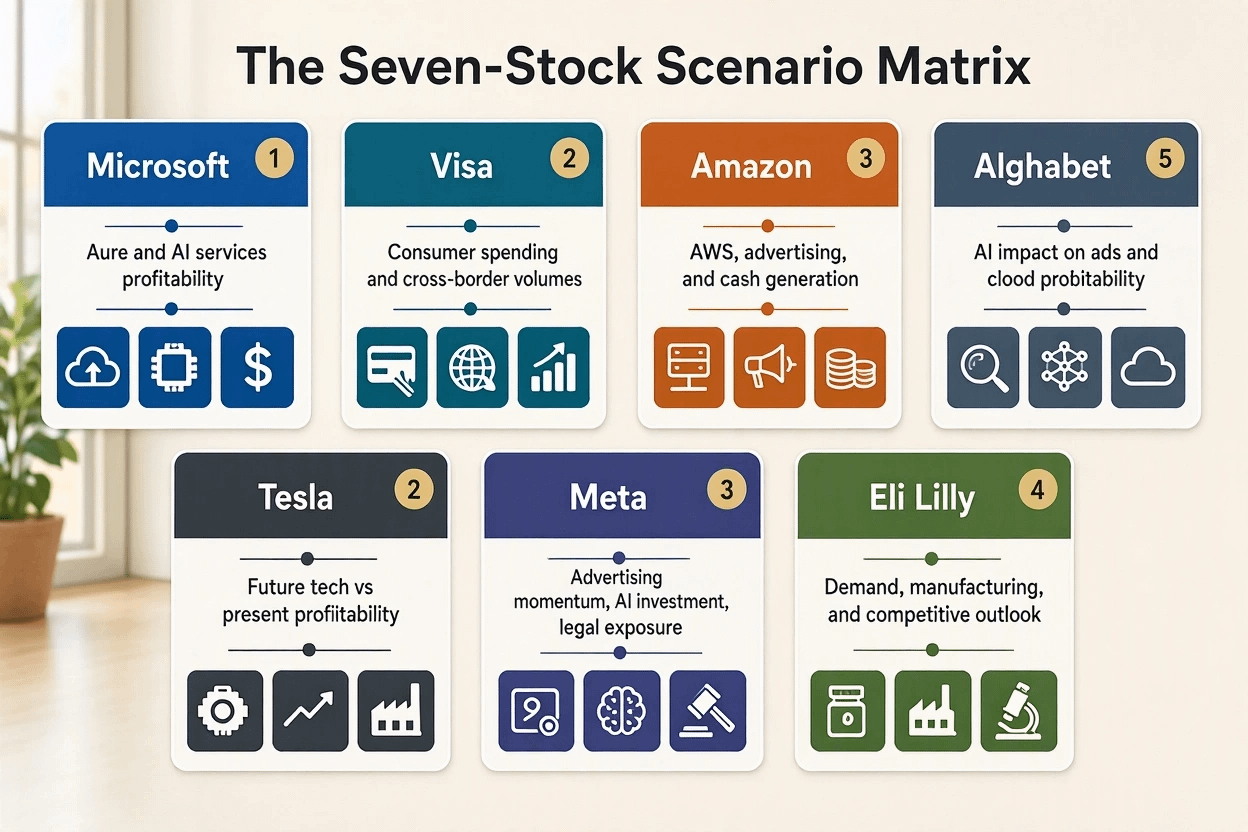
Each company faces a different test. Investors should avoid assuming that all seven stocks will move in the same direction after earnings.
Microsoft: The key question is whether Azure and AI services can generate profitable growth.
Visa: Consumer spending, payment volumes, and cross-border transactions will help determine the strength of its outlook.
Amazon: The decisive issue is whether AWS growth, advertising, and operational efficiency can support stronger cash generation.
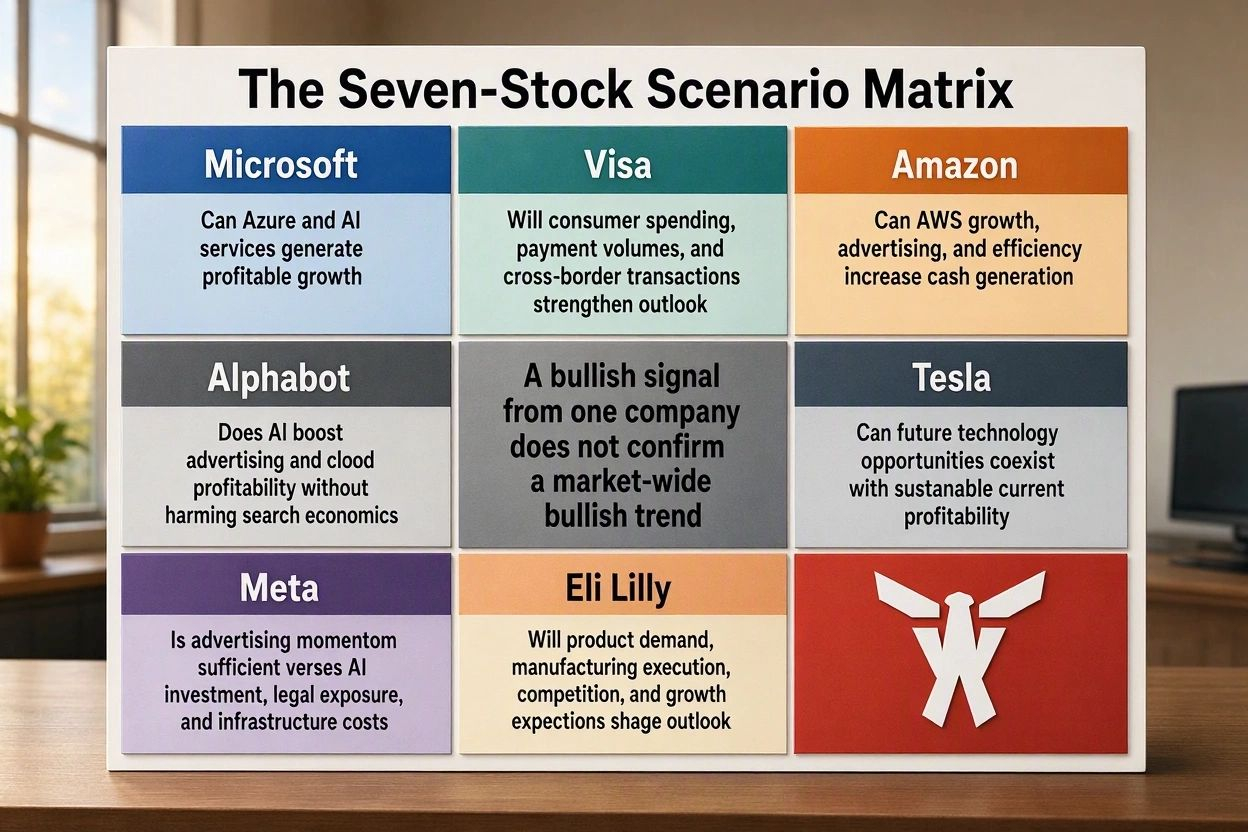
Alphabet: Investors must assess whether AI strengthens advertising and cloud profitability without undermining established search economics.
Tesla: The challenge is proving that future technology opportunities can coexist with sustainable present-day profitability.
Meta: The market must weigh advertising momentum against AI investment, legal exposure, and infrastructure costs.
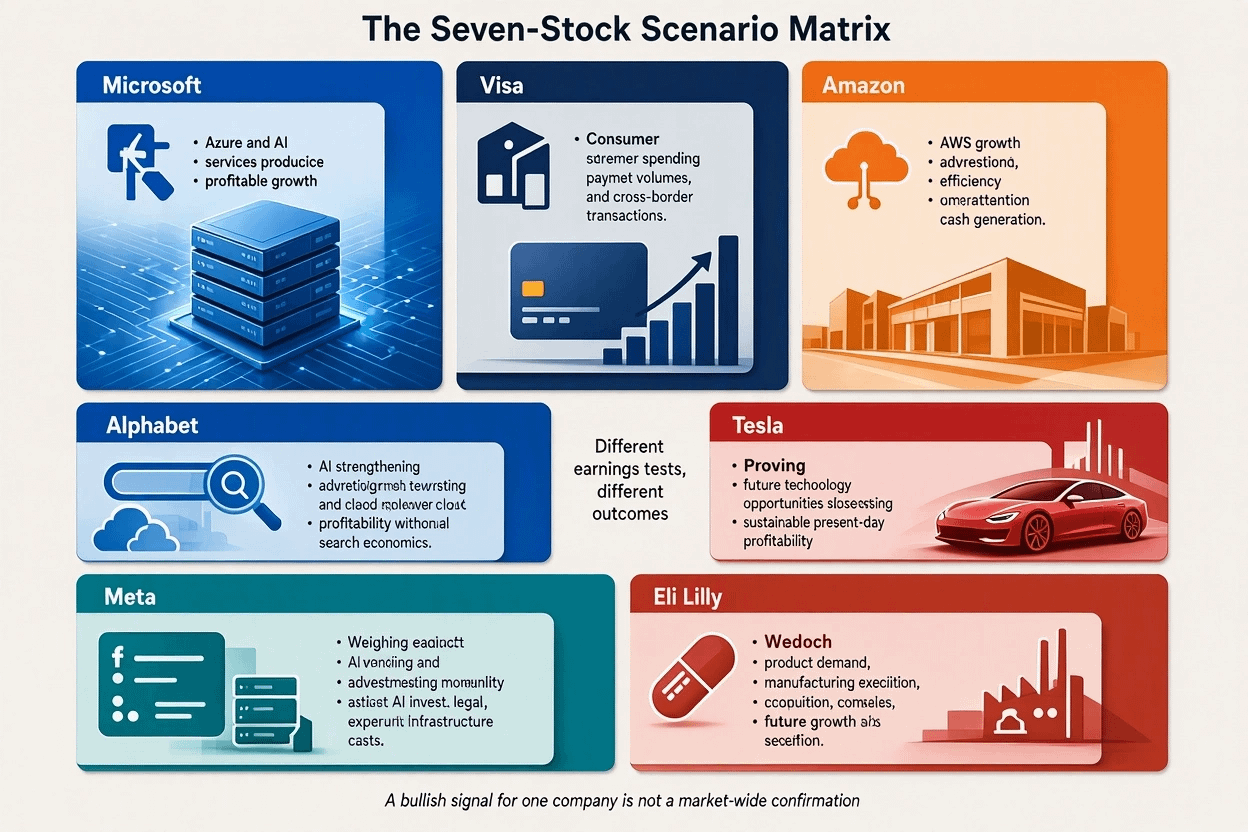
Eli Lilly: Product demand, manufacturing execution, competition, and future growth expectations will shape its outlook.
The broader lesson is that a bullish signal from one company does not automatically confirm a bullish trend across the entire stock market.
10. Three Potential Market-Wide Outcomes
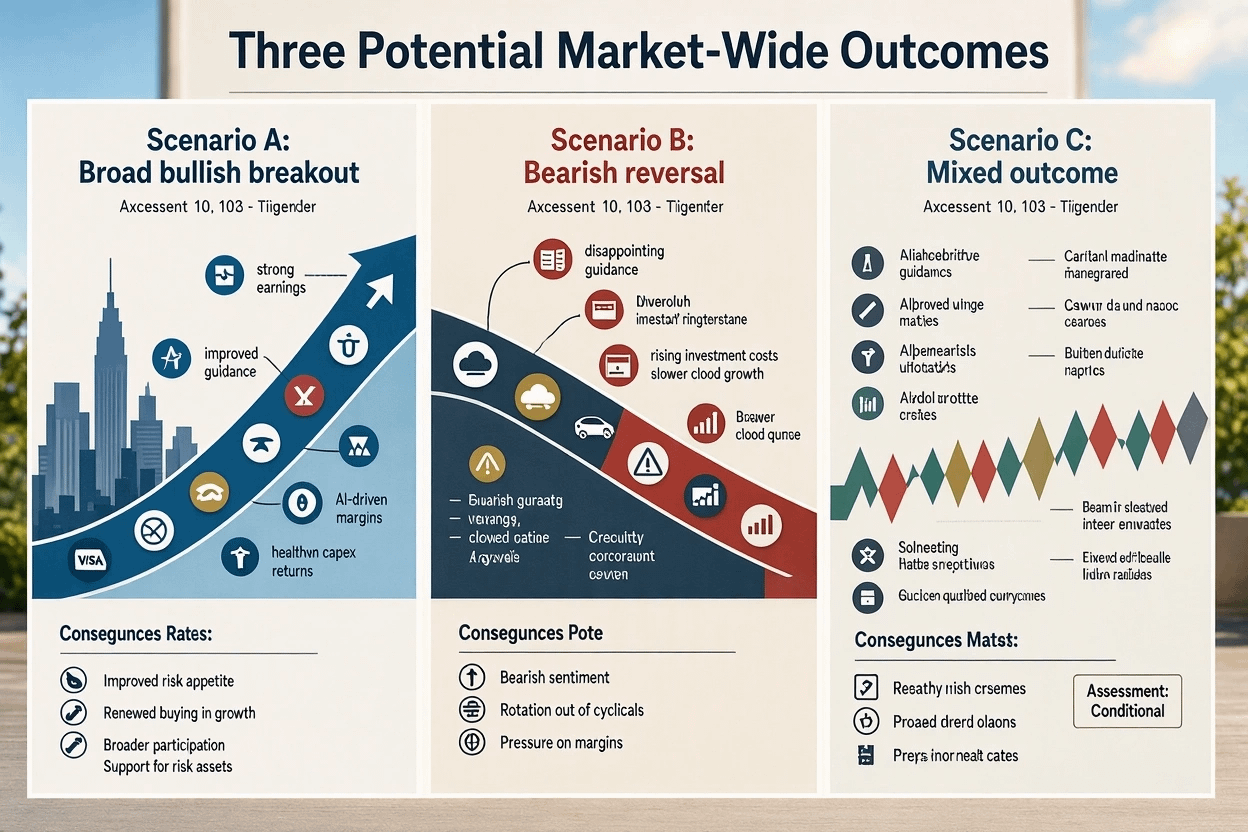
The combined results could influence investor sentiment well beyond the seven individual companies. However, the market's reaction will depend on earnings quality, forward guidance, valuations, interest-rate expectations, and investment costs.
Scenario A: Broad bullish breakout
Assessment: Conditional, requiring confirmation from actual results and market behavior.
A broad bullish outcome could develop if earnings remain strong, forward guidance improves, and investors gain confidence that AI investment is generating sustainable economic returns.
Potential catalysts include stronger cloud performance from Microsoft and Alphabet, improved AWS profitability at Amazon, resilient payment activity at Visa, continued advertising growth at Meta, better automotive profitability at Tesla, and strong product demand at Eli Lilly.
Supportive economic conditions and stable financial markets could reinforce this scenario.
Possible consequences include:
Improved risk appetite across US equities.
Renewed buying interest in growth and technology stocks.
Broader participation beyond a small group of market leaders.
Greater confidence in AI-related capital expenditure.
Potential support for other risk-sensitive assets if financial conditions also improve.
However, even a strong earnings season may produce only modest gains if share prices already reflect optimistic expectations.
Bullish confirmation would require positive earnings surprises accompanied by constructive guidance, healthy margins, sustainable cash flow, and improving market breadth.
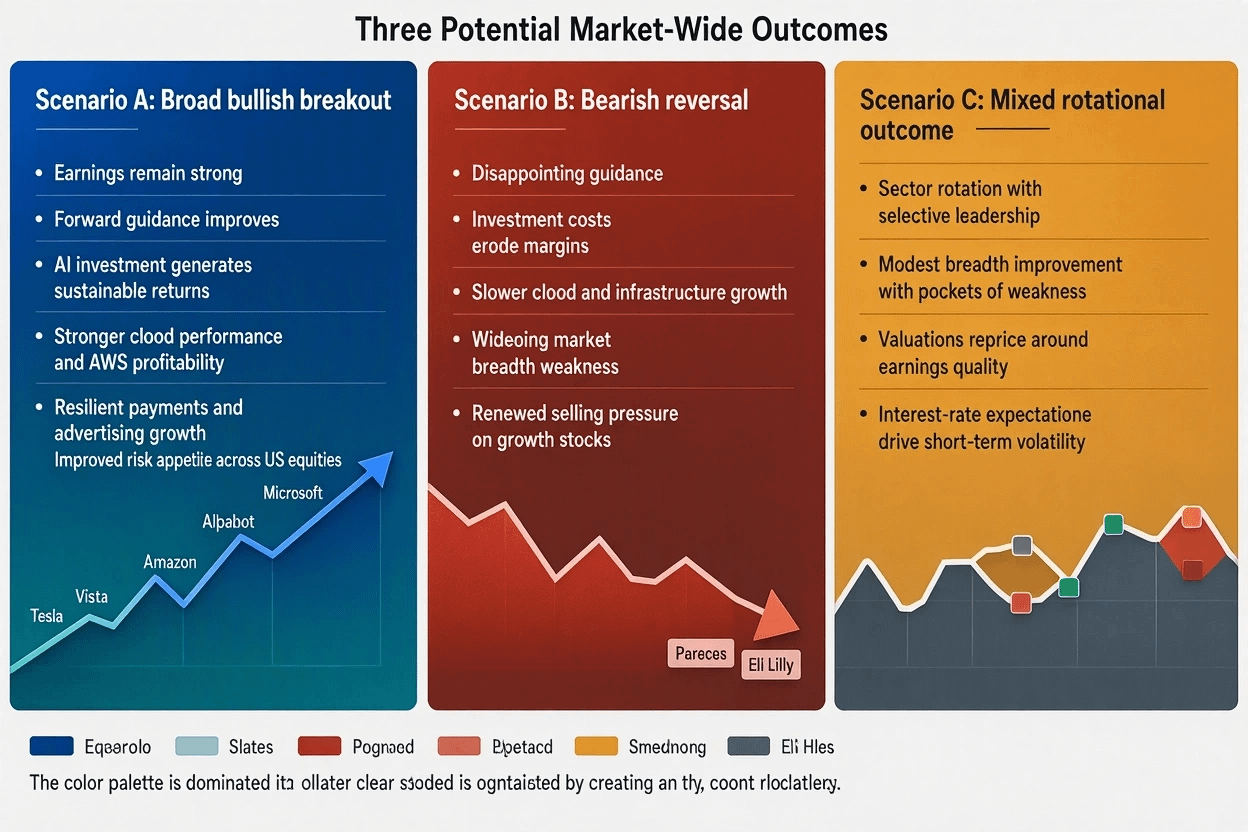
Scenario B: Bearish reversal
Assessment: Conditional, requiring evidence of deteriorating fundamentals or market sentiment.
A bearish outcome could emerge if companies deliver acceptable quarterly results but issue disappointing guidance or reveal that investment costs are eroding profitability.
Potential catalysts include slower-than-expected cloud growth, rising infrastructure expenditure without adequate returns, weakening consumer demand, increasing AI costs, further pressure on Tesla's margins, or disappointing pharmaceutical guidance.
Higher bond yields or renewed inflation concerns could add pressure by reducing the valuations investors are willing to pay for future growth.
Possible consequences include:
Selling pressure in highly valued growth stocks.
Greater volatility following earnings announcements.
A shift toward companies with more predictable cash flows.
Lower willingness to pay premium valuations.
Potential weakness in other risk-sensitive assets if investors broadly reduce exposure to risk.
A particularly concerning combination would be slowing revenue growth, declining operating margins, and rising capital expenditure across several major technology companies.
Bearish confirmation would include repeated downward guidance revisions, deteriorating cash generation, weakening market breadth, and persistent selling after earnings releases.
Scenario C: Mixed results and stock-by-stock divergence
Assessment: A credible alternative that should not be overlooked.
The market does not need to choose one direction for every company.
Microsoft and Alphabet could benefit from strong cloud results while Amazon declines because of spending concerns. Visa could remain relatively resilient if payment activity holds up. Tesla could experience volatility around profitability and future technology expectations, while Eli Lilly responds primarily to healthcare-specific developments.
Possible consequences include:
Large differences in individual stock performance.
Sharp price movements in both directions after earnings.
Rotation between technology, healthcare, and other sectors.
Greater importance of stock selection and valuation.
Broader indices moving sideways despite substantial individual-stock volatility.
This scenario becomes more plausible when investors distinguish between companies generating immediate profits and those whose valuations depend heavily on future growth.
Confirmation would come from divergent earnings reactions, changing sector leadership, and major indices failing to establish a sustained direction.
11. Why a Stock Can Fall After Beating Earnings
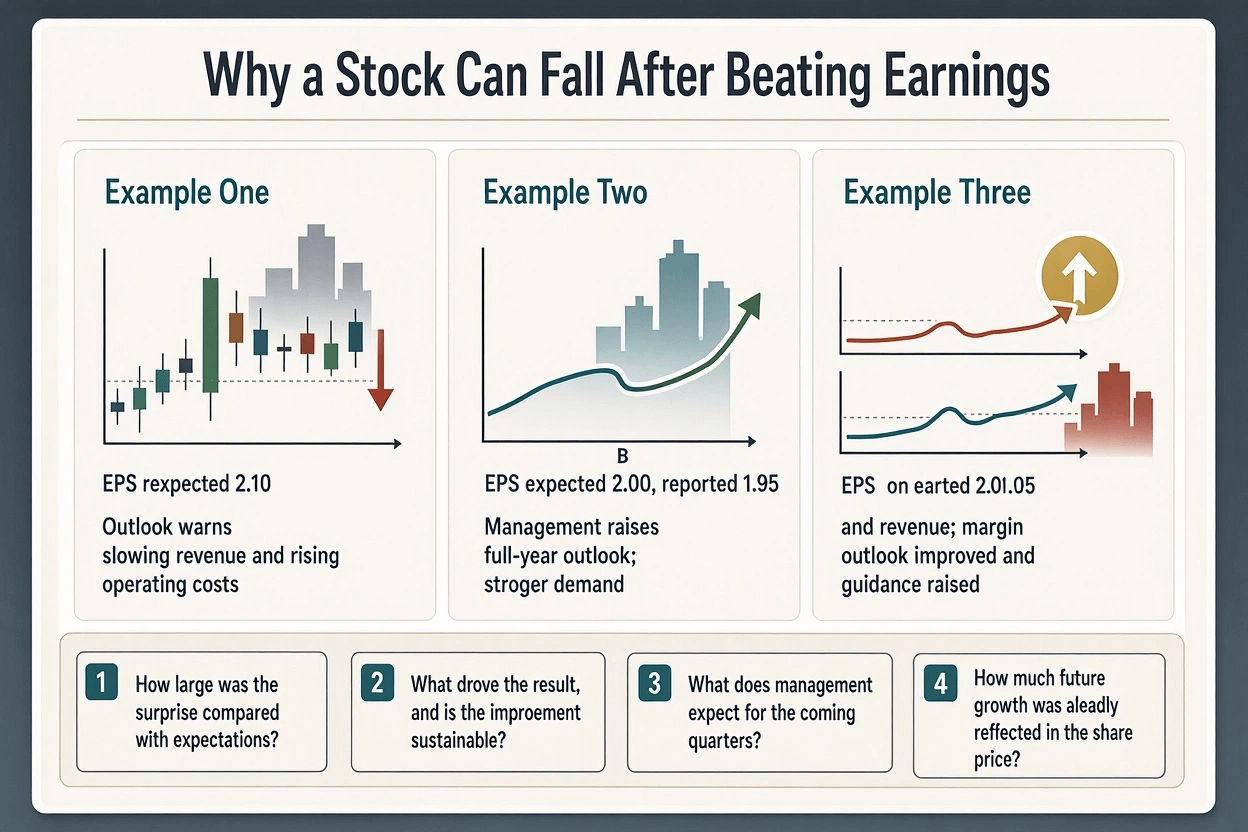
One of the most common mistakes in earnings analysis is assuming that an earnings beat automatically means a stock should rise.
Consider three hypothetical examples.
Example One: Earnings beat, share price falls
Analysts expect earnings per share of 2.00 dollars. The company reports 2.10 dollars but warns that revenue growth will slow and operating costs will rise.
The company has beaten the earnings estimate, but the outlook may have deteriorated. Investors could therefore sell the stock.
Example Two: Earnings miss, share price rises
Analysts expect earnings per share of 2.00 dollars. The company reports 1.95 dollars but raises its full-year outlook and identifies stronger demand for its products.
If investors had anticipated a much larger disappointment, the shares could rise.
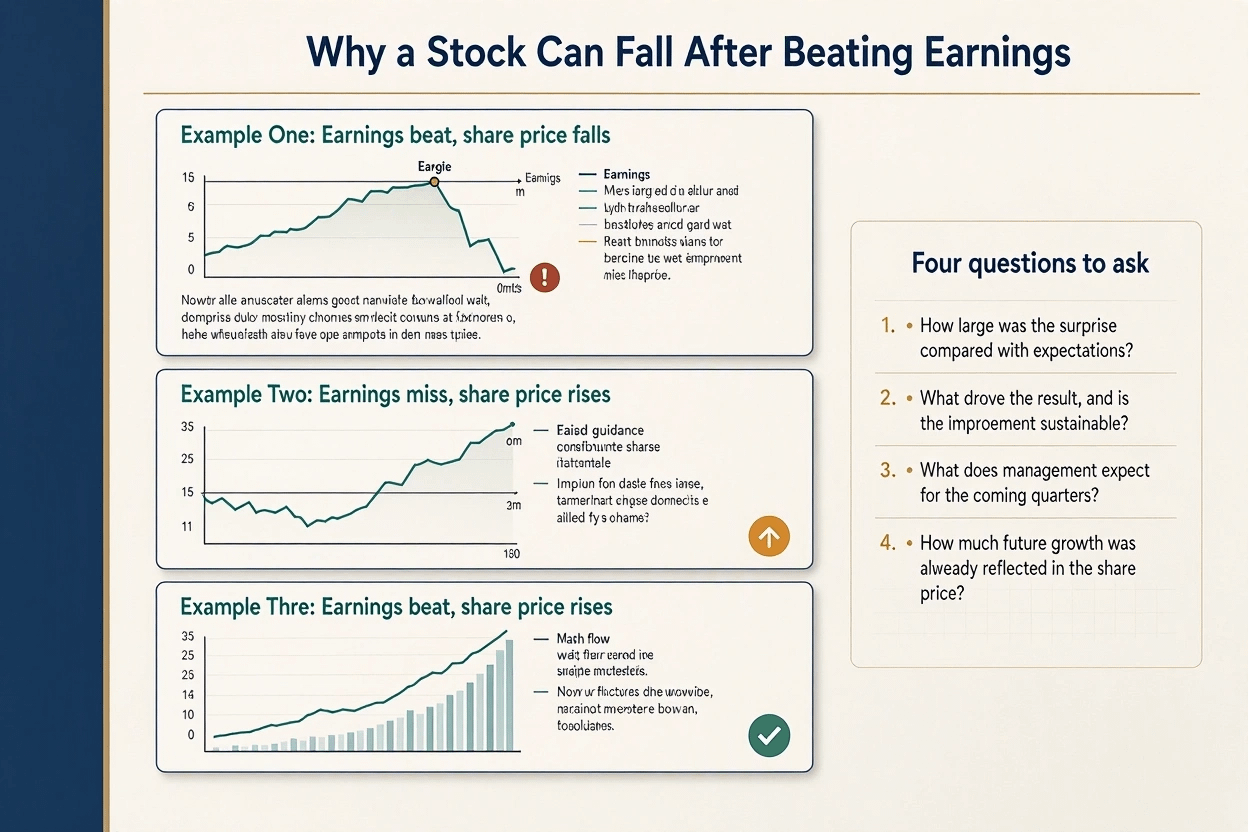
Example Three: Earnings beat, share price rises
The company exceeds earnings and revenue expectations, improves its margin outlook, generates strong cash flow, and raises guidance.
This combination provides stronger evidence of improving financial performance.
These examples are illustrative rather than predictions for the seven companies.
Before interpreting an earnings announcement, investors should ask four questions:
How large was the surprise compared with expectations?
What drove the result, and is the improvement sustainable?
What does management expect for the coming quarters?
How much future growth was already reflected in the share price?
The final question is especially important when valuations are high.
12. What Could This Mean for Bitcoin, Ethereum, and BNB?

Although this analysis focuses on equities, earnings season can provide useful context for cryptocurrency investors.
Stocks and cryptocurrencies may respond to shared influences, including liquidity, interest-rate expectations, the US dollar, bond yields, and overall risk appetite. However, the relationship is not fixed, and digital assets can move independently because of their own market structure and catalysts.
Bullish cross-market scenario
If corporate earnings strengthen confidence in economic growth, financial conditions remain supportive, and investors become more willing to accept risk, cryptocurrencies could benefit from an improvement in broader sentiment.
Bitcoin: BTC could benefit from stronger risk appetite and supportive investment flows.
Ethereum: ETH could benefit if demand for digital assets broadens and activity across its ecosystem strengthens.
BNB: BNB could benefit from improved sentiment across the digital-asset market, although Binance ecosystem developments and BNB-specific demand remain important.
These are conditional possibilities, not guarantees that all three assets will rise.

Bearish cross-market scenario
If earnings disappoint, concerns about AI investment intensify, or financial conditions tighten, investors may reduce exposure to volatile assets.
Bitcoin: BTC could experience selling pressure if risk appetite deteriorates.
Ethereum: ETH could face additional volatility if demand for higher-risk digital assets weakens.
BNB: BNB could decline alongside the broader market or react to developments specific to its ecosystem.
However, weakness in equities should not be treated as a standalone sell signal for cryptocurrencies.
Mixed cross-market scenario
Stock markets could experience sector rotation while cryptocurrencies follow their own catalysts.
Strong earnings from one technology company might support its shares without producing a meaningful Bitcoin rally. Similarly, positive developments within the crypto industry could support digital assets while equities remain under pressure.

The practical approach is to monitor corporate earnings, Federal Reserve policy, Treasury yields, the US dollar, crypto investment flows, leverage, and digital-asset-specific developments together.
No single indicator provides a complete picture of market direction.
13. Final Verdict: What Matters Most Next Week?
The upcoming earnings announcements offer an opportunity to evaluate the quality of corporate growth rather than simply count how many companies beat analyst estimates.
Microsoft and Alphabet will provide important information about cloud computing and AI monetization. Amazon will test whether infrastructure investment can translate into stronger operating performance. Visa will offer insight into payment activity and consumer resilience, while Eli Lilly will provide a healthcare-specific assessment of demand and growth.

Tesla and Meta illustrate why investors must look beyond headline numbers. Positive revenue or cash-flow developments can coexist with pressure on operating margins, legal exposure, and rising investment requirements.
The most useful conclusions will emerge from comparing actual results with management guidance, financial performance, and market expectations.

The bullish outlook
Strong revenue growth, improving profitability, sustainable cash generation, and constructive guidance could support further advances in selected stocks.
The bearish outlook
Slowing growth, rising investment costs, weaker margins, and disappointing guidance could trigger valuation adjustments, even among companies that report earnings beats.

The mixed outlook
Different business models, valuations, and earnings quality could produce sharply divergent share-price reactions. The broader market may therefore remain difficult to classify as uniformly bullish or bearish.
No outcome is guaranteed. These scenarios should be reassessed as actual earnings, management guidance, and market reactions become available.
The objective is not to predict every market move. It is to identify the conditions that would make a bullish or bearish interpretation more credible.
Positive thinking creates possibilities. Financial discipline helps distinguish those possibilities from evidence.
Important Disclaimer
This article is for informational and educational purposes only. Bullish and bearish scenarios are conditional assessments, not guaranteed outcomes, personalized financial advice, or promises of investment returns. Analyst estimates may change, and actual results may differ materially from expectations. Verify financial figures and reporting dates against official company disclosures before relying on them. Conduct independent research, assess your risk tolerance, and avoid making investment decisions based solely on earnings headlines or speculative forecasts.
#PositiveMindsGlobalResults #BinanceSquare #EarningsBeatParadox #USStocksOutlook #MarketSentimentToday #MSFT #Visa #AMZN #GOOGL #Tesla #META #LLY #EarningsSeason #BullishVsBearish #StockMarketAnalysis #AIMarketOutlook #CorporateEarnings #MarketRisk #BTC #ETH #BNB #EstimatesNotAdviceButHope