

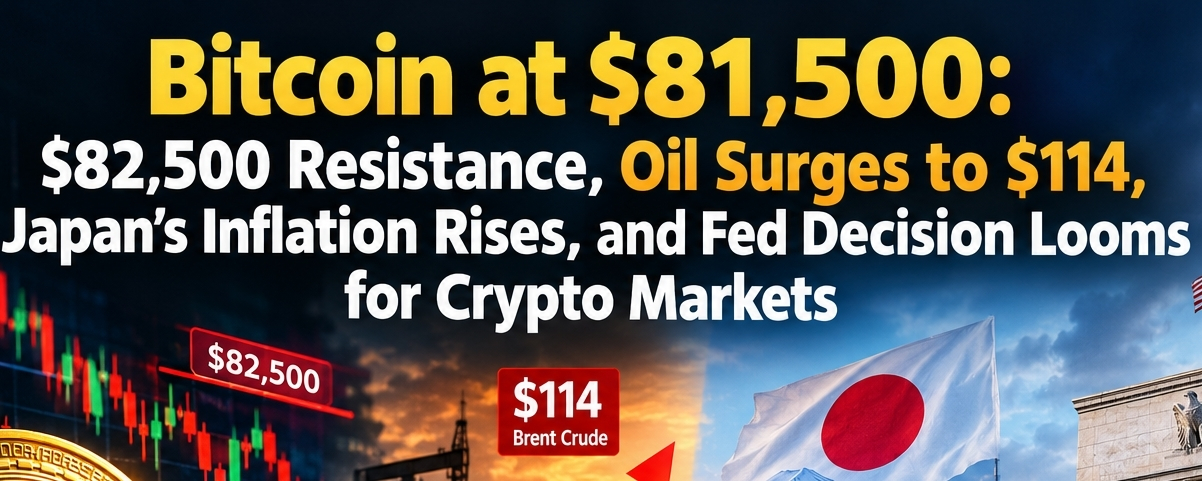

Bitcoin is holding near $81,500, but the market is struggling to regain momentum as $82,500 continues to act as an important resistance level. At the same time, Brent crude has climbed above $114 per barrel, Japan's inflation has returned above the Bank of Japan's 2% target, and investors are preparing for the Federal Reserve's next policy meeting on October 27 and 28. These developments are creating uncertainty across global financial markets, and cryptocurrency traders are watching closely to see what happens next.
Bitcoin's recent price action shows that buyers are still facing a difficult market. After attempting to recover towards $85,000, BTC came under renewed selling pressure and slipped towards $81,000. It has since remained around the $81,500 area, with traders looking for signs of a stronger recovery.
The $82,500 level is particularly important because reclaiming it could help restore short-term confidence. If Bitcoin moves above this level and holds there, the next challenge could be the $84,000 to $85,000 zone. A convincing breakout would suggest that buyers are becoming more confident and willing to enter the market at higher prices.
However, the situation could turn against buyers if Bitcoin fails to recover and selling pressure increases. The $81,000 area is an immediate level to watch, while $80,000 remains an important psychological support. A sustained break below $80,000 could increase fears of a deeper correction.
For now, neither a strong bullish reversal nor a confirmed breakdown is clear. Bitcoin remains sensitive to economic news, investor sentiment and movements in traditional financial markets.
One reason for this weakness is the recent pressure on technology stocks. Investors have become more cautious about the enormous amount of money being spent on artificial intelligence infrastructure and whether those investments will generate sufficient returns. The resulting sell-off has affected major technology companies and added pressure to other risk-sensitive assets.
Bitcoin has increasingly reacted to these broader market movements. When investors feel confident about economic conditions, they are often more willing to invest in cryptocurrencies and technology shares. When uncertainty increases, they may reduce exposure to volatile assets and move towards investments they consider safer.
This does not mean Bitcoin will always follow the stock market. However, the current environment shows how strongly macroeconomic developments can influence cryptocurrency prices.
There is still some encouraging news for Bitcoin investors. Recent US spot Bitcoin ETF flows have shown signs of improvement, suggesting that institutional demand has not disappeared. Nevertheless, these inflows have not been strong enough to prevent the latest price decline.
That is an important distinction. Positive fund flows can support a recovery, but they do not guarantee higher prices. Selling pressure, leveraged positions and uncertainty about interest rates can outweigh demand during difficult market conditions.
Meanwhile, the rise in oil prices is creating another challenge for the global economy. Brent crude traded above $114 per barrel on Friday, reaching its highest level since May. Concerns about possible disruptions to energy supplies in the Middle East have contributed to the increase.
Geopolitical tensions can push oil prices higher even before a major supply shortage occurs. Traders often respond to the possibility of future disruption by demanding higher prices. If the situation escalates, energy markets could become even more volatile. If tensions ease, some of the recent increase could reverse.
For financial markets, expensive oil matters because it can put fresh pressure on inflation. Higher energy costs can increase transportation expenses, raise production costs and make everyday goods more expensive. Businesses may eventually pass some of these costs on to consumers.
This creates a difficult situation for central banks. If inflation remains stubbornly high, policymakers may have less room to reduce interest rates. Higher borrowing costs can make investors more cautious and reduce demand for assets that depend heavily on favourable financial conditions.
That is one reason Bitcoin traders are paying attention to oil prices rather than focusing only on cryptocurrency news.
Japan has also delivered an important economic signal. The country's core consumer inflation rate rose to 2.1% year over year in September, moving above the Bank of Japan's 2% target for the first time in nine months. A separate measure excluding fresh food and energy increased to 2.4%, suggesting that price pressures extend beyond fuel costs.
The data has strengthened expectations that the Bank of Japan may need to raise interest rates further. Although another immediate increase is not certain, investors are paying closer attention to the possibility of tighter monetary policy in the coming months.
The Japanese yen strengthened following the inflation report, briefly reaching around 156 yen per US dollar before some of its gains faded. The currency's movement reflects both changing interest-rate expectations and demand for safer assets during periods of market uncertainty.
Why should cryptocurrency investors care about the yen? Because changes in Japanese interest rates can influence global investment strategies. Some investors have historically borrowed yen at relatively low interest rates to finance investments in other markets. If the yen strengthens sharply or borrowing costs rise, those investors may reduce their positions, potentially adding selling pressure to riskier assets.
This is not an automatic process, but it is another factor worth watching when markets are already under pressure.
The biggest event on the immediate calendar is the Federal Reserve's policy meeting on October 27 and 28. Markets broadly expect the US central bank to leave its benchmark interest rate unchanged at 3.75% to 4.00% at this meeting. However, investors are also considering the possibility of another increase in December as inflation remains above the Fed's target.
The decision itself will matter, but the Fed's message could be just as important. Investors want to understand whether policymakers believe inflation is moving in the right direction or whether interest rates may need to remain restrictive for longer.
For Bitcoin, the difference could be significant. A more hawkish message could strengthen expectations of tighter financial conditions and put pressure on cryptocurrencies. A more reassuring assessment could improve sentiment, particularly if technology stocks stabilise and demand for Bitcoin strengthens.
Still, even a decision to hold rates would not automatically trigger a rally. Markets often react to what policymakers say about the future rather than simply responding to the decision announced that day.
Traders should also pay attention to leverage. Recent market declines have triggered liquidations among traders betting on higher cryptocurrency prices. When leveraged long positions are forcibly closed, additional selling can accelerate a decline. Similarly, short liquidations can intensify a sudden recovery.
This is why sharp price movements should be treated carefully. A temporary bounce does not always indicate the beginning of a sustained rally, just as a sudden decline does not automatically confirm a long-term bearish trend.
Over the coming days, Bitcoin's ability to reclaim $82,500 will be an important signal. Continued strength above that level could improve the chances of another attempt towards $85,000. Failure to recover, combined with renewed selling pressure, could bring $81,000 and $80,000 back into focus.
Oil prices, the Japanese yen, technology stocks and the Federal Reserve's policy decision will all help shape the broader market environment.
The bigger picture is straightforward: investors are balancing inflation risks against concerns about economic growth. Rising oil prices could make inflation harder to control, while uncertainty surrounding technology investments is encouraging some investors to reduce risk. Bitcoin is caught between these forces, with improving fund flows offering some support but insufficient momentum to confirm a stronger recovery.
For now, the market needs confirmation rather than speculation. Bitcoin must reclaim important resistance levels, oil prices need to be watched for signs of easing supply concerns, and the Fed's upcoming decision could provide a clearer picture of financial conditions.
Bitcoin remains at a critical point. A recovery above $82,500 could bring buyers back into the market, while a sustained move below $80,000 would raise concerns about further downside. The next few sessions could offer important clues about which direction the market is preparing to take.