


AI Recreates Satoshi’s 2009 Bitcoin Executable Byte for Byte
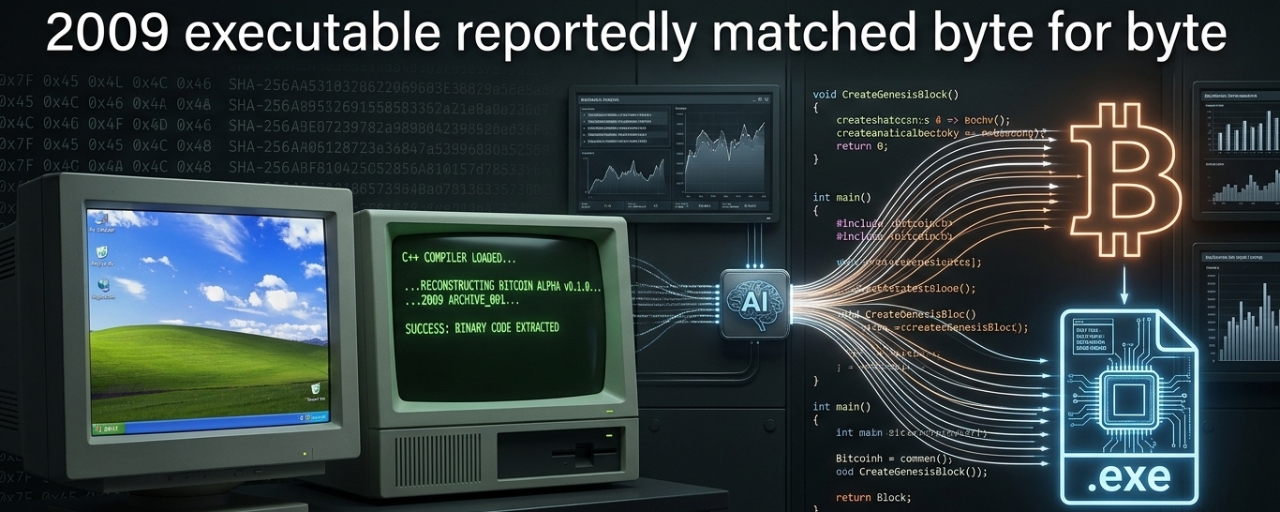
A developer known as t4t5 has reportedly used Anthropic’s Claude Opus 5.5 to recreate Bitcoin’s original Windows executable from its early source code.
The rebuilt bitcoin.exe is 6,440,960 bytes and matches the historical file’s SHA-256 hash, according to the project’s GitHub repository.
The challenging part was reconstructing the original development environment using legacy software, including Windows XP-era tools and MinGW GCC 3.4.5.
Why does this matter?
Historical verification: The matching hash provides strong evidence that the reconstructed executable matches the preserved 2009 binary.
Software archaeology: The process helps reveal details about the tools and settings used to build early Bitcoin.
AI-assisted research: It demonstrates how AI can help developers investigate complex legacy software and reproducible builds.
There is an important distinction: matching the executable supports the integrity of the preserved binary, but it does not independently prove that every aspect of Bitcoin’s original software was free from vulnerabilities or backdoors.
The discovery does not crack Bitcoin private keys or, by itself, change BTC’s market outlook. Its significance lies in understanding and verifying Bitcoin’s technical history.
AI is becoming a useful tool for exploring crypto’s past — not just its future.
