


The market views Muse as just another chat application, while Bernstein sees it in its October 20, 2026 report as Meta’s AI operating system. Launched on September 8, Muse topped the US App Store download charts within 10 days, accumulating approximately 2.5 million daily active users (DAU) in the US. Bernstein sets a price target of $800 for Meta, compared to its current price of $705.44, representing 13% upside.
The report maintains a long-term bullish stance but remains cautious in the near term. Muse provides Meta with its first consumer-facing AI product, demonstrating a return on AI investments and yielding a positive return on invested capital (ROIC). Valuations and expectations have already elevated, while Q3 2026 earnings before interest and taxes (EBIT) are weighed down by a $10 billion legal settlement.
Positioned at the center of the Meta ecosystem, hardware serves as the carrier while Muse is the product. The long-term narrative holds, though near-term earnings benchmarks have been set tighter.
Muse's Chart-Topping Rise Changes the Narrative
Launched on September 8, Muse reached number one on the US App Store download charts within 10 days, surpassing ChatGPT on September 17 and maintaining that position. Citing Sensor Tower data, Bernstein notes that Muse's post-launch download trajectory outpaces both ChatGPT's May 2023 launch and Meta's own AI app.
American DAU stands at approximately 2.5 million, with an average daily usage time of 16 minutes compared to ChatGPT's 19 minutes. Muse's retention curve outperforms ChatGPT's. Bernstein cautions that while early downloads and retention are strong, the initial buzz in the total addressable market (TAM) cannot be directly extrapolated, pointing to precedents like Facebook Shops and the Metaverse.
Muse has expanded from a chatbot to include real-time voice, customizable personas, avatars, email, and PC control integrations with Shopify, Walmart, Best Buy, Sephora, Ulta, Wayfair, Gap, Expedia, Instacart, Notion, GitHub, and Box. The hardware strategy revolves around "using Muse in any way," positioning glasses, virtual reality (VR) headsets, and pendants as endpoints.
Valuation Now Par with Google and Amazon
Following Muse's launch, Meta's stock has undergone repricing, aligning closely with the one-year forward P/E multiples of Google and Amazon. Bernstein's charts show all three trading around 20x. Muse has reignited discussions on the "iPhone moment" for consumer AI and revived debates surrounding agentic commerce and search displacement pressures.
Bernstein posits that Muse could evolve from a discovery platform into a decision-making layer, positioning itself closer to where purchase intent forms in the consumer funnel. Amazon is excluded from Muse's partner network, as it pursues its own agentic commerce initiatives. Meanwhile, Google faces concerns over AI accelerating the replacement of traditional search.
Higher valuations bring higher expectations. Bernstein maintains an Outperform rating with an $800 price target, utilizing a blended valuation model of 50% 2027 enterprise value-to-sales (EV/Sales) at 6.7x and 50% discounted cash flow (DCF), with a weighted average cost of capital (WACC) of 10% and terminal growth of 3.5%. At the current price of $705.44, this implies 13% upside.
Near-Term Expectations Outpace Fundamentals
For Q3 2026, Bernstein forecasts revenue at $64.058 billion against consensus of $63.312 billion. EBIT is projected at $11.338 billion versus consensus of $19.016 billion, including $10 billion in legal costs related to the minor media usage settlement. EPS is estimated at $3.95 against consensus of $3.56. Revenue beat estimates, while EBIT was suppressed by one-time charges.
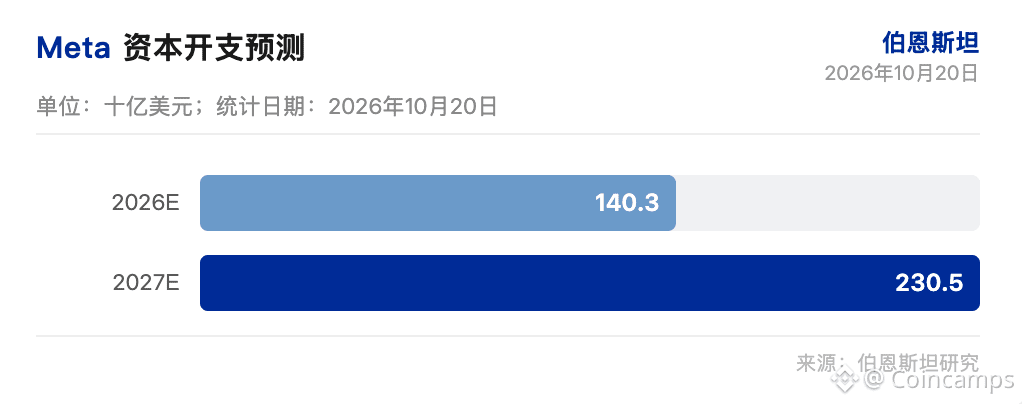
Capex is forecast at $140.3 billion for 2026 and $230.5 billion for 2027, exceeding consensus of $201.6 billion. For 2027, Bernstein projects EBIT at $97.89 billion against consensus of $103.94 billion, and EPS at $33.21 versus consensus of $33.87. Bernstein has lowered 2027 EBIT and EPS forecasts to account for Muse investments, third-party cloud deals, and marketing expenditures.
Pressure on free cash flow (FCF) is even more pronounced. Bernstein forecasts 2027 FCF at -$59.684 billion versus consensus of -$33.418 billion, a divergence of $26.266 billion. Q3 2026 FCF is projected at -$13.756 billion against consensus of -$8.953 billion. 2027 capex is 14.3% above consensus, marketing spending rises due to Muse promotion, and third-party cloud transactions increase operating costs. These factors weigh on near-term profits and cash flows, though top-line strength remains intact.
Other revenue surpassed the $1 billion quarterly mark for the first time in Q2 2026, growing 73% year over year. Bernstein raised its other revenue forecast to reflect monetization from business messaging, commercial agents, subscriptions, and Muse. While early-stage monetization of Muse does not yet factor into baseline expectations, it could contribute visibly to other revenue growth in 2027. Muse's monetization hinges on four key metrics: subscription count, gross merchandise value (GMV), downloads, and engagement levels. An uplift in any single area would shift the gap between near-term expectations and fundamentals.
Muse turns Meta's AI investments from a mere narrative into a trackable consumer product, with near-term expectations already running ahead of realization.
Disclaimer
This article compiles and interprets a third-party broker research report (Bernstein, October 20, 2026) through TechFlow Research, alongside publicly available market information. All cited ratings, price targets, earnings forecasts, and related judgments represent the views of the broker's analysts, reflecting solely their institution's stance rather than those of TechFlow Research, and do not constitute investment advice.
Markets involve risks; decisions should be made independently. This article should not serve as a basis for buying or selling any securities.
Join the official Coincamps community:
X: https://x.com/coincamps
Telegram: https://t.me/coin_camps