


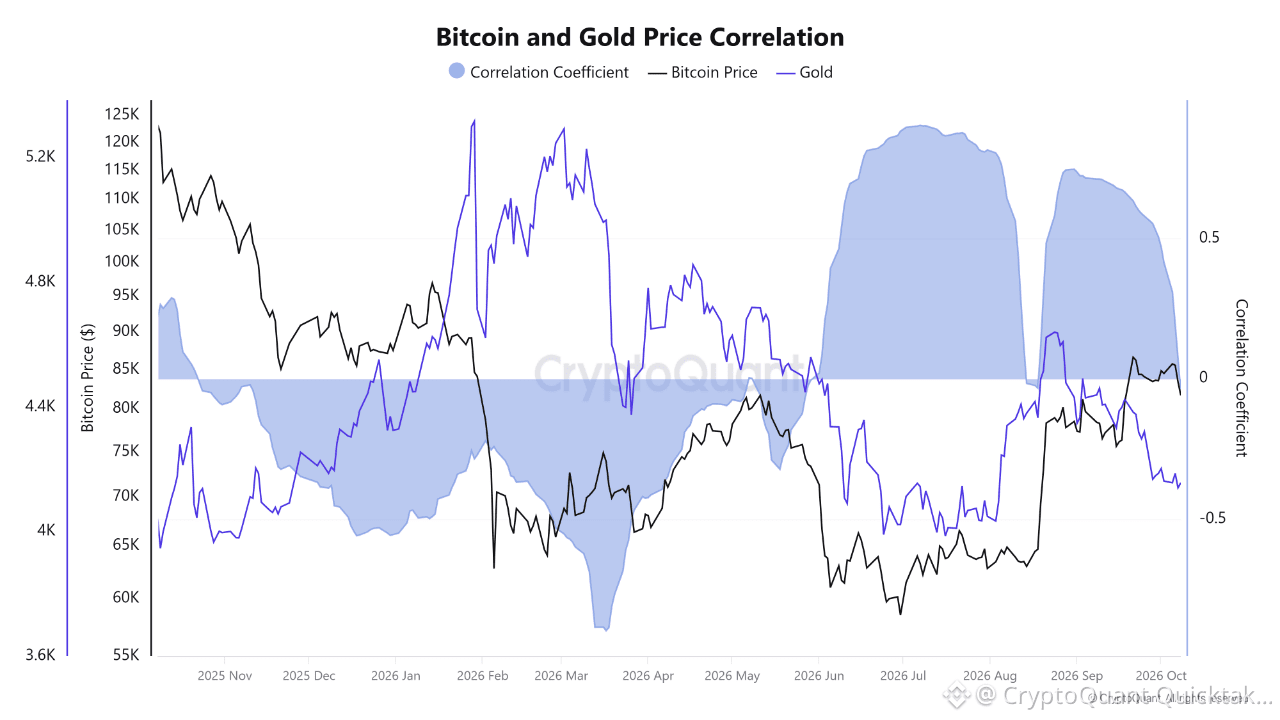
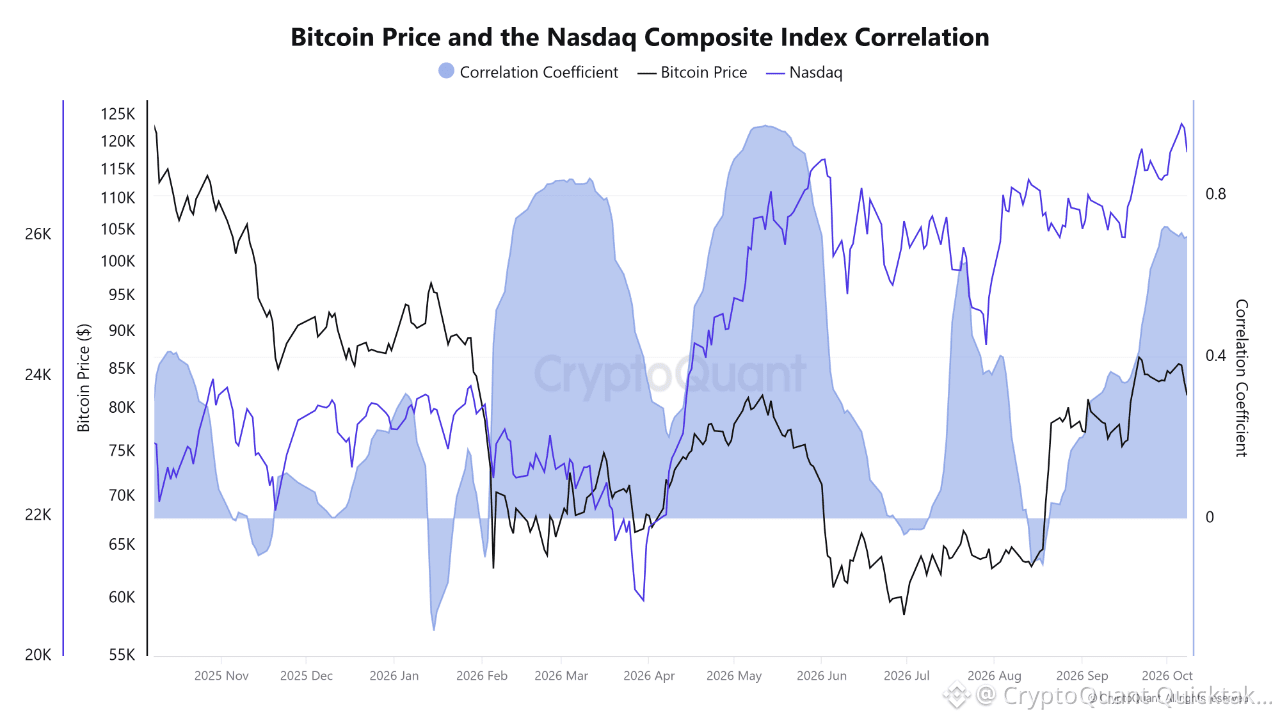
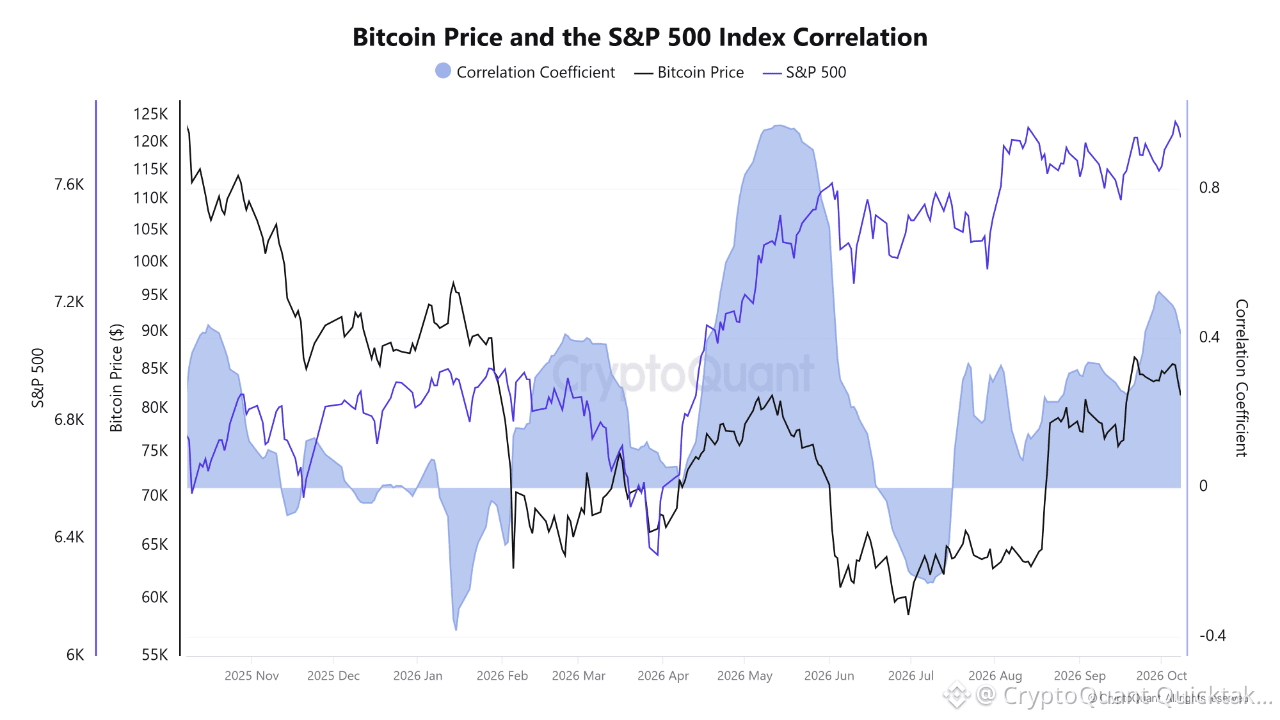
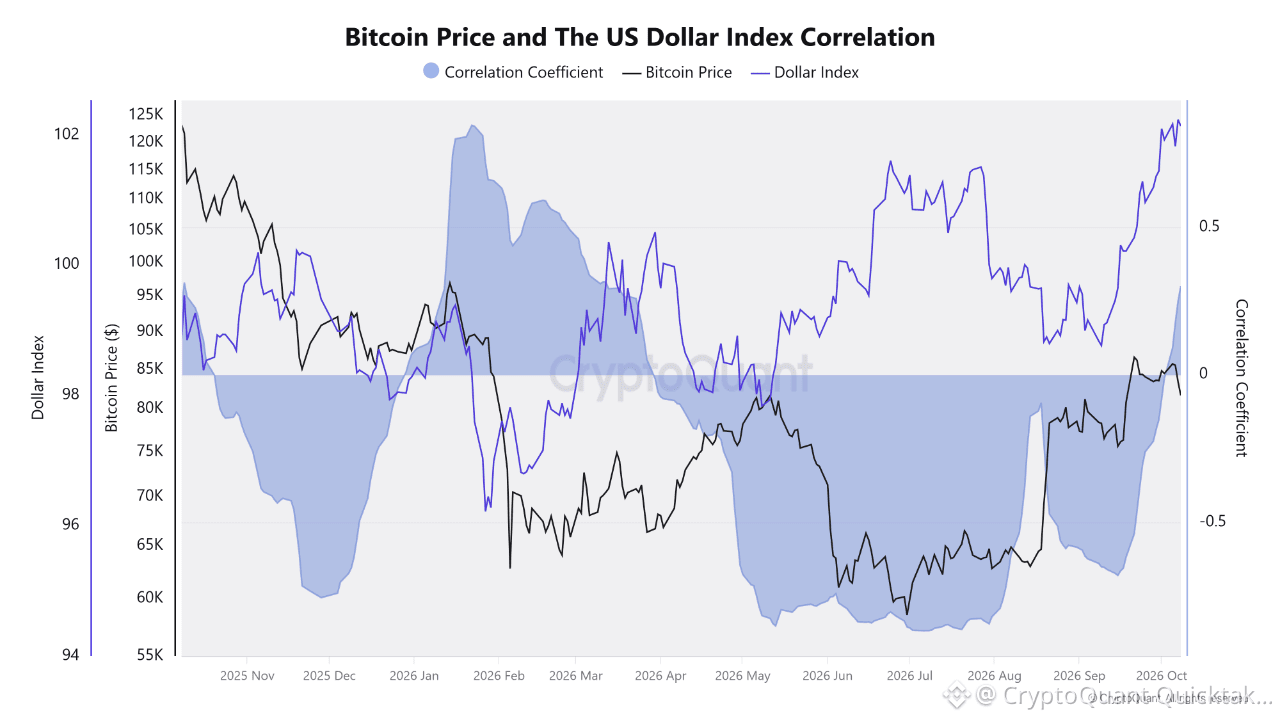
Does Bitcoin still trade on its own, or with the rest of the market? Today it trades with the market. Correlation measures how closely two prices move together from day to day, from −1 (opposite) to +1 (in step). Over the 90 trading days to 8 October 2026, Bitcoin's daily returns show a correlation of +0.42 with the Nasdaq, −0.36 with the US dollar index and +0.51 with gold. Each is large enough that chance is an unlikely explanation.
Seeing all three at once is uncommon. In 12.8 years of daily prices since 2014 it has held on 11% of days, in three stretches: August 2020 to January 2021, September 2022 to June 2023, and since 12 June 2026. The gold reading is higher than 98.9% of all 90-day readings in that history. From 2014 to 2019, Bitcoin showed no reliable link to any of the three on 81% of days.
In the first two stretches the dollar was falling, by 2.9% and 4.6%, and Bitcoin gained. This time the Federal Reserve raised rates on 16 September, the 10-year Treasury yield is near a 24-year high and the dollar is up 2.4%. Bitcoin is still up 29% since 12 June, a gain these three markets largely do not explain, which points to demand specific to Bitcoin.
With the link this tight, further dollar strength would more likely weigh on Bitcoin, and a turn lower would more likely help. The reading weakens if these correlations drift back toward zero. Two earlier cases are too few to form a base rate, and the three markets explain only about a third of Bitcoin's daily moves.
Statistics, not advice.
Written by Crazzyblockk