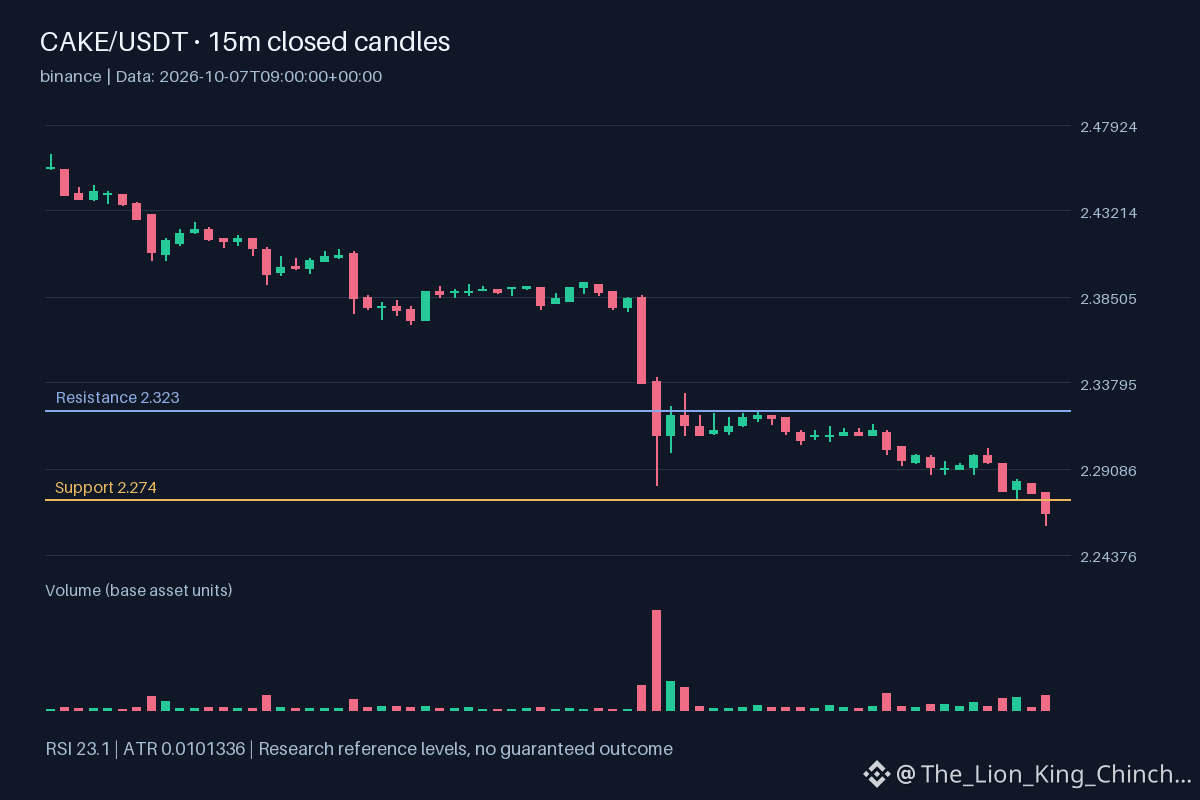

$CAKE : Understanding Liquidity When Volume Looks Strong
When a token shows hourly direction down while volume sits above baseline, the first question is whether the market can absorb price pressure without large slippage. This is a liquidity question, not a simple price‑value comparison.
Think of a market as a bathtub filled with water. The water level represents price, while the faucet and drain represent buyers and sellers. A wide, deep tub (high liquidity) lets the water rise or fall slowly even when the faucet runs fast. A shallow tub (low liquidity) will splash and overflow with the same flow, causing abrupt price moves.
In practice, liquidity is reflected by the amount of token that can be traded near the current price. Spot turnover and the spread between best bid and ask give clues. A tight spread and a high relative volume metric, such as 3.05432, suggest that many participants are placing orders close to the market price, which cushions moves. Conversely, a wide spread indicates that most orders sit farther away, so a single large market order can push price sharply.
To apply this idea, monitor the spread and compare it to the recent quote volume 7.09445e+06. If the spread remains narrow while volume stays elevated, the down move may be genuine pressure rather than a forced dip. If the spread widens, the same volume could be masking a fragile price level.
Before trusting a smooth‑looking price move, check the spread, the depth of limit orders, and whether the volume is accompanied by a consistent liquidity profile.
Probabilistic market research, not a recommendation or guaranteed return.
What would you check before trusting a smooth-looking price move?
#CAKE #CryptoEducation #CryptoLearning
When a token shows hourly direction down while volume sits above baseline, the first question is whether the market can absorb price pressure without large slippage. This is a liquidity question, not a simple price‑value comparison.
Think of a market as a bathtub filled with water. The water level represents price, while the faucet and drain represent buyers and sellers. A wide, deep tub (high liquidity) lets the water rise or fall slowly even when the faucet runs fast. A shallow tub (low liquidity) will splash and overflow with the same flow, causing abrupt price moves.
In practice, liquidity is reflected by the amount of token that can be traded near the current price. Spot turnover and the spread between best bid and ask give clues. A tight spread and a high relative volume metric, such as 3.05432, suggest that many participants are placing orders close to the market price, which cushions moves. Conversely, a wide spread indicates that most orders sit farther away, so a single large market order can push price sharply.
To apply this idea, monitor the spread and compare it to the recent quote volume 7.09445e+06. If the spread remains narrow while volume stays elevated, the down move may be genuine pressure rather than a forced dip. If the spread widens, the same volume could be masking a fragile price level.
Before trusting a smooth‑looking price move, check the spread, the depth of limit orders, and whether the volume is accompanied by a consistent liquidity profile.
Probabilistic market research, not a recommendation or guaranteed return.
What would you check before trusting a smooth-looking price move?
#CAKE #CryptoEducation #CryptoLearning