


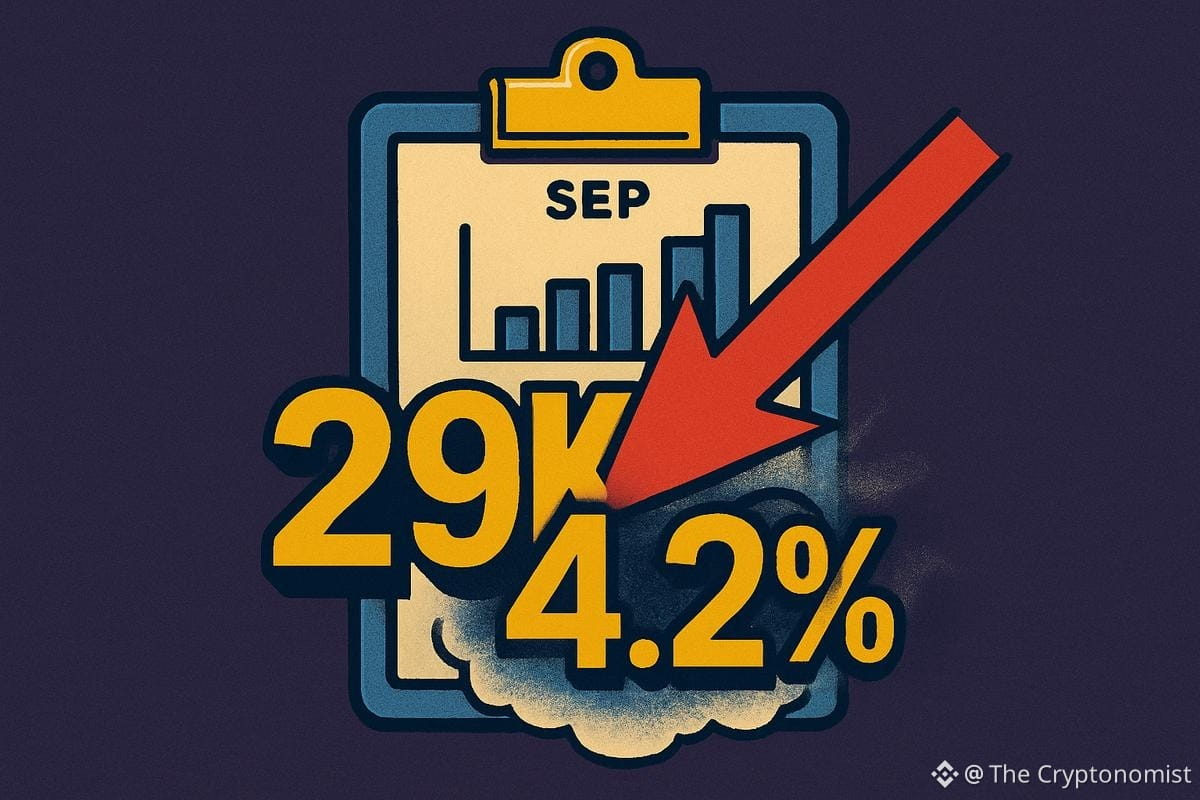
The U.S. labor market delivered a much weaker signal than Wall Street expected on Friday, as the U.S. September jobs report showed employers added just 29,000 positions last month, a sharp miss against the 90,000 consensus forecast. The unemployment rate, which most economists expected to hold steady, instead climbed to 4.2%, adding a fresh layer of uncertainty to an already choppy hiring picture heading into the final quarter of the year.
Key takeaways
The U.S. added only 29,000 jobs in September, well below the 90,000 jobs economists had forecast.
The unemployment rate rose unexpectedly to 4.2%, up from August’s 4.1% reading.
August’s reported gain of 162,000 jobs was revised down to 133,000, and July’s 21,000 gain was revised into a loss of 10,000.
Average hourly earnings rose just 0.1% in September, missing the 0.3% forecast, with annual wage growth at 3% versus the 3.2% expected.
Bitcoin, Nasdaq futures and Treasury yields all moved sharply following the release, as traders recalculated the odds of the Federal Reserve holding interest rates steady.
U.S. Labor Market Shows Weak Job Growth in September
The Bureau of Labor Statistics‘ Nonfarm Payrolls report, released Friday morning, confirmed that hiring slowed far more than anticipated last month. The headline number of 29,000 new jobs landed well short of the 90,000 consensus, marking one of the softer monthly readings of the year and reinforcing concerns that momentum in the labor market has been fading since the summer.
Job additions fall short of expectations
Economists had been looking for a more modest slowdown rather than a near-stall in hiring. Instead, the 29,000 jobs added in September came in at roughly a third of what forecasters had penciled in, a gap large enough to shift the broader narrative around the strength of the U.S. economy heading into the fourth quarter.
Revisions to prior months reveal weaker trends
The report also included downward revisions that painted an even softer picture of recent months. August’s originally reported gain of 162,000 jobs was revised down to 133,000, while July’s initially reported increase of 21,000 jobs was revised into an outright loss of 10,000. Taken together, the revisions suggest the labor market had already begun losing steam before September’s disappointing print, a trend that is not captured in any single month’s headline number.
This matters because revisions of this size can change how policymakers read the trajectory of hiring. A single weak month might be dismissed as noise, but two consecutive downward revisions alongside a soft September reading point to a more consistent cooling trend rather than a one-off blip.
Unemployment Rate Rises Unexpectedly
The unemployment rate climbed to 4.2% in September, surprising economists who had expected it to hold at 4.1%, the same level recorded in August. A rising jobless rate paired with weak payroll growth is typically read as a sign that the labor market is losing some of the resilience it showed earlier in the year.
The move is modest in absolute terms, but it breaks from a pattern in which the unemployment rate had stayed roughly steady even as monthly payroll growth fluctuated. For a labor market that Fed officials have repeatedly described as stable, an unexpected uptick in joblessness adds a new variable to the policy conversation.
Wage Growth Misses Forecasts in September
Wage growth also came in softer than expected. Average hourly earnings rose just 0.1% in September, falling short of the 0.3% forecast and well below August’s 0.3% increase. On an annual basis, average hourly earnings grew 3%, missing the 3.2% consensus and slowing from August’s 3.1% pace.
Slower wage growth, combined with weaker hiring, reduces one of the pressure points the Federal Reserve has been watching closely. Fed officials have repeatedly noted that current wage trends show no evidence of a wage-price spiral, and a cooler reading on hourly earnings reinforces that view rather than complicating it.
Market Reactions and Implications for Federal Reserve Policy
Financial markets moved quickly once the numbers hit the tape, with the weak jobs data reading as a signal that the Federal Reserve may have more room to keep interest rates unchanged even with inflation still running above target.
Financial market responses to the jobs report
Bitcoin, already trending upward during the session, pushed further and came close to $87,000, climbing nearly 2% on the day to roughly $86,600 shortly after the release, while U.S. stock index futures extended their advance as well, with Nasdaq futures up about 1.2%.
Bond markets saw an even sharper reaction. Yields on the 10-year Treasury dropped 7 basis points to reach 5.17%, while the 2-year yield declined by a comparable amount to 4.71%, as Gold climbed over 1% and the dollar lost ground against major currencies—a pattern that usually signals markets are factoring in a more accommodative rate outlook.
Potential Federal Reserve policy impact
The soft report arrives just weeks after the Fed delivered a quarter-point rate hike in September. New York Fed President John Williams said earlier in the week that “there is no need for urgency” in deciding whether to follow up with another increase, adding that “the data show that the labor market continues to be solid — and has even strengthened a bit on the margin.” Fed Vice Chairman Philip Jefferson echoed that tone in a separate speech, noting that “a broad range of data indicates that conditions have stabilized” and that “layoffs have remained low, and job openings have moved a bit higher on net.”
Those remarks had already pushed markets to reduce the odds of a hike at the Fed’s upcoming Oct. 27-28 meeting, with a move seen as more likely in December. Friday’s weaker-than-expected jobs numbers give that cautious stance additional weight: a softening labor market, paired with cooler wage growth, provides the Fed more room to hold rates steady rather than tighten further, even as inflation remains elevated.
Article produced with the assistance of artificial intelligence and reviewed by the editorial team.