#BTC
Why $28B in weekend trading has Wall Street chasing crypto’s 24/7 model
For years the crypto industry had one apparent advantage over the stock market: while Bitcoin [BTC] never sleeps, stock exchanges have their opening and closing times. But what happens when stocks begin trading almost around the clock as well?
TradFi is now chasing crypto’s 24/7 trading model
The stock market model is now starting to change.
In April, the SEC approved Nasdaq’s request to extend the hours for U.S. equity trading to 23 hours a day, five days a week, the new rules of which are coming into force on the 6th of December. Notably, the extended session will be from 9 p.m. to 4 a.m. ET. In addition to Nasdaq, NYSE is also planning to extend trading hours, hence moving towards an “always-on” market.
Naturally, the question arises: Why now?
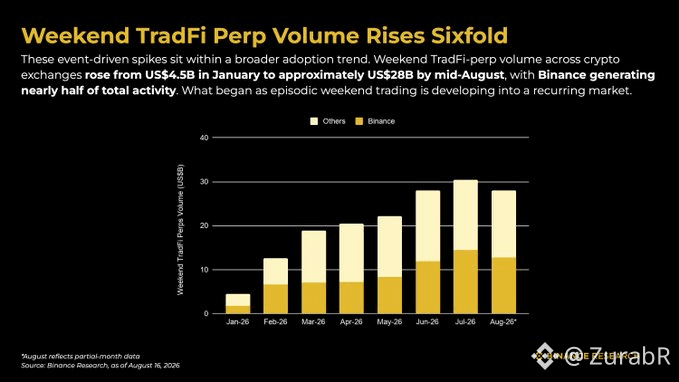
According to the report, published by Binance, in recent months, weekend trading volume of TradFi’s perpetual futures, across crypto exchanges, has surged sixfold to $28 billion, with Binance alone accounting for nearly half the total volume.
This is significant, as it is not merely a spike in weekend trading activity.
The data instead shows that traders are already using crypto markets to get 24/7 exposure to traditional assets, so TradFi’s push to offer “round-the-clock” trading makes sense. It aims to meet this demand by bringing more trading activity to traditional markets from crypto’s always-on markets.
Tal Cohen, President of Nasdaq, recently noted this shift:
The new wave of retail investors is already used to 24/7 crypto markets and as a result, equities are gravitating towards almost 24-hour trading and a willingness to allow pre-market and after hours trading. In other words, crypto has already normalized 24/7 trading and TradFi is now adapting to that demand.#Write2Earn #EarningsSeason $BTC
Why $28B in weekend trading has Wall Street chasing crypto’s 24/7 model
For years the crypto industry had one apparent advantage over the stock market: while Bitcoin [BTC] never sleeps, stock exchanges have their opening and closing times. But what happens when stocks begin trading almost around the clock as well?
TradFi is now chasing crypto’s 24/7 trading model
The stock market model is now starting to change.
In April, the SEC approved Nasdaq’s request to extend the hours for U.S. equity trading to 23 hours a day, five days a week, the new rules of which are coming into force on the 6th of December. Notably, the extended session will be from 9 p.m. to 4 a.m. ET. In addition to Nasdaq, NYSE is also planning to extend trading hours, hence moving towards an “always-on” market.
Naturally, the question arises: Why now?
According to the report, published by Binance, in recent months, weekend trading volume of TradFi’s perpetual futures, across crypto exchanges, has surged sixfold to $28 billion, with Binance alone accounting for nearly half the total volume.
This is significant, as it is not merely a spike in weekend trading activity.
The data instead shows that traders are already using crypto markets to get 24/7 exposure to traditional assets, so TradFi’s push to offer “round-the-clock” trading makes sense. It aims to meet this demand by bringing more trading activity to traditional markets from crypto’s always-on markets.
Tal Cohen, President of Nasdaq, recently noted this shift:
The new wave of retail investors is already used to 24/7 crypto markets and as a result, equities are gravitating towards almost 24-hour trading and a willingness to allow pre-market and after hours trading. In other words, crypto has already normalized 24/7 trading and TradFi is now adapting to that demand.#Write2Earn #EarningsSeason $BTC