


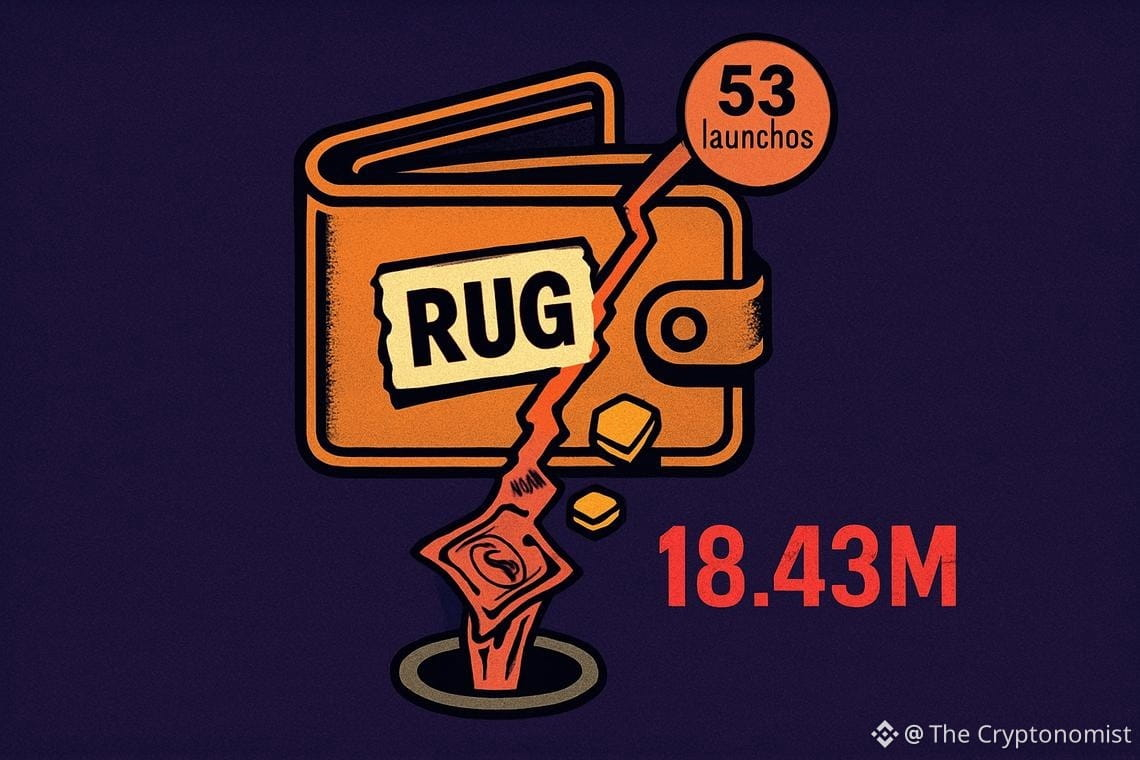
An on-chain sleuth just pulled back the curtain on what looks like one of the largest coordinated scams to hit a young blockchain network in recent memory. The Robinhood Chain rug-pull scheme, traced by analyst Wazz and detailed on September 27, connects 53 separate token launches to a single operation that drained at least $18.43 million from buyers over roughly two months.
Key takeaways
Analyst Wazz linked 53 token launches on Robinhood Chain to one coordinated rug-pull operation.
The scheme extracted at least $18.43 million, with the real figure likely higher.
45 launches were tied together through direct on-chain fund flows, four through a shared private key, and four through a common collector wallet.
Most launches used 70 to 200 wallets to quietly control over 70% of a token’s supply before going public.
The top three drained tokens were CRUMBS ($3.12 million), LEGS ($2.9 million) and PINK ($1.44 million).
Wazz Uncovers Large Robinhood Chain Rug-Pull Operation
Wazz, an on-chain analyst who posts under the handle @WazzCrypto, said suspicious activity around a token called DEED sent him down a rabbit hole that turned into a much bigger story. What started as a look at one questionable launch ended with the discovery of a sprawling network tied to the same group of bad actors.
Tracing 53 Token Launches Over Two Months
Wazz said he traced 53 Robinhood Chain token launches over roughly two months back to the same rug-pull operation. That is a striking number for a chain that only went live on July 1, 2026, as an Arbitrum Orbit Layer 2 network. In under three months of operation, Robinhood Chain had already become a magnet for memecoin activity, with heavy daily token deployment volumes creating what one investigator described as fertile ground for bad actors.
Notably, DEED — the token that first caught Wazz’s attention — turned out to be a relatively minor player once the full picture emerged. It didn’t even rank among the ten largest cash-outs identified in the investigation.
Total Funds Extracted Reach At Least $18.43 Million
Across all 53 launches, the operation extracted at least $18.43 million. That figure, however, may understate the true scale of the damage. Wazz separately identified two additional serial operations extracting funds from the Robinhood Chain ecosystem that appeared unlinked to the main syndicate. Those weren’t folded into the 53-launch count or the headline $18.43 million total, which means the overall toll on investors could run meaningfully higher than the reported number.
Mechanics of the Coordinated Token Fraud
The operation’s real sophistication shows up in how the individual launches were stitched together. Rather than a series of unrelated scams, the pattern points to a single group recycling profits and infrastructure across dozens of tokens.
Fund Flows Link 45 Launches; Shared Keys and Wallets Connect Others
Of the 53 launches, 45 were connected through direct on-chain fund flows, with proceeds from one rug pull used to seed the next. That self-funding cycle effectively created a conveyor belt of token fraud, where each successful extraction financed the next round of deception. Beyond the fund-flow links, four launches shared the exact same private key used for funding batches, and another four shared a common collector wallet — additional fingerprints tying the launches to the same operators.
Use of 70–200 Wallets to Control Majority Supply
The playbook behind most of these launches followed a consistent template. In every case, a cluster of 70 to 200 wallet addresses worked together to lock up over 70% of a token’s supply before the general public was ever given the opportunity to purchase it. Once insiders locked up that majority stake, the outcome was largely predetermined: minimal capital could pump the price, and dumping the concentrated holdings guaranteed profits at everyone else’s expense.
Deployment via Pons V2 Platform and Fake Pre-Launch Contracts
Many of the tokens were deployed through Pons V2, a launch platform used widely on Robinhood Chain. On top of the wallet concentration tactic, some projects allegedly used fake pre-launch contracts — what Wazz called “fake launches” — designed to mislead investors before the real contract address was ever revealed. This means buyers could have been trading against a decoy contract, unaware the token they thought they were purchasing wasn’t the genuine deployment at all.
Top Tokens and Impact
Not every launch in the operation extracted the same amount, but a handful of tokens accounted for a disproportionate share of the damage.
Largest Single Extractions by Token
The single biggest cash-out identified by Wazz came from CRUMBS, which pulled roughly $3.12 million in one operation. LEGS followed with about $2.9 million extracted, and PINK rounded out the top three with roughly $1.44 million. Together, those three tokens alone account for a meaningful chunk of the $18.43 million total tied to the broader scheme.
Implications for Investors and Robinhood Chain Ecosystem
This episode underscores a structural vulnerability that goes beyond any single bad actor: supply concentration. When a coordinated group can quietly accumulate 70% or more of a token’s supply before retail buyers even know the real contract address, the mechanics of the scam are already locked in place. The Robinhood Chain rug-pull case shows how quickly that dynamic can scale once a syndicate treats each successful drain as seed capital for the next one.
Historical data shows multiple documented rug pulls on Robinhood Chain since its launch, but the scale of this particular syndicate dwarfs earlier incidents, according to Wazz’s investigation. For a network built around high-volume memecoin activity, the case is a reminder that rapid token deployment and thin due diligence can create exactly the conditions a coordinated operation needs to exploit.
FAQ
How many Robinhood Chain token launches were linked to the rug-pull operation?
53 token launches were linked to the same rug-pull operation traced by the analyst Wazz.
What was the total amount extracted from the rug-pull operation?
At least $18.43 million was extracted from the operation involving Robinhood Chain tokens.
How did the rug-pull syndicate connect the different token launches?
They connected 45 launches through fund flows, shared private keys in four launches, and shared a collector wallet in another four launches.
What tactics were used to deceive buyers in this scheme?
Some projects used fake pre-launch contracts to attract buyers before releasing the official contract address.
Article produced with the assistance of artificial intelligence and reviewed by the editorial team.