


Conflicting readings can sound plausible at the time
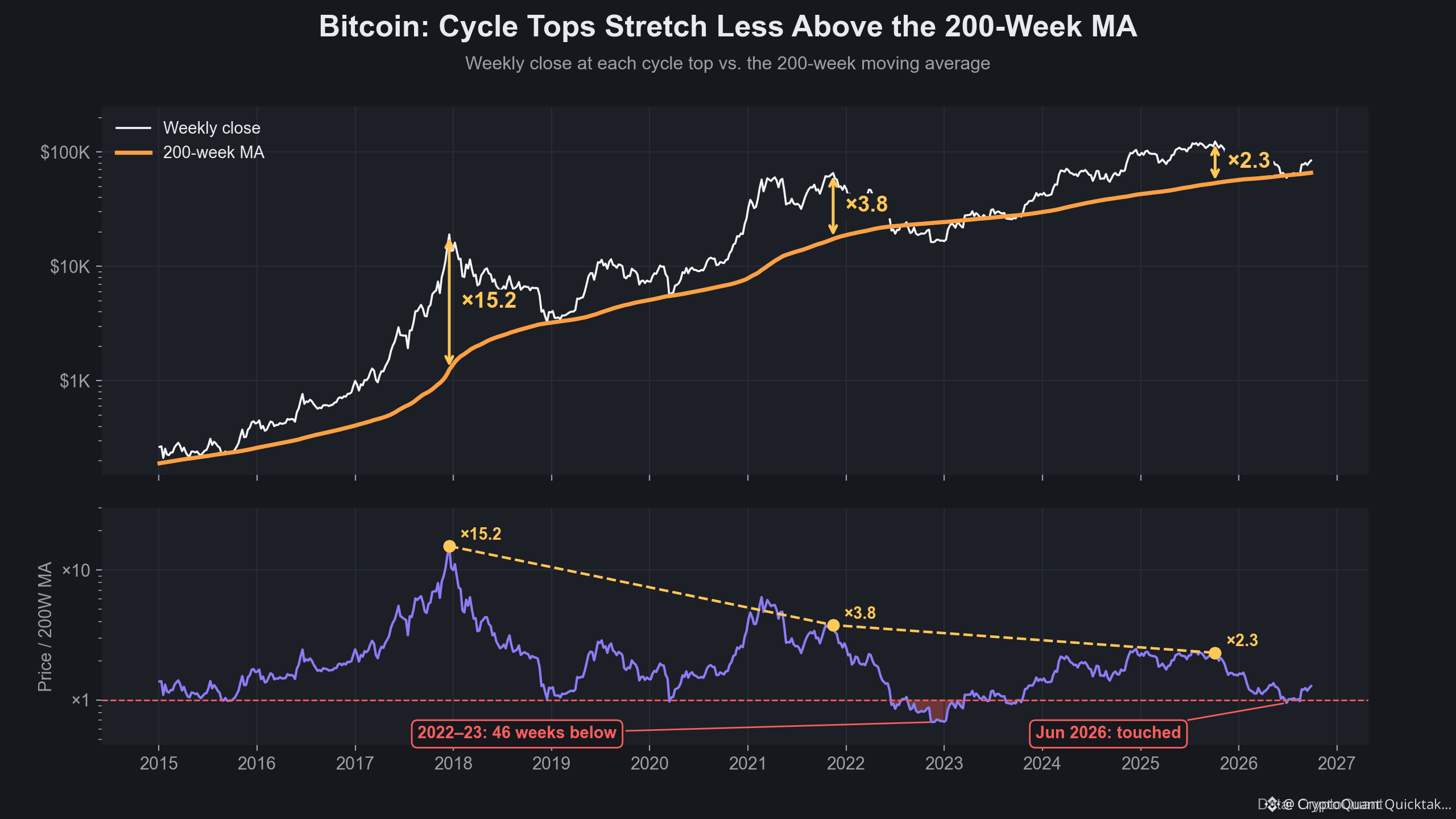
In June-July 2026, price touched the 200-week moving average. Again, the same data backed two claims:
A: Apart from 2022, a 200WMA touch has historically marked a bottom.
B: In 2022, price stayed below the 200WMA for months. So this is not the bottom yet.
In real time, you can't tell which is right. Focus on a single metric and a plausible case for the other side is easy to build. Suppose someone notes that as Bitcoin's market cap grows, the gap between the weekly close at cycle tops and the 200WMA keeps shrinking, and argues that with the 2025 top so close to it, price could fall further below it than in 2022, even with a smaller drawdown. The 200WMA does rise sharply every cycle, so it is hard to say for sure which view holds.
The urge to be right creates bias
Signals can contradict each other at the same moment. Which one was right is settled not on the day but after the outcome. In hindsight any signal can be fitted to the result, but without look-ahead no one can call the answer in real time.
The urge to call "bottom or not" as a binary invites bias. It tempts you to pick the conclusion first, then choose past cases that fit. A pattern with no counterexample yet is easy to mistake for a law, which deepens the trap.
And that desired conclusion usually comes from the analyst's own position. Someone heavy in cash or short tends to read the same metric bearishly; someone with a large long tends to read it bullishly. Everyone believes their conclusion comes from cold analysis, but no one can prove they looked at the data objectively, as it is.
The alternative starts with giving up on calling the answer: estimate roughly where we are in the long cycle, and take only as much risk as you can bear, even when signals are weak. This approach can be wrong too. The point is to keep the cost of being wrong within a range set in advance. What we control is not the conclusion, but how much being wrong costs.
Written by AbstractRyu