

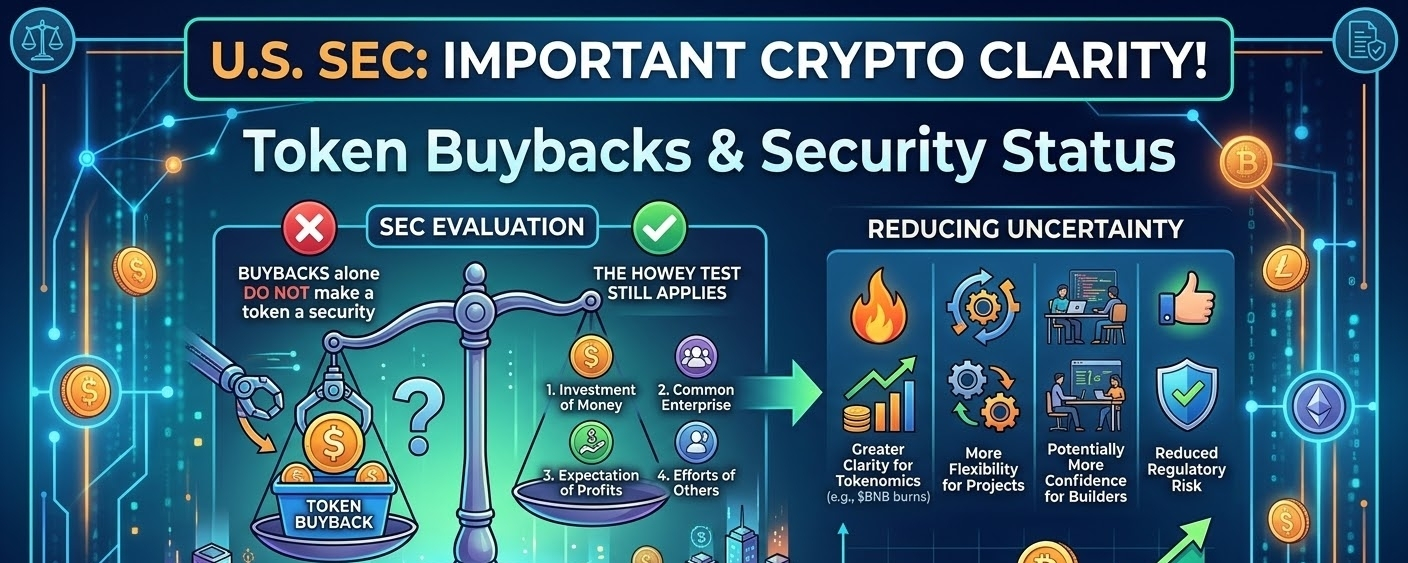

SEC Clarifies Token Buybacks: What You Need to Know
The Division of Corporation Finance at the U.S. Securities and Exchange Commission (SEC) updated its staff FAQs regarding digital assets. The guidance clarifies that announcing a token buyback or burn program on an already functional, operational network does not automatically classify the asset as a security.
Key Takeaways
The Howey Test Still Controls: The SEC did not create a blanket exemption or new statutory law. Whether a token qualifies as an investment contract under the 1946 SEC v. W.J. Howey Co. test remains a fact-specific evaluation based on the entire set of economic realities and marketing around the asset.
Functional vs. Pre-Launch Networks:
Operational Networks: Repurchasing tokens to manage treasury reserves, return value, or facilitate network dynamics on a fully functioning system does not, by itself, satisfy the "essential managerial efforts" or "expectation of profits" prongs of Howey.
Pre-Launch / Speculative Projects: If an unreleased project markets a future buyback mechanism explicitly as a tool to guarantee yields, profit, or price appreciation for early buyers, it can still trigger an investment contract classification.
Routine Maintenance is Not "Managerial Effort": Ongoing engineering, network upgrades, security maintenance, and general promotion of a functional protocol's current utilities generally do not count as essential managerial efforts under Howey.
Why This Matters for Tokenomics & Builders
Greater Tokenomics Flexibility: Protocols generating real cash flows or network fees can deploy buyback-and-burn mechanics (similar to stock repurchases in traditional finance) with reduced regulatory risk of triggering an immediate enforcement action solely because of the buyback.
Impact on Fee-Switch Models: DeFI protocols and exchange-token models (such as $BNB,$UNI, or card reward ecosystems) gain clearer parameters for structuring revenue distribution and token repurchases.
3. Important Distinction (Staff Guidance vs. Law): These FAQs represent SEC staff views, not binding commission rulemaking, formal legislation, or court precedent. They can be revised, and courts evaluate each token on a case-by-case basis.