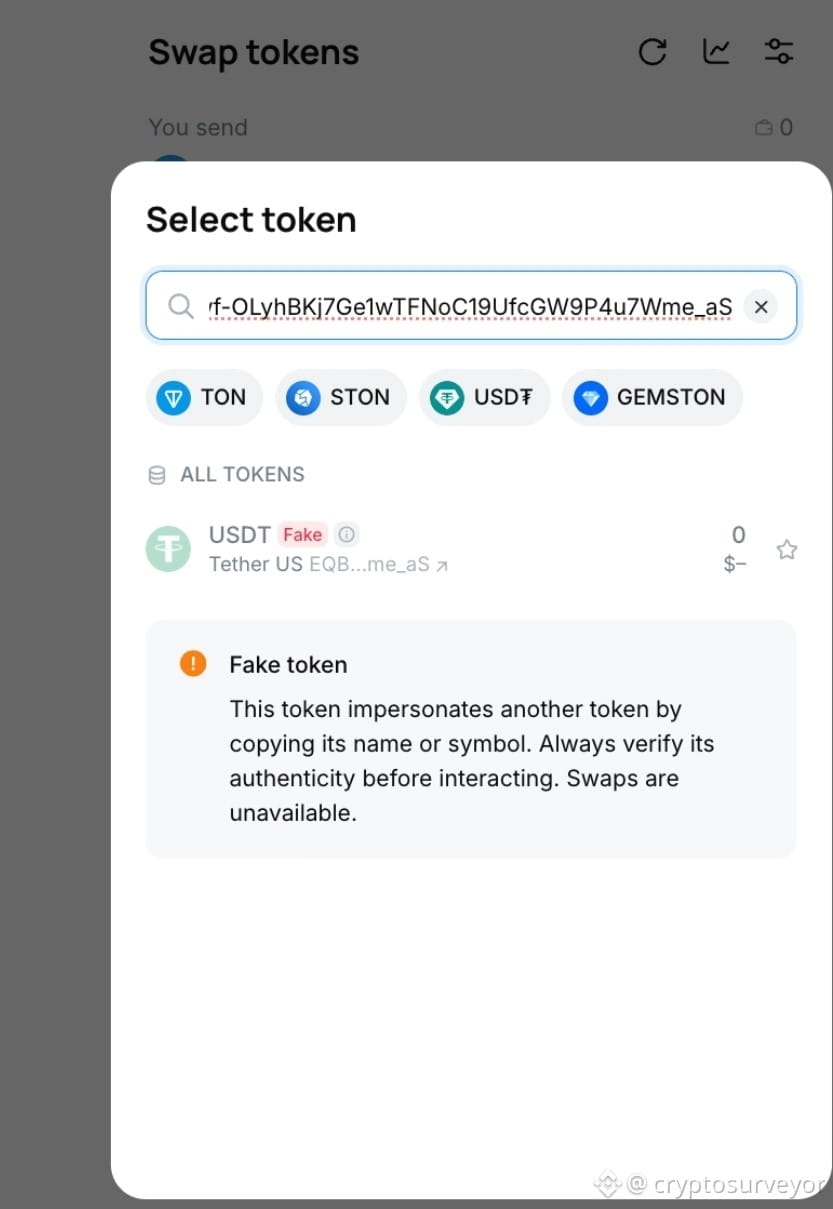
𝐇𝐨𝐰 𝐭𝐨 𝐫𝐞𝐚𝐝 𝐭𝐨𝐤𝐞𝐧 𝐬𝐞𝐜𝐮𝐫𝐢𝐭𝐲 𝐰𝐚𝐫𝐧𝐢𝐧𝐠𝐬 𝐨𝐧 𝐚 𝐃𝐄𝐗 .
A token warning isn't an investment rating.
It's a signal telling you what to investigate next.
STON.fi provides a useful real-world example 👇
1️⃣ Fake
A token may imitate another token by copying its name, symbol, or identity.
→ Verify the contract address using the project's official sources.
2️⃣ Honeypot
A token may be purchasable but have restrictions that prevent normal selling.
→ Investigate the token's transfer and selling mechanics.
3️⃣ Taxable
The token includes an additional fee mechanism on swaps or transfers.
→ Check how the tax works and how it affects the amount you receive.
4️⃣ Suspicious
The token raises concerns that require additional attention.
→ Research the project, branding, documentation, contract, and activity.
5️⃣ DMCA Notice
STON.fi uses this label for tokens associated with an intellectual-property complaint.
→ Understand what the notice concerns and investigate the token's legitimacy and authorization.
The important part:
A warning isn't automatically a verdict.
And no warning doesn't mean zero risk.
Interface labels are based on detectable signals and documented inputs. They can't identify every possible problem with a token.
So when you see a warning:
𝐖𝐚𝐫𝐧𝐢𝐧𝐠 → 𝐈𝐧𝐯𝐞𝐬𝐭𝐢𝐠𝐚𝐭𝐞 → 𝐕𝐞𝐫𝐢𝐟𝐲 → 𝐔𝐧𝐝𝐞𝐫𝐬𝐭𝐚𝐧𝐝
Before signing a transaction, make sure you know what you're interacting with.
That screenshot of STON.fi's Fake label is a perfect example of why the label should be treated as a starting point for verification—not the end of your research.
A token warning isn't an investment rating.
It's a signal telling you what to investigate next.
STON.fi provides a useful real-world example 👇
1️⃣ Fake
A token may imitate another token by copying its name, symbol, or identity.
→ Verify the contract address using the project's official sources.
2️⃣ Honeypot
A token may be purchasable but have restrictions that prevent normal selling.
→ Investigate the token's transfer and selling mechanics.
3️⃣ Taxable
The token includes an additional fee mechanism on swaps or transfers.
→ Check how the tax works and how it affects the amount you receive.
4️⃣ Suspicious
The token raises concerns that require additional attention.
→ Research the project, branding, documentation, contract, and activity.
5️⃣ DMCA Notice
STON.fi uses this label for tokens associated with an intellectual-property complaint.
→ Understand what the notice concerns and investigate the token's legitimacy and authorization.
The important part:
A warning isn't automatically a verdict.
And no warning doesn't mean zero risk.
Interface labels are based on detectable signals and documented inputs. They can't identify every possible problem with a token.
So when you see a warning:
𝐖𝐚𝐫𝐧𝐢𝐧𝐠 → 𝐈𝐧𝐯𝐞𝐬𝐭𝐢𝐠𝐚𝐭𝐞 → 𝐕𝐞𝐫𝐢𝐟𝐲 → 𝐔𝐧𝐝𝐞𝐫𝐬𝐭𝐚𝐧𝐝
Before signing a transaction, make sure you know what you're interacting with.
That screenshot of STON.fi's Fake label is a perfect example of why the label should be treated as a starting point for verification—not the end of your research.