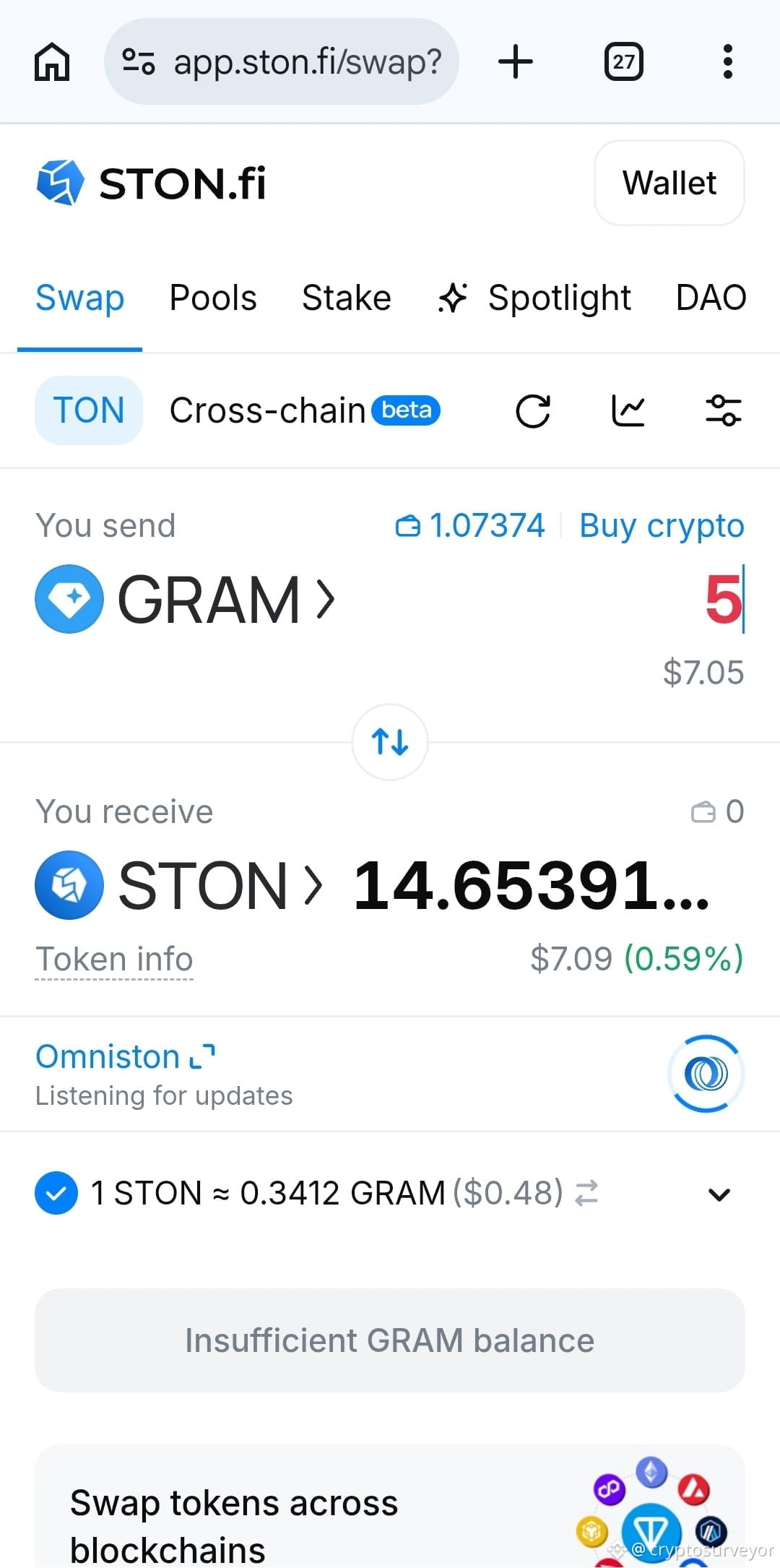
I’ve been looking more closely at how @ston_fi is handling cross-chain swaps, and the interesting part isn’t just the volume.
DefiLlama currently shows roughly $26M in TVL, with daily volume still reaching the millions.
Those numbers are useful.
But I’m more interested in what’s happening underneath.
Omniston takes a different approach to moving assets between chains.
Instead of relying on a traditional bridge with wrapped assets, you can request a quote for something like USDT on TRON and receive USDT on TON — or route between TON, Arbitrum, Base and other supported networks.
Resolvers compete to execute the trade, while linked HTLCs handle the settlement.
The user remains self-custodial throughout the process.
And honestly, that’s what makes the experience interesting.
From the user side, the process can feel surprisingly ordinary:
Select the asset and source chain.
Choose where you want to receive it.
Review the quote.
Sign.
Done.
The complicated infrastructure is happening behind the scenes.
STON.fi is also pushing the system through its current “One Swap. Across Chains” campaign, with weekly missions and rotating Flight Deals.
They’ve also been showing how this infrastructure can extend beyond the main interface, including an open-source Telegram Mini App example for moving from TON into EVM ecosystems.
That’s the part I’m watching.
Not the biggest headline number.
Not the cumulative volume alone.
The real question is whether this resolver-based model can continue processing meaningful volume while maintaining reliable execution and avoiding the familiar risks associated with bridge infrastructure.
That’s a much more interesting metric to me than hype.
Has anyone here recently tried a larger TRON → TON swap through Omniston?
I’d be interested in hearing how the amount you actually received compared with the quoted amount.
NFA. DYOR.
DefiLlama currently shows roughly $26M in TVL, with daily volume still reaching the millions.
Those numbers are useful.
But I’m more interested in what’s happening underneath.
Omniston takes a different approach to moving assets between chains.
Instead of relying on a traditional bridge with wrapped assets, you can request a quote for something like USDT on TRON and receive USDT on TON — or route between TON, Arbitrum, Base and other supported networks.
Resolvers compete to execute the trade, while linked HTLCs handle the settlement.
The user remains self-custodial throughout the process.
And honestly, that’s what makes the experience interesting.
From the user side, the process can feel surprisingly ordinary:
Select the asset and source chain.
Choose where you want to receive it.
Review the quote.
Sign.
Done.
The complicated infrastructure is happening behind the scenes.
STON.fi is also pushing the system through its current “One Swap. Across Chains” campaign, with weekly missions and rotating Flight Deals.
They’ve also been showing how this infrastructure can extend beyond the main interface, including an open-source Telegram Mini App example for moving from TON into EVM ecosystems.
That’s the part I’m watching.
Not the biggest headline number.
Not the cumulative volume alone.
The real question is whether this resolver-based model can continue processing meaningful volume while maintaining reliable execution and avoiding the familiar risks associated with bridge infrastructure.
That’s a much more interesting metric to me than hype.
Has anyone here recently tried a larger TRON → TON swap through Omniston?
I’d be interested in hearing how the amount you actually received compared with the quoted amount.
NFA. DYOR.