

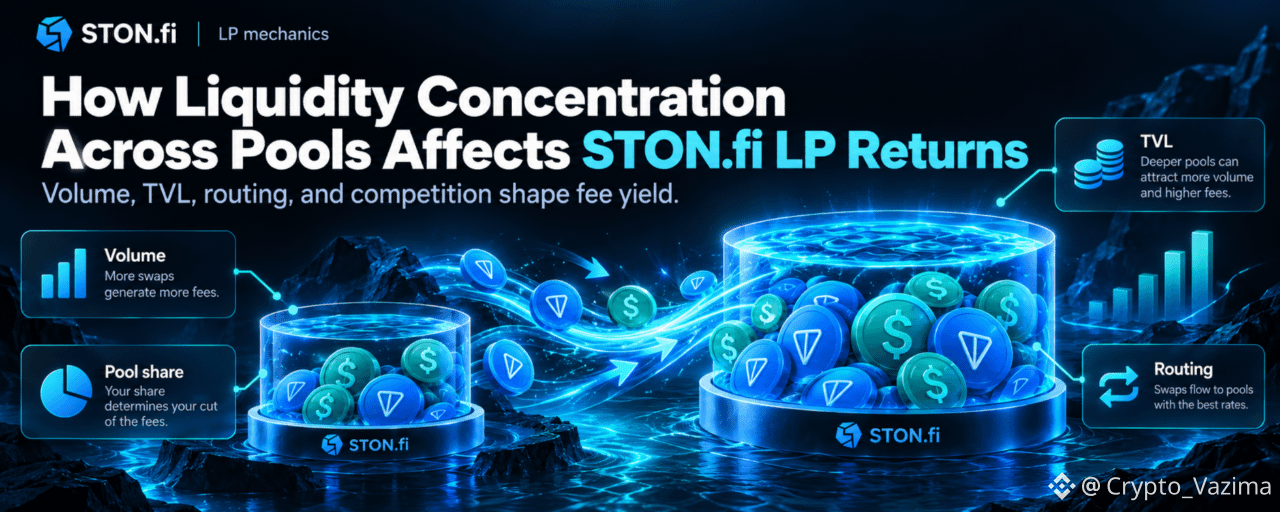

Why the deepest pool is not automatically the highest-yielding pool, and why LPs should compare volume, liquidity, fees, routing, and risk together.
Liquidity concentration affects LP returns because trading fees are earned inside specific pools, not across an entire token market. If most swap activity and liquidity collect in one pool, that pool may offer deeper execution and attract more routed volume. At the same time, every additional liquidity provider reduces each existing provider's percentage share.
That creates an important tension. A large pool can generate far more fees in total but divide them among much more capital. A smaller pool can give you a larger ownership share but may receive too little trading volume to make that advantage useful.
For a STON.fi liquidity provider, the question is therefore not simply, "Which pool has the most TVL?" A better question is, "How much fee-generating volume is this pool handling relative to the liquidity competing for those fees?"
Liquidity concentration changes two things at once
Here, "liquidity concentration" means the distribution of capital across separate liquidity pools or liquidity sources. It should not be confused with range-based concentrated liquidity, where an LP chooses a specific price interval.
Imagine a token market where $10 million of liquidity could theoretically be distributed in two ways.
In the first case, $9 million sits in Pool A and $1 million sits in Pool B. Liquidity is highly concentrated.
In the second case, each pool holds $5 million. Liquidity is more evenly fragmented.
From a trader's perspective, Pool A in the first scenario may be attractive because deeper reserves generally mean a large swap moves the pool price less. From an LP's perspective, however, deeper liquidity means more capital is competing for each dollar of fees.
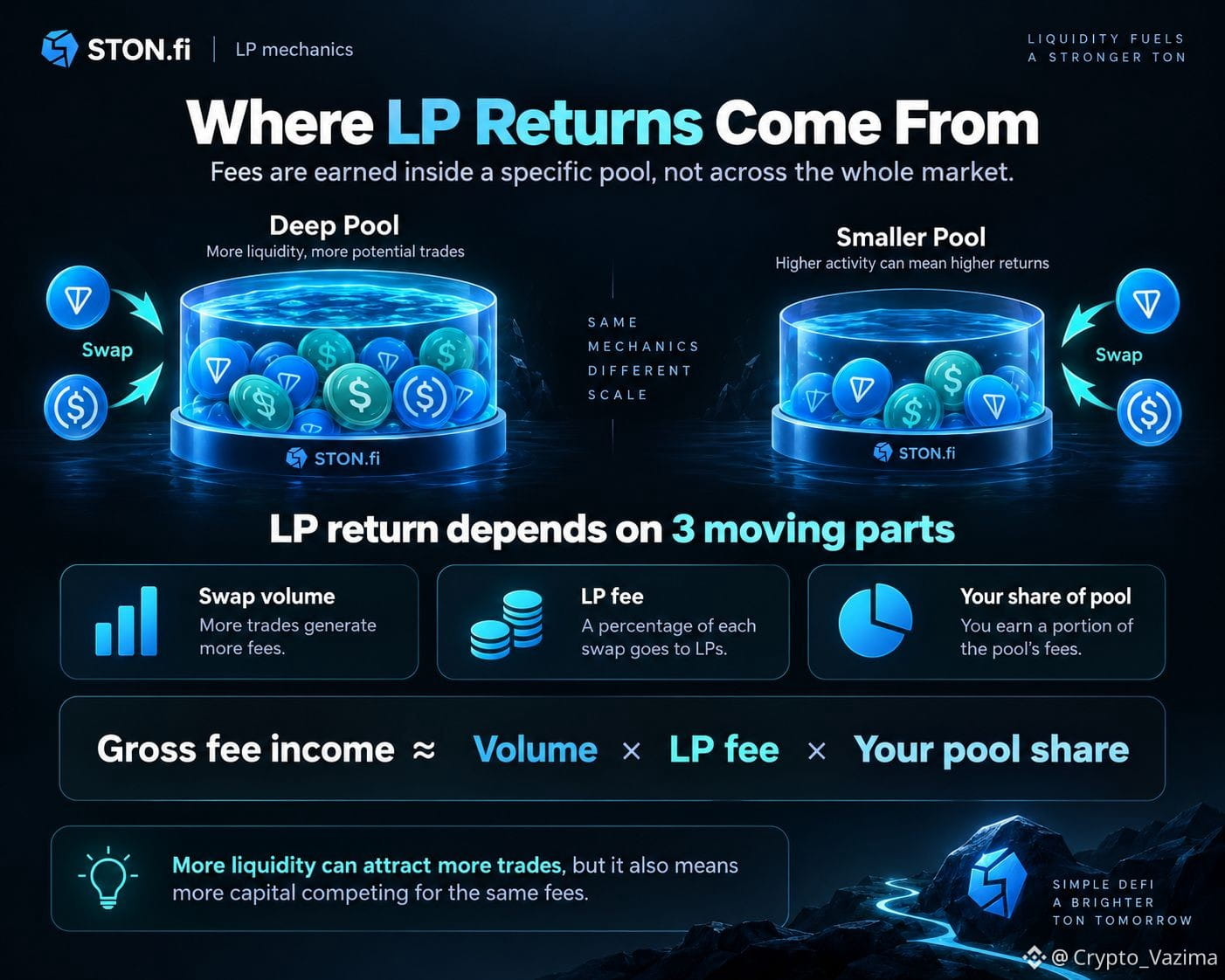
STON.fi describes the same basic fee relationship at the individual pool level: LP rewards depend on swap volume, the LP fee, and your share of the pool. Its documentation also notes that TVL, swap volume, and APR should be considered together rather than using any single metric in isolation.
The basic relationship can be simplified as:
Your gross fee income ≈ Pool swap volume × LP fee rate × Your share of pool liquidity
That equation immediately explains why TVL by itself cannot tell you whether an LP position is attractive.
A deeper pool can be excellent for traders while becoming increasingly competitive for LPs.
The ratio that matters more than raw TVL
Suppose your capital represents roughly the same proportion of the pool's economic value as its share of total liquidity.
Then:
Your pool share ≈ Your liquidity / Total pool liquidity
Substituting that into the fee equation gives a useful simplified model:
Your fee income ≈ Volume × LP fee × Your liquidity / Pool liquidity
For the same deposit size and fee rate, the critical relationship becomes:
Volume / Liquidity
This is essentially a capital-utilization measure. It tells you how much trading activity is passing through each unit of liquidity.
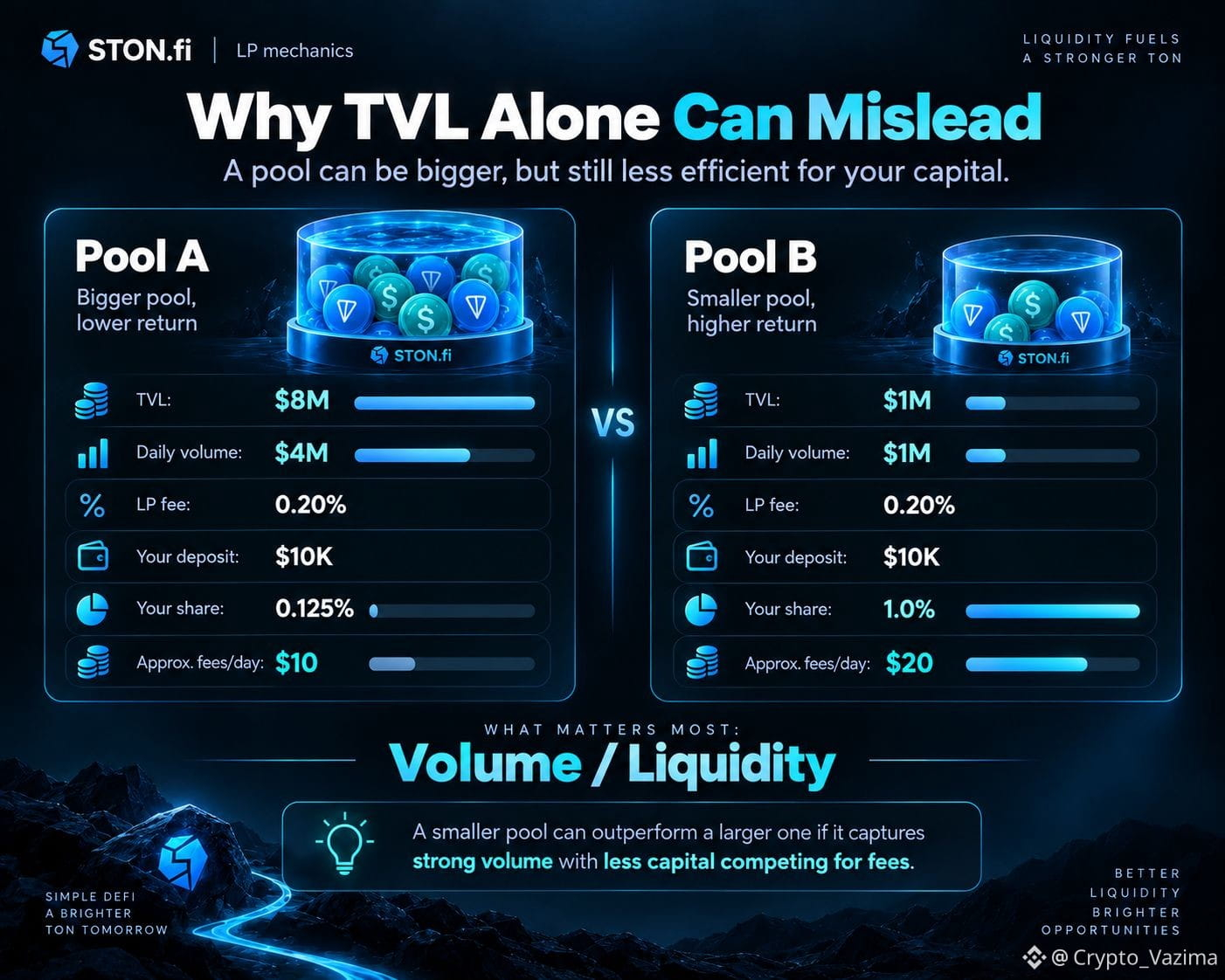
Consider a hypothetical example.
Pool B gives you eight times the ownership percentage, yet Pool A generates ten times as much fee income for the same deposit in this example.
Now change only Pool B's daily volume from $50,000 to $1 million. Its LPs would collectively receive about $2,000 per day at a 0.20% LP fee. A 1% share would correspond to about $20.
Suddenly, the smaller pool generates twice the hypothetical fee income of Pool A for the same $10,000 position.
The lesson is not that small pools are better or that large pools are better. What matters is the relationship between routed volume and the capital supplying that volume.
Why concentrated liquidity can attract even more trading
Liquidity distribution also affects the trader side of the market.
STON.fi uses automated market maker pools where token reserves determine execution. Its standard AMM model is based on the familiar constant-product relationship, while the protocol also supports other pool types such as Stableswap, weighted constant-product pools, and weighted Stableswap pools.
When one appropriate pool becomes much deeper than alternatives, a given trade will often create less price impact there than in a thinner pool, all else being equal.
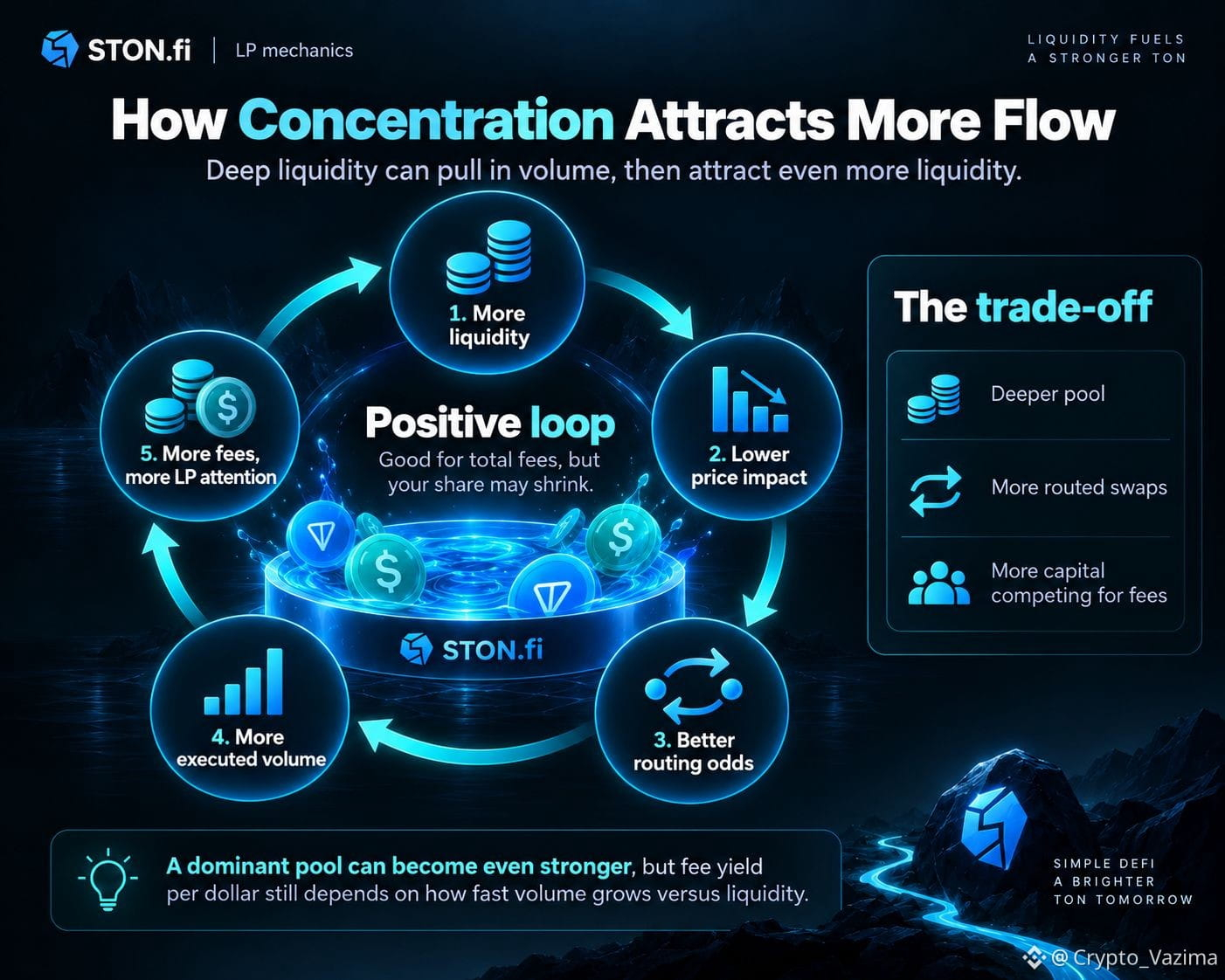
That can create a feedback loop:
More liquidity can improve execution for traders.
Better execution can make that liquidity source more competitive when routes are compared.
More executed volume can produce more total fees.
Strong fee activity can attract additional LP capital.
More LP capital can deepen the pool further, while also diluting each provider's share.
STON.fi's Omniston infrastructure makes routing especially relevant to this discussion. Official documentation says Omniston aggregates liquidity from multiple sources and searches for favorable routes and quotes rather than requiring a swapper to manually choose every underlying liquidity source.
For LPs, this means available trading demand is not necessarily divided evenly among pools just because those pools exist. A pool has to remain useful to execution.
Deep liquidity helps with that, but depth is only one factor. Pool curve, fees, current reserves, trade size, and competing quotes can all affect which route is attractive.
More liquidity can reduce your fee yield
There is a subtle effect that LPs sometimes miss.
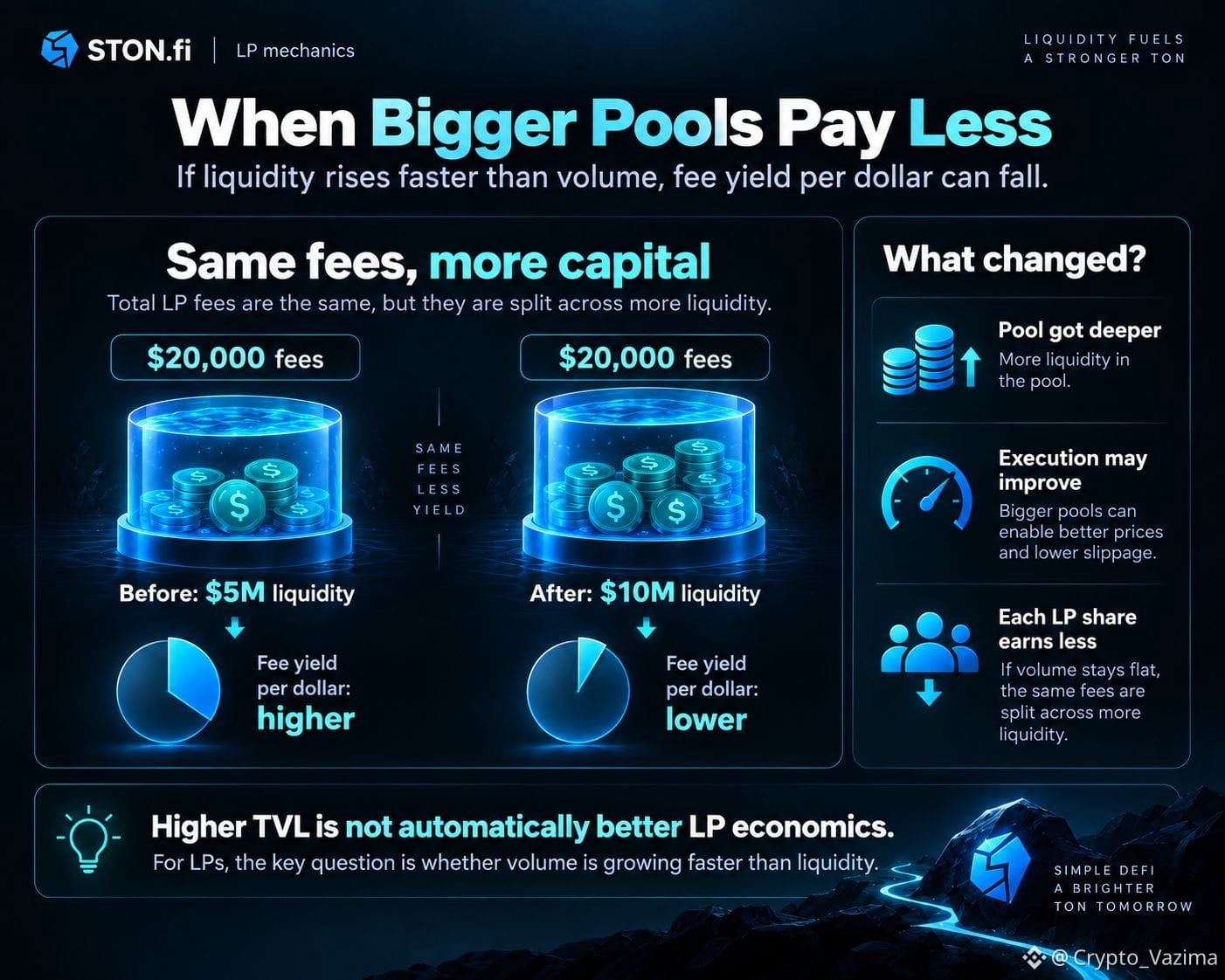
Suppose a pool generates $20,000 in LP fees during a certain period while holding $5 million of liquidity. If trading activity stays unchanged but liquidity grows to $10 million, the same fee pool is now divided across twice as much capital.
The pool became deeper and probably more useful for traders, but fee income per dollar of liquidity fell by roughly half.
This is why a rising TVL number should not automatically be interpreted as improving LP economics.
The reverse can also happen. Trading volume may rise faster than TVL. If a pool's liquidity grows by 20% while its fee-generating volume doubles, fee productivity per dollar of capital can improve despite greater LP competition.
Academic work on AMM liquidity fragmentation has similarly found that liquidity and trading volume do not necessarily increase proportionally. Research comparing liquidity allocation across AMM venues has shown that capital can become relatively oversupplied in some pools while other venues offer different reward conditions.
For an LP, the useful question is therefore not "Is TVL going up?"
It is:
Is relevant trading activity growing faster or slower than the liquidity competing for it?
Fragmentation is not automatically bad for LPs
From a trader's perspective, fragmented liquidity often sounds undesirable because dividing reserves can reduce the depth available in any single pool.
For LPs, the result is more complicated.
Imagine two pools serving similar economic demand. The dominant pool captures most swaps, but it also attracts an enormous amount of liquidity. The smaller pool receives less volume, yet very little capital competes for those fees.
If the reduction in competing liquidity is greater than the reduction in trading volume, the smaller pool can theoretically produce a higher gross fee return per dollar deposited.
That opportunity can disappear quickly. Higher displayed returns may attract capital, which raises TVL and dilutes existing LPs. Routing conditions may change. Another pool may become more competitive. Trading demand can move elsewhere.
Fragmentation can therefore produce temporary differences in capital efficiency without creating a guaranteed advantage.
This is one reason APR needs context. STON.fi states that pool APR is an estimate derived from recent activity and can change rapidly. The protocol recommends examining TVL and swap volume alongside APR rather than treating the displayed rate as a guaranteed future return.
A very high recent APR may simply describe a period when substantial volume passed through a relatively small amount of liquidity.
If more LPs respond by depositing capital, the future rate can be very different.
Fee yield is only one side of LP return
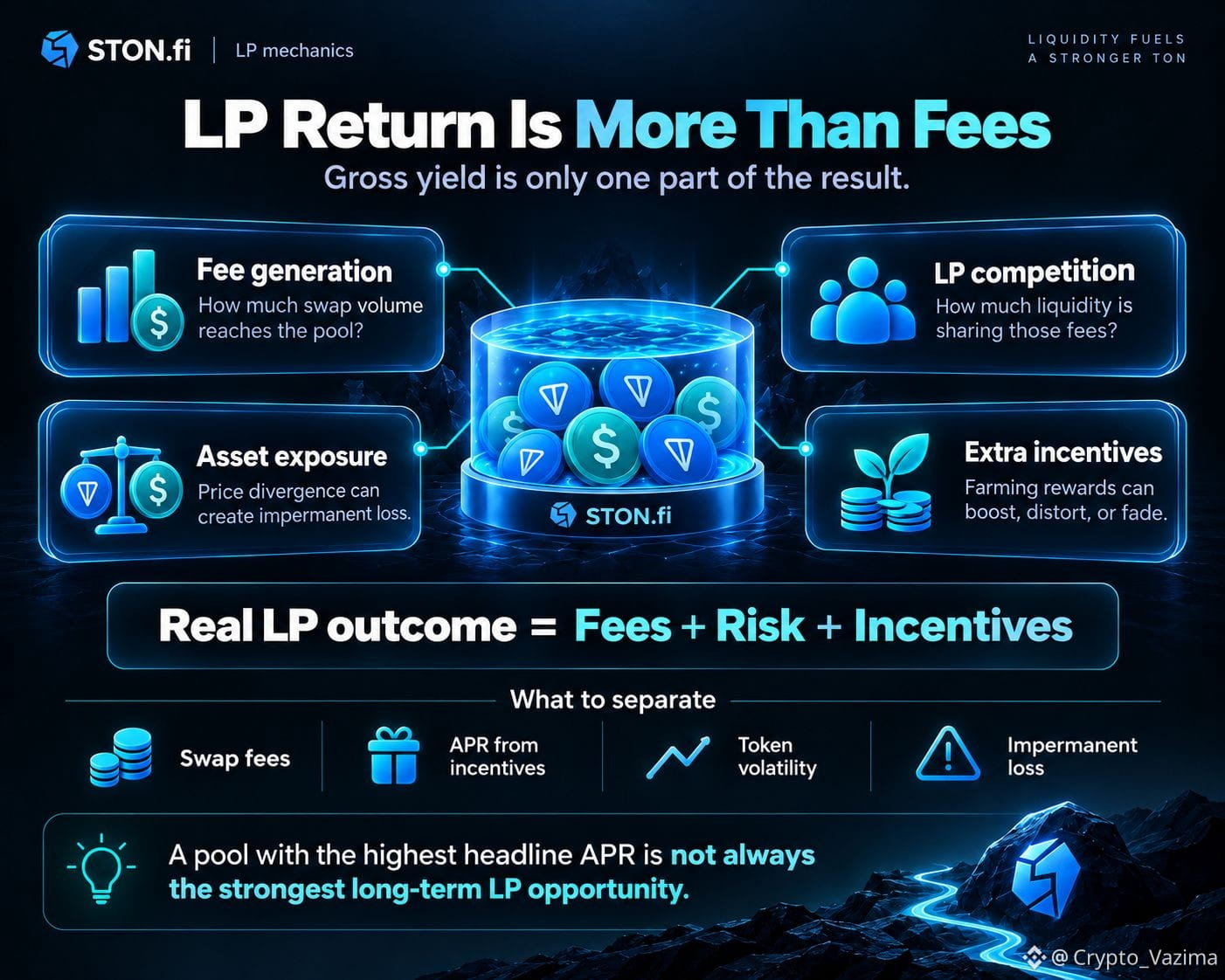
The volume-to-liquidity relationship helps compare gross fee generation, but it is not a complete measure of LP profitability.
An LP position also changes composition as traders interact with the pool. If the relative market prices of the two assets diverge, arbitrage activity changes the quantities held by the pool.
That creates impermanent loss relative to simply holding the original assets. Fees can offset part or all of that difference in some periods, but there is no guarantee that they will. STON.fi explicitly identifies impermanent loss and asset volatility as risks that need to be evaluated when comparing pools.
You should therefore separate at least four variables when comparing LP opportunities:
Fee generation: How much eligible swap volume actually reaches the pool?
LP competition: How much liquidity is sharing those fees?
Asset exposure: How could the relative prices of the two pooled assets change?
Additional incentives: Is the displayed return partly driven by a farm or another reward program rather than swap fees alone?
The fourth point is particularly important. STON.fi distinguishes ordinary liquidity provision from farming. LP fees come from swaps, while farming can add separate token incentives through a rewards contract. Those incentives can change independently of the underlying pool's trading activity.
A pool with the highest displayed reward rate is therefore not necessarily the pool producing the most sustainable swap-fee yield.
Following liquidity concentration on STON.fi
STON.fi provides several useful signals for examining this problem directly.
Its interface exposes pool statistics including TVL, swap volume, APR, balances, and other pool-specific parameters. For deeper analysis, the DEX API also exposes pool listings, individual pool data, pool statistics, markets, and an endpoint for retrieving pools associated with a token pair. The API can distinguish V2 pools, while STON.fi documentation confirms that earlier V1 pools continue to exist alongside the current V2 generation.
That means an LP should think at the pool level rather than assuming a token pair is represented by one universal bucket of liquidity.
Consider a practical workflow. You are interested in providing liquidity to a particular pair and discover more than one relevant liquidity venue or pool configuration.
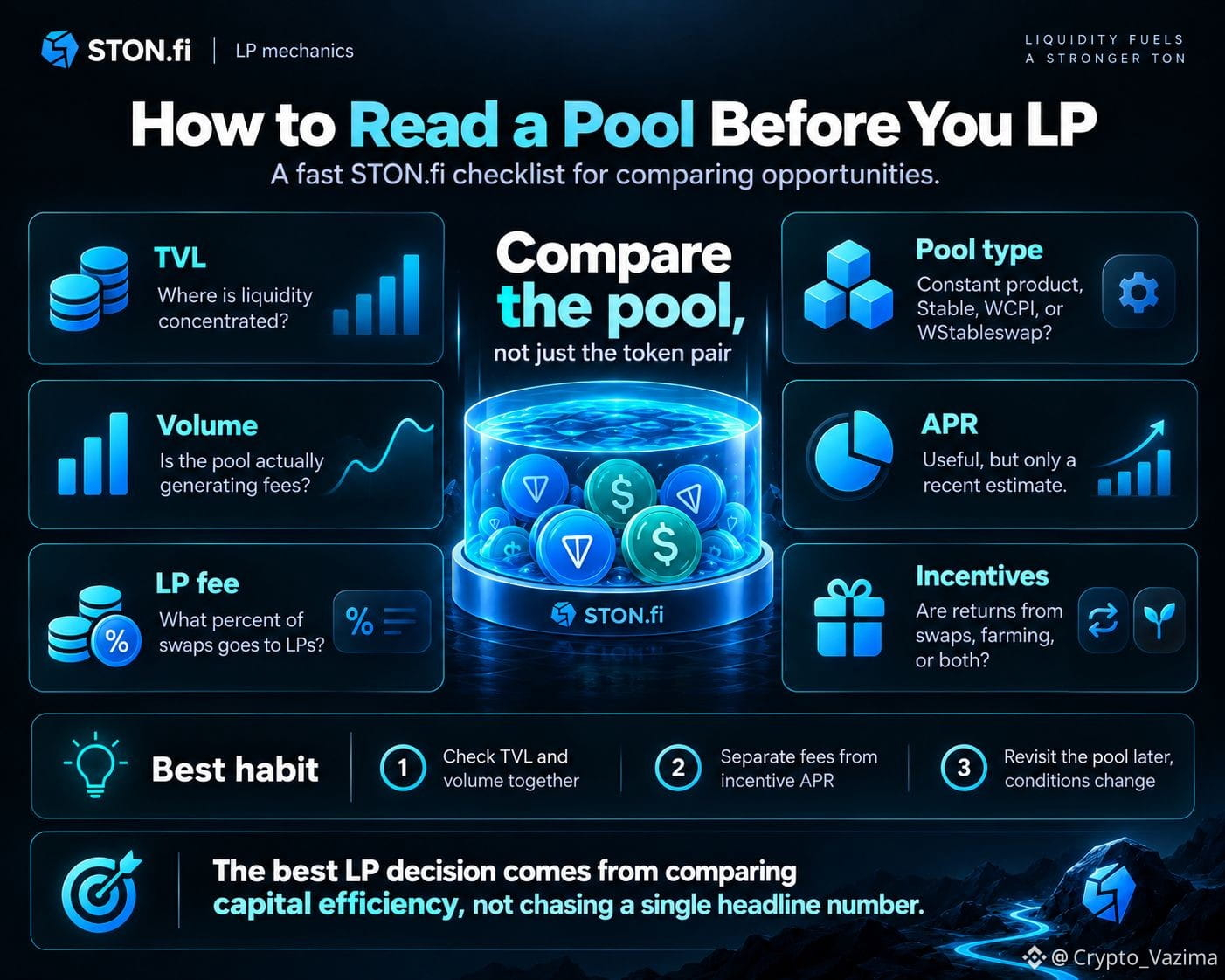
First, compare TVL. This tells you where capital is currently concentrated.
Next, compare recent swap activity. A pool with twice the TVL but ten times the relevant volume may be using capital much more intensively.
Then check the LP fee. STON.fi says the typical LP fee is 0.2% of swap volume, but the exact fee can vary by pool. V2 smart contracts store the LP fee as a pool parameter, and STON.fi advises checking the actual fee for the selected pair rather than assuming every pool uses the same value.
After that, identify the pool type. Constant Product, Stable, WCPI, and WStableswap pools do not have identical pricing behavior. Comparing TVL between pools without considering their curves can therefore give a misleading picture of useful market depth.
Finally, ask where trades are actually being routed. STON.fi notes that Omniston can choose efficient paths through available pools for swap users. A pool that looks attractive in isolation still needs real execution flow if it is going to generate fees for LPs.
Practical takeaway: Before providing liquidity on STON.fi, compare pool TVL, recent volume, actual LP fee, pool type, APR, and any separate farming incentives. Then revisit the comparison later. Liquidity concentration is dynamic: new LP deposits can dilute fee yield, trading activity can migrate, and routing can change which pools capture swaps. The most useful metric is not the largest TVL or highest recent APR by itself, but how efficiently each pool converts liquidity into fee-generating activity.
Frequently Asked Questions
Does the STON.fi pool with the highest TVL give LPs the highest return?
No. Higher TVL gives a pool more depth, but it also means more liquidity is sharing its fees. A lower-TVL pool can theoretically provide higher gross fee yield if it processes enough volume relative to its liquidity. Compare volume, TVL, fee rate, and risk together rather than ranking pools by TVL alone.
Why can LP APR fall while pool TVL rises?
If new liquidity enters faster than trading volume grows, each dollar of liquidity receives a smaller portion of approximately the same fee stream. A larger pool may become better for execution while producing a lower fee rate per dollar supplied. APR can also move because recent trading volume changes.
Is liquidity fragmentation always harmful?
No. Fragmentation can reduce depth in individual pools and affect execution, but its impact on LPs depends on how both volume and liquidity are distributed. A smaller pool can sometimes produce strong fee yield if it captures meaningful volume while relatively little liquidity competes for those fees.
What metric should I compare when choosing between pools?
A useful starting point is swap volume relative to TVL, adjusted for the actual LP fee. It provides a rough picture of how intensively liquidity is being used. It is not a complete return forecast because price divergence, changing volume, pool mechanics, incentives, and other risks still matter.
Does a high volume-to-TVL ratio guarantee better LP returns?
No. It only indicates potentially stronger gross fee generation per unit of liquidity. Net performance can still be reduced by impermanent loss, changes in token prices, changing routing, declining future volume, smart-contract risk, or the end of temporary incentive programs.
Can two STON.fi pools behave differently even if they involve similar assets?
Yes. STON.fi supports multiple pool types with different pricing curves and parameters, and V1 pools can coexist with current V2 infrastructure. The DEX API also exposes pool-specific data and pools by market. For an LP, the relevant unit of analysis is therefore the actual pool and its activity, not merely the token symbols.
What should I check on STON.fi before adding liquidity?
Check the selected pool's TVL, recent swap volume, APR, LP fee, pool type, and token balances. Separate swap-fee economics from any farming rewards. Then consider the volatility and impermanent-loss risk of the underlying pair. Rechecking these variables over time is more useful than assuming the conditions visible when you entered will persist.
Sources and Further Reading
STON.fi Help Center, What is a liquidity pool? - Explains pool reserves, LP tokens, fee accrual, and proportional LP ownership
STON.fi Help Center, Why isn't my liquidity provision earning rewards? - Explains the relationship between swap volume, LP fees, and a provider's share of the pool
STON.fi Help Center, How do I evaluate a liquidity pool using TVL, APR, and swap volume? - Covers pool comparison using TVL, trading activity, APR, and risk
STON.fi Help Center, What types of liquidity pools exist on STON.fi? - Describes Constant Product, Stable, WCPI, and WStableswap pool types
STON.fi Developer Documentation, Pool v2 - Documents reserves, LP fees, protocol fees, LP supply, and pool-specific parameters in V2 contracts
STON.fi Developer Documentation, DEX API Reference - Documents pool listings, pools by market, pool statistics, V1 and V2 filtering, and other market-data endpoints
STON.fi Developer Documentation, Omniston Overview - Explains aggregation of multiple liquidity sources and route selection for swap execution
Gogol, Schneider, Tessone and Livshits, Liquidity Fragmentation or Optimization? Analyzing Automated Market Makers Across Ethereum and Rollups - Empirical research on liquidity allocation, trading volume, and LP returns across AMM environments
Lehar, Parlour and Zoican, Fragmentation and optimal liquidity supply on decentralized exchanges - Research on how LP capital and trading volume can distribute differently across competing pools