Why the Deepest STON.fi Pool Is Not Always Best for LP Returns
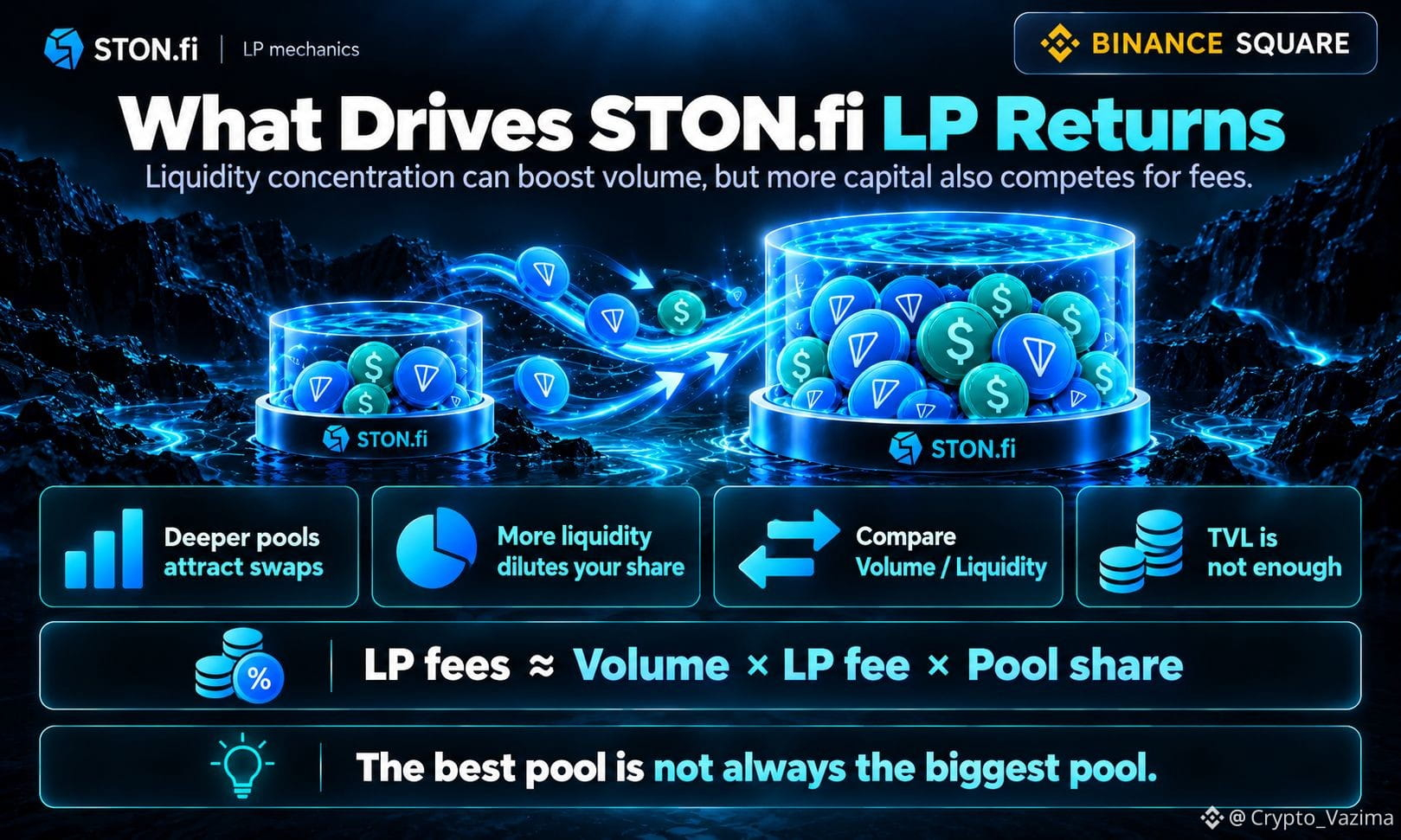
On STON.fi, LP returns depend on the pool that actually captures swaps, not on the token market as a whole. The deepest pool can look safest, but it is not automatically the highest-yielding pool because more liquidity also means more competition for the same fees.
🔥 What liquidity concentration actually does
Liquidity concentration means capital sits unevenly across separate STON.fi pools. Traders may prefer the deepest venue. LPs face a different trade-off.
- More TVL can reduce price impact and attract routed volume.
- The same TVL increase dilutes each provider's pool share.
- Fees stay inside the pool that executed the trade.
🚀 The volume-to-liquidity test
Your gross fee income is roughly pool volume times the LP fee times your share of that pool. Once deposit size and fee rate are fixed, volume relative to liquidity becomes the useful comparison.
- A high-TVL pool can generate more total fees and still pay you less.
- A thinner pool can pay more per dollar if it processes enough volume.
- APR should be read with TVL and recent swap volume, not alone.
🧠 Why concentration can feed on itself
Better depth can improve quotes. Better quotes can win more Omniston routes. More volume can attract more LPs. That loop can deepen the pool while shrinking fee yield per dollar.
⚡ What else still matters
Fee generation is only one part of LP return.
- Impermanent loss and asset volatility can offset fees.
- Farming rewards can inflate displayed APR without stronger swap-fee yield.
- Constant Product, Stable, WCPI, and WStableswap pools do not behave the same way.
The takeaway is practical: on STON.fi, compare how much fee-generating volume a pool handles against the liquidity competing for those fees.
Would a smaller STON.fi pool with stronger volume-to-TVL beat a giant pool for you? 👇
Drop the last pool comparison that surprised you in the comments.
Not investment advice - research on your own! 🚀
$GRAM @STONfi DEX
On STON.fi, LP returns depend on the pool that actually captures swaps, not on the token market as a whole. The deepest pool can look safest, but it is not automatically the highest-yielding pool because more liquidity also means more competition for the same fees.
🔥 What liquidity concentration actually does
Liquidity concentration means capital sits unevenly across separate STON.fi pools. Traders may prefer the deepest venue. LPs face a different trade-off.
- More TVL can reduce price impact and attract routed volume.
- The same TVL increase dilutes each provider's pool share.
- Fees stay inside the pool that executed the trade.
🚀 The volume-to-liquidity test
Your gross fee income is roughly pool volume times the LP fee times your share of that pool. Once deposit size and fee rate are fixed, volume relative to liquidity becomes the useful comparison.
- A high-TVL pool can generate more total fees and still pay you less.
- A thinner pool can pay more per dollar if it processes enough volume.
- APR should be read with TVL and recent swap volume, not alone.
🧠 Why concentration can feed on itself
Better depth can improve quotes. Better quotes can win more Omniston routes. More volume can attract more LPs. That loop can deepen the pool while shrinking fee yield per dollar.
⚡ What else still matters
Fee generation is only one part of LP return.
- Impermanent loss and asset volatility can offset fees.
- Farming rewards can inflate displayed APR without stronger swap-fee yield.
- Constant Product, Stable, WCPI, and WStableswap pools do not behave the same way.
The takeaway is practical: on STON.fi, compare how much fee-generating volume a pool handles against the liquidity competing for those fees.
Would a smaller STON.fi pool with stronger volume-to-TVL beat a giant pool for you? 👇
Drop the last pool comparison that surprised you in the comments.
Not investment advice - research on your own! 🚀
$GRAM @STONfi DEX