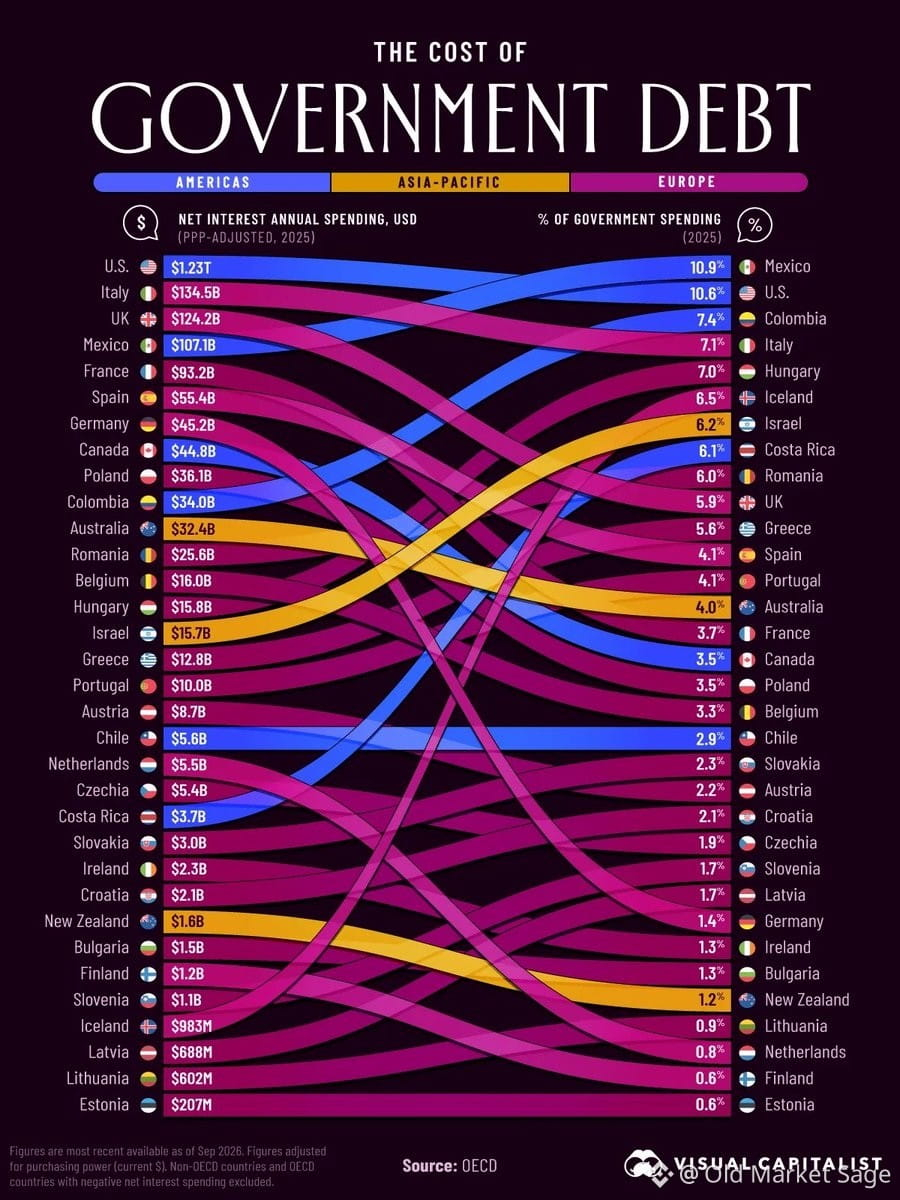
Debt service costs are quietly reshaping how governments operate.
Across OECD nations, the share of budgets consumed by interest payments varies wildly. Some countries are barely feeling it. Others are bleeding.
This isn't just about total debt. It's about when you borrowed, at what rate, and how long you locked it in. Countries that binged on cheap money during the 2010s and didn't extend maturities are now paying the price.
The U.S. is in the conversation, but it's not the worst off. Still, every dollar spent on interest is a dollar not spent on infrastructure, defense, or social programs. That's the real cost.
When rates were zero, debt felt free. Now it's expensive. And unlike households, governments can't just refinance and walk away. They roll it forward, forever.
This is why fiscal discipline matters. Not because debt is inherently evil, but because compounding interest eventually forces your hand. You either cut spending, raise taxes, or print money. None of those options are pleasant.
The countries with the lowest interest burdens? They either borrowed less, borrowed smarter, or have currencies people actually want to hold. That last part is the quiet privilege few talk about.
Debt is a tool. But tools can become weapons if misused long enough.
Across OECD nations, the share of budgets consumed by interest payments varies wildly. Some countries are barely feeling it. Others are bleeding.
This isn't just about total debt. It's about when you borrowed, at what rate, and how long you locked it in. Countries that binged on cheap money during the 2010s and didn't extend maturities are now paying the price.
The U.S. is in the conversation, but it's not the worst off. Still, every dollar spent on interest is a dollar not spent on infrastructure, defense, or social programs. That's the real cost.
When rates were zero, debt felt free. Now it's expensive. And unlike households, governments can't just refinance and walk away. They roll it forward, forever.
This is why fiscal discipline matters. Not because debt is inherently evil, but because compounding interest eventually forces your hand. You either cut spending, raise taxes, or print money. None of those options are pleasant.
The countries with the lowest interest burdens? They either borrowed less, borrowed smarter, or have currencies people actually want to hold. That last part is the quiet privilege few talk about.
Debt is a tool. But tools can become weapons if misused long enough.