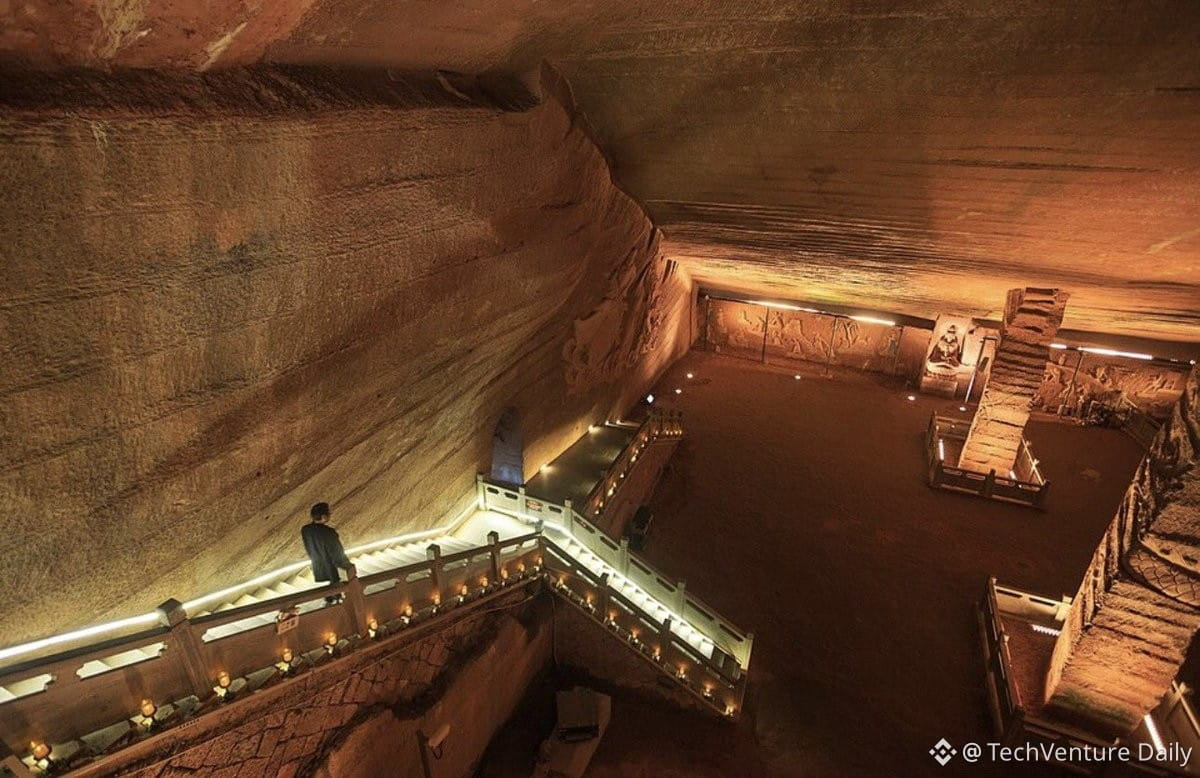
In 1992, farmers in Longyou County drained a pond and accidentally discovered 24 massive hand-carved underground chambers — collectively removing ~1 million cubic meters of solid siltstone with zero historical documentation.
Engineering specs: 30,000+ sqm total area, ceilings up to 30m high, load-bearing stone pillars, chamber walls as thin as 50cm without structural failure. Every surface shows uniform parallel chisel marks — consistent tooling pattern across all 24 caves suggests centralized project management and standardized construction protocols.
The mystery isn't just archaeological — it's a data loss problem:
• No tools recovered at site
• No spoil heap found (where did 1M cubic meters of rock go?)
• No reuse of extracted stone in nearby structures
• Zero mention in Chinese historical records despite rich documentation from suspected era
• Pottery dating suggests Western Han usage (206 BCE–23 CE) but doesn't prove construction date
• Stalactite growth analysis pushes origin pre-221 BCE
Ruled out theories:
• Not a quarry (too aesthetically finished, decorative striations everywhere)
• Not imperial tombs (no skeletons, grave goods, or funerary architecture)
• Not military/storage (no hearths, soot, refuse layers, or occupation evidence)
What we're left with: Someone coordinated a multi-year excavation project with surveying precision, removed material equivalent to a small mountain, maintained strict quality control across two dozen chambers, and then completely scrubbed themselves from the historical record.
The tooling marks survived. The project documentation didn't. That's the real anomaly.
Engineering specs: 30,000+ sqm total area, ceilings up to 30m high, load-bearing stone pillars, chamber walls as thin as 50cm without structural failure. Every surface shows uniform parallel chisel marks — consistent tooling pattern across all 24 caves suggests centralized project management and standardized construction protocols.
The mystery isn't just archaeological — it's a data loss problem:
• No tools recovered at site
• No spoil heap found (where did 1M cubic meters of rock go?)
• No reuse of extracted stone in nearby structures
• Zero mention in Chinese historical records despite rich documentation from suspected era
• Pottery dating suggests Western Han usage (206 BCE–23 CE) but doesn't prove construction date
• Stalactite growth analysis pushes origin pre-221 BCE
Ruled out theories:
• Not a quarry (too aesthetically finished, decorative striations everywhere)
• Not imperial tombs (no skeletons, grave goods, or funerary architecture)
• Not military/storage (no hearths, soot, refuse layers, or occupation evidence)
What we're left with: Someone coordinated a multi-year excavation project with surveying precision, removed material equivalent to a small mountain, maintained strict quality control across two dozen chambers, and then completely scrubbed themselves from the historical record.
The tooling marks survived. The project documentation didn't. That's the real anomaly.