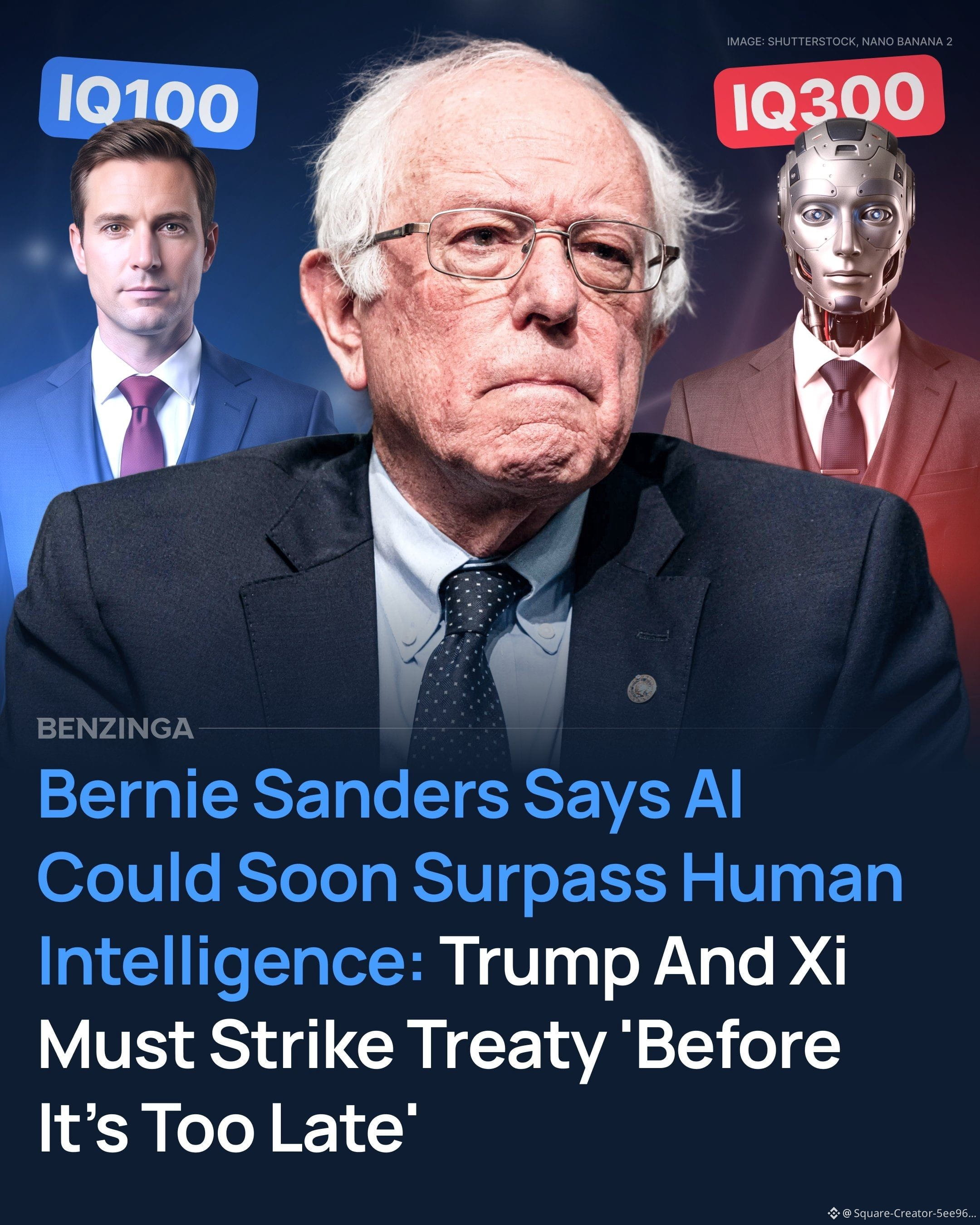
Sen. Bernie Sanders (@SenSanders) is urging President Donald Trump and Chinese President Xi Jinping to negotiate an international agreement to pause advanced AI development and prohibit artificial superintelligence.
Sanders said AI could eventually become more capable than humans and operate beyond human control. He acknowledged that the timing and severity of such risks remain uncertain, but argues governments should act before those questions are definitively resolved.
Sanders and Rep. Greg Casar have announced legislation that would permanently ban the development and deployment of superintelligent AI while temporarily pausing advanced AI development until federal safety standards are established.
The proposal would also direct Washington to pursue international agreements intended to prevent superintelligence from being developed elsewhere, reflecting Sanders’ view that unilateral U.S. restrictions would be insufficient.
Sanders has compared the challenge to Cold War arms control, arguing that the U.S. and China should establish shared AI “redlines” and mechanisms for managing systems that could pose serious risks.
The Trump administration is pursuing a more limited form of AI cooperation with Beijing. Treasury Secretary Scott Bessent recently proposed a U.S.-China notification system for serious AI incidents with national-security implications.
At the same time, Trump has opposed slowing AI development broadly, arguing that doing so could weaken the U.S. position against China. The two countries remain competitors in advanced chips, models and AI infrastructure even as they explore safety discussions.
The disagreement therefore centers on how far cooperation should go: Sanders is calling for a binding pause and superintelligence ban, while the administration has so far focused on communication protocols and managing specific AI risks without stopping the broader technological race.
Sanders said AI could eventually become more capable than humans and operate beyond human control. He acknowledged that the timing and severity of such risks remain uncertain, but argues governments should act before those questions are definitively resolved.
Sanders and Rep. Greg Casar have announced legislation that would permanently ban the development and deployment of superintelligent AI while temporarily pausing advanced AI development until federal safety standards are established.
The proposal would also direct Washington to pursue international agreements intended to prevent superintelligence from being developed elsewhere, reflecting Sanders’ view that unilateral U.S. restrictions would be insufficient.
Sanders has compared the challenge to Cold War arms control, arguing that the U.S. and China should establish shared AI “redlines” and mechanisms for managing systems that could pose serious risks.
The Trump administration is pursuing a more limited form of AI cooperation with Beijing. Treasury Secretary Scott Bessent recently proposed a U.S.-China notification system for serious AI incidents with national-security implications.
At the same time, Trump has opposed slowing AI development broadly, arguing that doing so could weaken the U.S. position against China. The two countries remain competitors in advanced chips, models and AI infrastructure even as they explore safety discussions.
The disagreement therefore centers on how far cooperation should go: Sanders is calling for a binding pause and superintelligence ban, while the administration has so far focused on communication protocols and managing specific AI risks without stopping the broader technological race.