
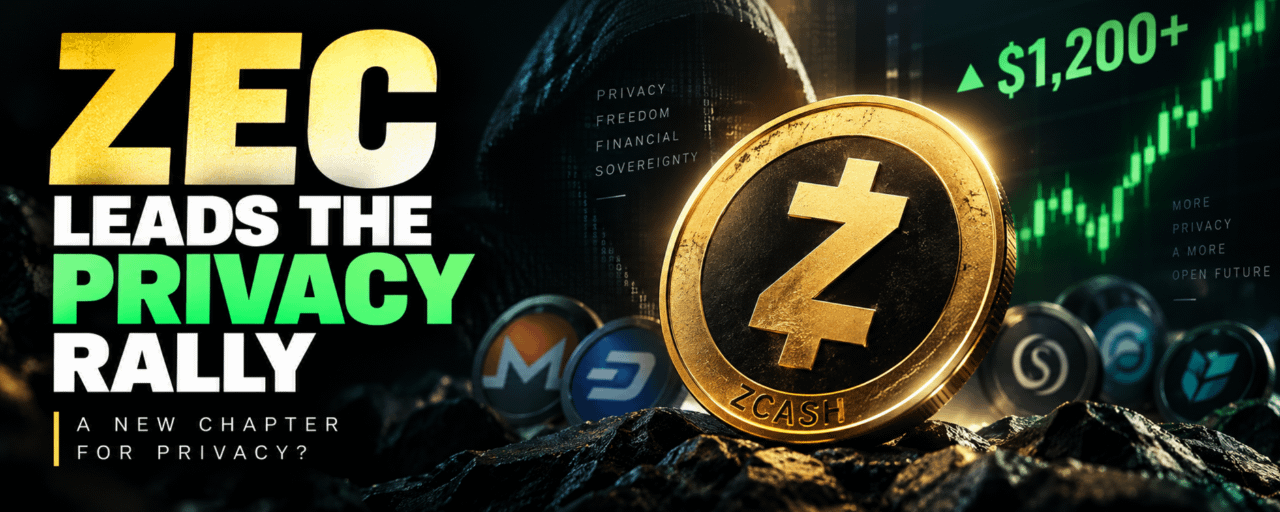


ZEC just printed above $1,200. I went back and read what I wrote in November 2025 - when Zcash was already "surging 700%." That feels quaint now.
Privacy coins didn't just have a good cycle. They had a different cycle. The sector reached approximately $33.6 billion in market cap as Zcash, Monero, Dash and other privacy-focused assets outperformed much of the broader crypto market. What changed between 2025 and 2026 isn't the technology.
It's why people want that technology.
What Are Privacy Coins?
Privacy coins are cryptocurrencies built to hide who sent what to whom. Standard blockchains like Bitcoin are transparent by design - every transaction is publicly viewable. Privacy coins use cryptographic methods to flip that default: Monero uses ring signatures to mix senders in a crowd, Zcash uses zk-SNARKs to verify a transaction is valid without revealing any of its details, Dash lets users optionally route payments through a coin-mixing layer called PrivateSend.
The word "optional" matters for Zcash specifically. About 30% of total ZEC supply migrated into shielded addresses in 2026 - a record level, suggesting genuine adoption rather than speculative positioning alone. That number is the real signal. When more coins move into privacy mode, it means people are actually using the feature.
Why Are Privacy Coins Surging in 2026?
Three catalysts converged this year. I'd argue the first one is the most underreported.
Quantum computing became a named threat, not a theory.
Fears around quantum computing's impact on cryptocurrency security grew significantly, as a Google study warned that Bitcoin and Ethereum - both relying on elliptic curve cryptography - could be vulnerable to quantum attacks. In contrast, Zcash employs zero-knowledge proofs, making it less susceptible to these risks. Shielded coins have no public metadata to harvest and decrypt later, which is exactly the attack vector quantum computing opens. Zcash is targeting full quantum proofing by mid-to-late summer via Project Takyon and out-of-band key exchange. Whether that timeline held is another question - but the direction matters.
AI surveillance became a market thesis.
Traders began paying closer attention to privacy projects "amid broader concerns about the impact of AI, quantum computing and financial surveillance on crypto," according to Pav Hundal, lead analyst at Swyftx. What I found more pointed was Multicoin Capital's framing: Tushar Jain said institutions will increasingly seek private assets to protect themselves from a "political trend to seize private wealth." That's privacy repositioned as financial insurance - not just a feature.
Grayscale launched the first-ever privacy coin ETF.
On August 25, 2026, Grayscale debuted the Zcash ETF under the ticker symbol ZCSH on NYSE Arca. Within days, the ETF had gathered about $362 million in AUM. ZEC closed September 6, 2026 at $1,228.32 - a price not seen in over eight years. The ETF didn't just add liquidity. It gave institutional buyers a regulated on-ramp that didn't require self-custody. Those are two different things.
A background factor worth noting: exchanges had been delisting privacy coins for years. OKX, which had delisted ZEC in 2023, relisted it in November 2025 - a signal that commercial pressure can move faster than regulatory posture. The SEC also closed its investigation into Zcash without action, which reset the risk calculus for a lot of allocators.
Top Privacy Coins to Watch in 2026
Zcash (ZEC) is the clear leader this cycle. ZEC climbed from roughly $16 in 2024 to above $1,000 in September 2026, a gain exceeding 6,300% from those lows. Major investors like Barry Silbert compared ZEC to "Bitcoin circa 2013," while Arthur Hayes revealed ZEC is now one of his largest positions outside Bitcoin. The Winklevoss twins accumulated over 300,000 ZEC through Cypherpunk Technologies. My concern: a major whale opened a $19.68 million 10x leveraged long position in May, and network adoption and DeFi liquidity growth remain modest relative to trading activity. If spot demand cools, reversals will be sharp.
Monero (XMR) has held multi-year highs through mid-2026. Not the same explosive move as ZEC, but XMR hasn't been idle. The team advanced FCMP++ for maximized anonymity sets and deployed a metadata obfuscation refactor specifically to prevent IP-level tracking. XMR remains the choice for users who want privacy on by default, not optional.
Dash (DASH) earned its rally the slower way. Dash partnered with Alchemy Pay, opening fiat access in 173 countries through 300 payment channels, while the Evolution platform rollout in Q1 2026 drew speculative interest. DASH sits in a hybrid position — not fully anonymous, but fast and real-commerce-usable. It benefits when the narrative shifts from trading privacy to payment privacy.
Secret Network (SCRT) released its Confidential AI Hub SDK in Q2 and upgraded IBC for encrypted messaging across Cosmos chains, alongside a TEE firmware refresh against hardware side-channel attacks. The intersection of on-chain privacy and AI computation is the angle I'm watching here. Execution is early. But the direction is differentiated from most of this sector.
Oasis Network (ROSE) is a different story entirely. Oasis expanded the Privacy Layer for cross-chain confidential execution and launched institutional Data-DAO partnerships for health and financial data, disbursing $8.5M in developer grants. That's a B2B privacy story - not trader-driven, which changes the risk profile significantly.
Horizen (ZEN) made DeFi access its main play in 2026: fully migrating to an EVM-compatible L3 on Base, launching liquidity pools on Uniswap and Aerodrome, and committing a 1 million ZEN developer grant pool. I haven't fully tracked what developer uptake looks like post-migration - that's the next thing I'd verify before forming a stronger view.
Final Thoughts
Privacy wasn't a narrative in 2026. It became infrastructure risk management.
The six coins above aren't ranked by expected return. ZEC and XMR are trading assets with established liquidity. SCRT and ROSE are building toward enterprise use cases with entirely different timelines and buyer profiles. Treating all of them as the same "privacy coin trade" is how investors end up in rotations they didn't actually understand.
I'll revisit this as the ETF flows develop and the quantum threat discourse matures. Both can move fast.
Which privacy coin do you @Spin-zk think has the strongest fundamentals going into Q4 2026? Drop it in the comments.
As always — DYOR before making any investment decisions.
#PrivacyCoins #ZEC #XMR #Crypto2026 $ZEC $DASH

