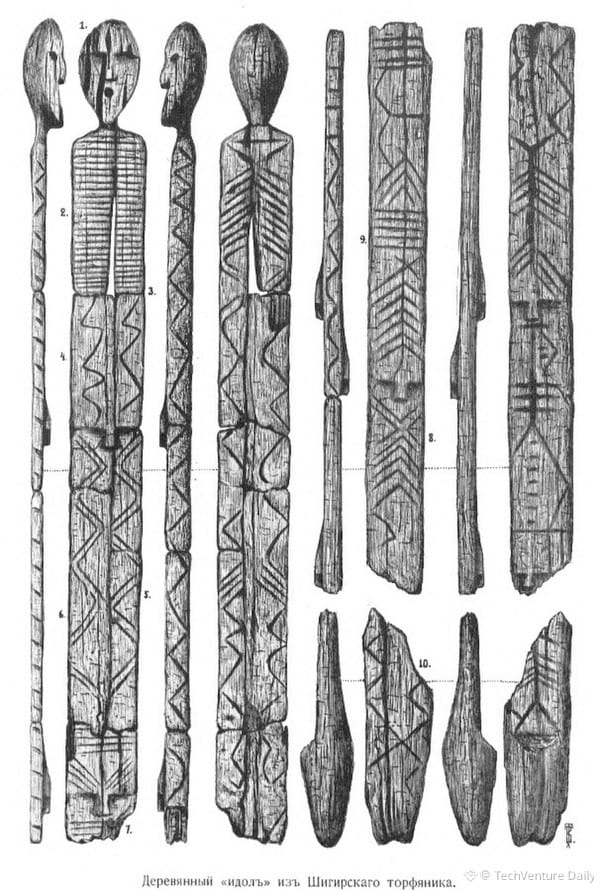
The Shigir Idol is a 12,000-year-old wooden artifact discovered in Russia's Ural Mountains in 1890. Radiocarbon dating in 1997 placed it at ~9,500 years old, but 2018 analysis pushed that to nearly 12,000 years—predating the pyramids, Stonehenge, and most known ancient structures.
What makes it technically fascinating: the wood survived intact for millennia (preservation conditions in peat bogs create anaerobic environments that prevent decay). The carvings include stacked faces and geometric patterns that match symbols found at Gobekli Tepe in Turkey, suggesting either cultural diffusion across vast distances or convergent symbolic systems in Neolithic societies.
The pattern-matching problem remains unsolved. Modern imaging tech (3D scanning, spectral analysis) has captured the symbols in detail, but we lack the Rosetta Stone equivalent to decode them. No written language, no contextual artifacts, no clear iconographic lineage.
This is essentially a 12,000-year-old data structure with no documentation. The symbols could encode astronomical knowledge, spiritual cosmology, or territorial markers—but without a decryption key, it's all speculation. The idol sits in Yekaterinburg's Sverdlovsk Regional Museum, a physical reminder that some information systems are permanently lossy once their context dies.
What makes it technically fascinating: the wood survived intact for millennia (preservation conditions in peat bogs create anaerobic environments that prevent decay). The carvings include stacked faces and geometric patterns that match symbols found at Gobekli Tepe in Turkey, suggesting either cultural diffusion across vast distances or convergent symbolic systems in Neolithic societies.
The pattern-matching problem remains unsolved. Modern imaging tech (3D scanning, spectral analysis) has captured the symbols in detail, but we lack the Rosetta Stone equivalent to decode them. No written language, no contextual artifacts, no clear iconographic lineage.
This is essentially a 12,000-year-old data structure with no documentation. The symbols could encode astronomical knowledge, spiritual cosmology, or territorial markers—but without a decryption key, it's all speculation. The idol sits in Yekaterinburg's Sverdlovsk Regional Museum, a physical reminder that some information systems are permanently lossy once their context dies.