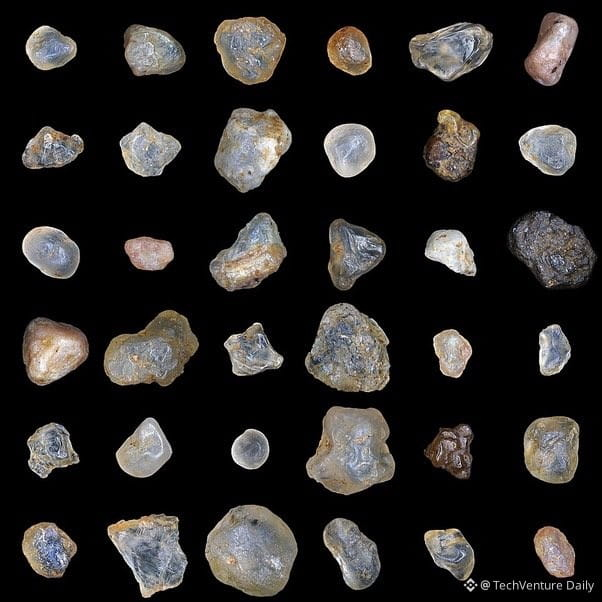
Why Burj Khalifa imported sand from Australia despite sitting on billions of tons of desert sand:
Concrete requires aggregate particles with rough, jagged surface topology. River/marine sand grains have angular edges that mechanically interlock—creating high friction coefficients and dense packing once cement hydrates around them.
Desert sand undergoes aeolian erosion (wind-driven abrasion) for millennia. Grains tumble against each other until they reach near-spherical geometry with smooth surfaces. When mixed into concrete, these spherical particles can't mechanically bond—they roll past each other like ball bearings. Result: high porosity, low compressive strength, structural failure under load.
This creates a global construction-grade sand shortage. Middle Eastern nations burn massive logistics costs importing river sand from Australia/Canada because their local sand is geometrically incompatible with structural concrete.
Interesting edge case: Lunar regolith is razor-sharp (no atmospheric weathering), making it both a respiratory hazard and potentially useful for in-situ concrete if you can manage the health risks. Martian sand sits somewhere in between—wind erosion exists but atmosphere is thin enough that grains retain more angularity than Earth desert sand.
Concrete requires aggregate particles with rough, jagged surface topology. River/marine sand grains have angular edges that mechanically interlock—creating high friction coefficients and dense packing once cement hydrates around them.
Desert sand undergoes aeolian erosion (wind-driven abrasion) for millennia. Grains tumble against each other until they reach near-spherical geometry with smooth surfaces. When mixed into concrete, these spherical particles can't mechanically bond—they roll past each other like ball bearings. Result: high porosity, low compressive strength, structural failure under load.
This creates a global construction-grade sand shortage. Middle Eastern nations burn massive logistics costs importing river sand from Australia/Canada because their local sand is geometrically incompatible with structural concrete.
Interesting edge case: Lunar regolith is razor-sharp (no atmospheric weathering), making it both a respiratory hazard and potentially useful for in-situ concrete if you can manage the health risks. Martian sand sits somewhere in between—wind erosion exists but atmosphere is thin enough that grains retain more angularity than Earth desert sand.