I was looking at Binance’s BNCB collateral announcement and one detail felt more important than the listing itself: who actually decides what BNCB is worth as collateral?
I initially assumed Binance would simply use $BNCB ’s live market price. But the collateral system uses a separate index.
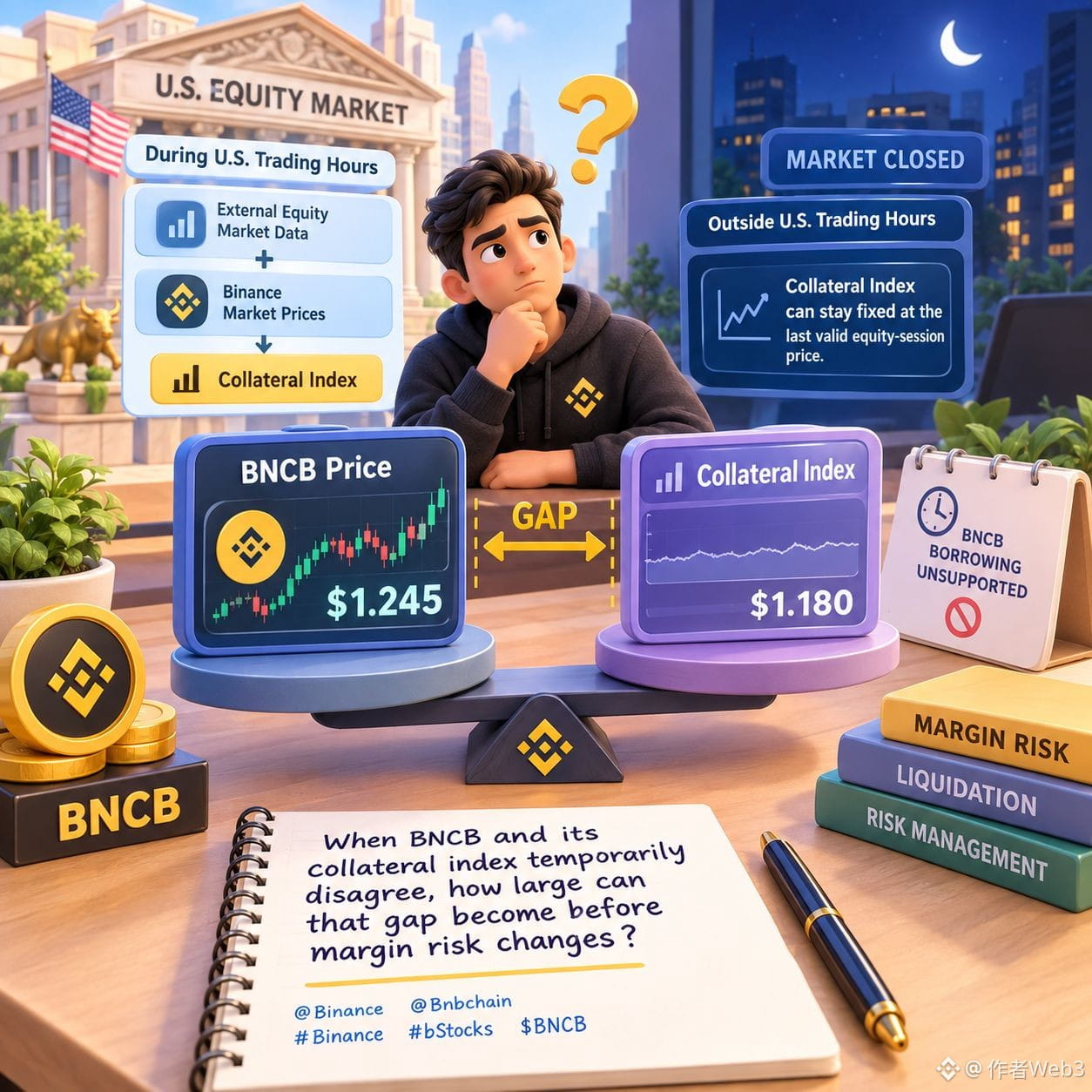
During U.S. equity trading hours, Binance combines external equity-market data with Binance market prices. When those markets are closed, the index can stay fixed at the last valid equity-session price.
That creates an unusual timing dependency.
BNCB can trade while the underlying equity market is closed. If sentiment moves sharply overnight, the token can react before the collateral index fully catches up.
That matters because collateral valuation directly affects margin risk.
The design has a clear mechanism for non-trading hours, and borrowing is currently unsupported.
So my question is simple: when $BNCB and its collateral index temporarily disagree, how large can that gap become before margin risk changes?
@Binance Global Türkçe @BNB Chain #Binance #BStocks $BNCB
I initially assumed Binance would simply use $BNCB ’s live market price. But the collateral system uses a separate index.
During U.S. equity trading hours, Binance combines external equity-market data with Binance market prices. When those markets are closed, the index can stay fixed at the last valid equity-session price.
That creates an unusual timing dependency.
BNCB can trade while the underlying equity market is closed. If sentiment moves sharply overnight, the token can react before the collateral index fully catches up.
That matters because collateral valuation directly affects margin risk.
The design has a clear mechanism for non-trading hours, and borrowing is currently unsupported.
So my question is simple: when $BNCB and its collateral index temporarily disagree, how large can that gap become before margin risk changes?
@Binance Global Türkçe @BNB Chain #Binance #BStocks $BNCB