
The crypto market is entering the September 16 Federal Reserve decision with a surprisingly important shift taking place underneath the surface.
Bitcoin is losing ETF money while Ethereum is attracting it.
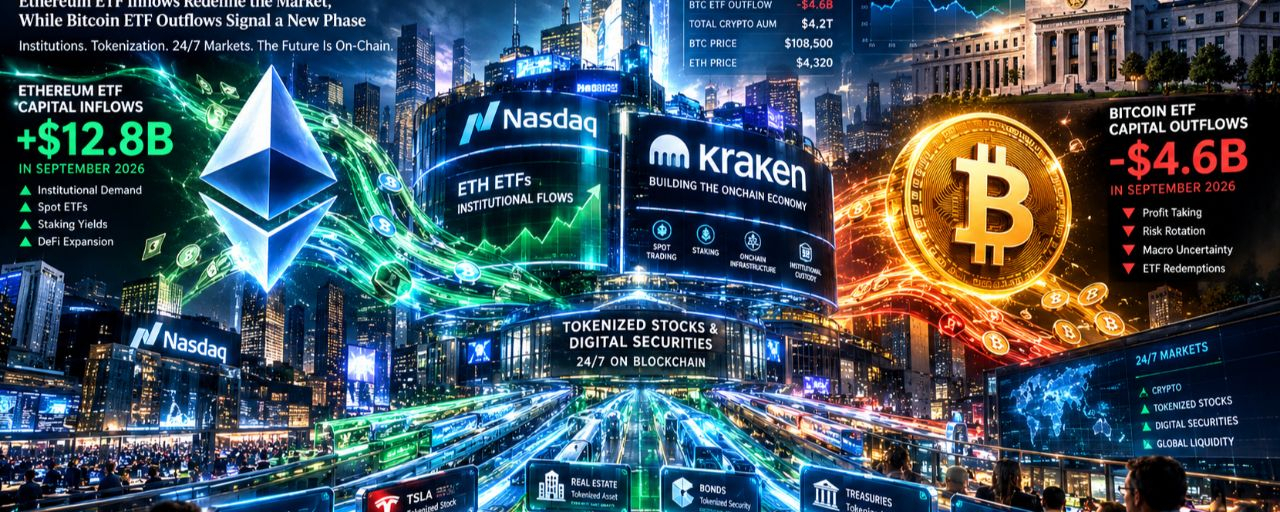
On Friday, September 11, U.S. spot Ethereum ETFs recorded approximately $216 million in net inflows, while spot Bitcoin ETFs recorded a $13.29 million net outflow, marking Bitcoin's fourth consecutive day of ETF redemptions. XRP ETFs recorded zero net flow on the same session.
That divergence matters.
Bitcoin remains the dominant institutional crypto asset, but investors are increasingly looking beyond BTC toward Ethereum, tokenization infrastructure and specialized blockchain applications.
At the same time, the macro environment is becoming more difficult.
1. Inflation Is Changing the Fed Story
The Federal Reserve's September 16 meeting has become the biggest short-term catalyst for crypto.
U.S. consumer prices increased 0.4% in August, taking annual inflation to 3.4%. Core CPI also increased 0.3% during the month and remained at 2.4% year over year. The hotter inflation numbers, combined with strong producer-price data and oil prices above $100, have increased expectations that the Federal Reserve could raise interest rates.
That is not an ideal environment for speculative assets.
Higher interest rates increase the opportunity cost of holding assets that do not generate traditional income, while tighter financial conditions can reduce liquidity flowing into risk markets.
Bitcoin has consequently been volatile.
Recent market data put BTC in roughly the $76,000–$82,000 range, with CryptoQuant analysts highlighting $81,700 as an important level for confirming a stronger bullish structure.
The next Fed decision could therefore determine whether the market attempts another breakout or enters a deeper consolidation phase.
2. Ethereum Is Showing Institutional Strength
Against that backdrop, Ethereum's ETF performance is particularly interesting.
The $216 million of net inflows on September 11 arrived while Bitcoin ETFs were recording their fourth consecutive day of outflows.
Ethereum's institutional story has been strengthening because ETH increasingly represents more than simply another cryptocurrency.
It is becoming a proxy for the growth of tokenized assets, stablecoins, decentralized finance and blockchain-based financial infrastructure.
Reuters recently noted that Ether had already completed a 37% rally over 10 days, reaching approximately $2,564 before entering consolidation.
That strength suggests institutions are not abandoning crypto altogether.
Instead, some capital may be rotating between different digital-asset narratives.
3. Bitcoin ETF Outflows Do Not Mean Institutional Adoption Is Over
It would be wrong to interpret several days of Bitcoin ETF outflows as the end of institutional demand.
Bitcoin ETFs had a very strong August, and September has simply introduced a different environment.
The important question is whether investors are temporarily reducing exposure because of the Fed and inflation—or permanently changing their allocation preferences.
The answer is not yet clear.
Bitcoin remains the largest and most liquid digital asset, and its institutional infrastructure is far more developed than most altcoins.
But the recent ETF data shows that investors now have more choices.
Ethereum ETFs, Solana products and other crypto investment vehicles can absorb capital that previously had fewer destinations.
This is one reason the next stage of the market could become much more fragmented.
4. Tokenization Is Becoming a Major Institutional Theme
The broader institutional story extends beyond ETFs.
Nasdaq's recent $100 million investment in Payward, the parent company of Kraken, is one of the clearest examples.
The partnership is designed around tokenized equities, 24/7 markets and infrastructure connecting regulated financial markets with blockchain-based trading. Nasdaq has said its proposed equity-token system is targeting launch in the second quarter of 2027.
That is important because tokenization could eventually change how traditional securities are issued, traded and settled.
Instead of financial institutions treating blockchain as an alternative investment playground, they are increasingly treating it as potential market infrastructure.
That is a much bigger shift.
5. Altcoins Are Splitting Into Specialized Narratives
The altcoin market is increasingly divided into individual themes.
PENDLE is positioned around DeFi yield markets and has expanded onto Robinhood Chain. Additional yield markets are scheduled to become available through Robinhood Crypto later this month.
Stacks is targeting Bitcoin-native DeFi, with its Bitcoin Staking upgrade receiving 99% governance support and STX benefiting from renewed BTCFi interest.
Polkadot is showing renewed activity after recovering above $1, while its ETF recently attracted $663,057 after a three-month dry spell.
Avalanche continues to build blockchain infrastructure despite AVAX trading near $7.40 and facing pressure from higher borrowing costs in its DeFi ecosystem.
And Render is once again attracting attention as the AI and decentralized-computing narrative returns to the crypto market. RENDER is around $1.38 and has recently shown signs of technical recovery.
These projects are not competing for exactly the same capital.
Each represents a different thesis.
Outlook: September Could Decide the Next Market Direction
The coming week could be one of the most important periods of September.
The Federal Reserve decision on September 16 will determine how markets interpret the latest inflation data.
If policymakers become more hawkish, Bitcoin and high-beta altcoins could remain under pressure.
If markets interpret the Fed decision as less aggressive than feared, the recent Ethereum ETF inflows could become an important signal that institutional capital is ready to rotate back into crypto.
The other major trend is tokenization.
Nasdaq's partnership with Kraken demonstrates that traditional financial institutions are not waiting for crypto markets to mature on their own.
They are actively building the infrastructure themselves.
That could eventually matter more than any individual coin's weekly price chart.
Closing Thought
September 13 presents a crypto market at an interesting crossroads.
Bitcoin is still the industry's largest institutional asset, but Ethereum is currently attracting more ETF capital, while specialized networks such as Stacks, Pendle, Polkadot, Avalanche and Render are developing their own narratives.
Meanwhile, Nasdaq and Kraken are working toward a future in which tokenized equities could trade across blockchain-based infrastructure.
The next phase of crypto may therefore be less about one coin dominating the market.
It could be about different blockchains becoming financial infrastructure for different parts of the global economy.
The Fed may determine the direction of prices this week.
But tokenization, DeFi, Bitcoin-native finance and decentralized computing may determine where the industry goes next.
Financial disclaimer: This article is for informational and educational purposes only and is not financial, investment, trading or legal advice. Cryptocurrency markets are highly volatile, and prices can change rapidly. Always conduct your own research and consider your own risk tolerance before making investment decisions.
#SECReceivesGrayscaleLitecoinTrustETFFiling #ClarityActFacesProceduralVoteSept15 #US10YearTreasuryYieldNears5% #CryptoLiquidations$674MIn24H #RevolutConfirmsFakeGovEmailDataBreach