


#cpiwatch - CPI TRIGGER RATE HIKE? U.S. INFLATION PUTS THE FEDERAL RESERVE AT A CRITICAL CROSSROADS
ThinkPositiveGlobal | PositiveMindsGlobalResults
Saturday, September 12, 2026
U.S. CPI Changes the Rate-Hike Debate
The U.S. inflation picture has delivered another warning to financial markets.
August Consumer Price Index data showed that inflation remains considerably above the Federal Reserve's 2% objective, while the monthly increase in core inflation was stronger than economists expected. The report has sharply increased expectations that the Federal Reserve could raise interest rates at its September 15–16 policy meeting.
The central question for investors is no longer simply whether inflation is falling.
The more important question is:
Is inflation falling quickly enough for the Federal Reserve to remain on hold?
The latest CPI report suggests the answer may be no.
U.S. consumer prices increased 0.4% month-over-month in August, accelerating from a 0.1% increase in July. On a year-over-year basis, headline CPI increased 3.4%, unchanged from July and above the roughly 3.3% economists had expected.
More importantly for monetary policy, core CPI increased 0.3% month-over-month, accelerating from 0.2% in July. Core CPI was up 2.4% year-over-year, down slightly from July's 2.5%.
That combination creates a complicated picture for the Fed:
Annual core inflation is moving in the right direction, but the monthly momentum has become less encouraging.
And that distinction could be critical.
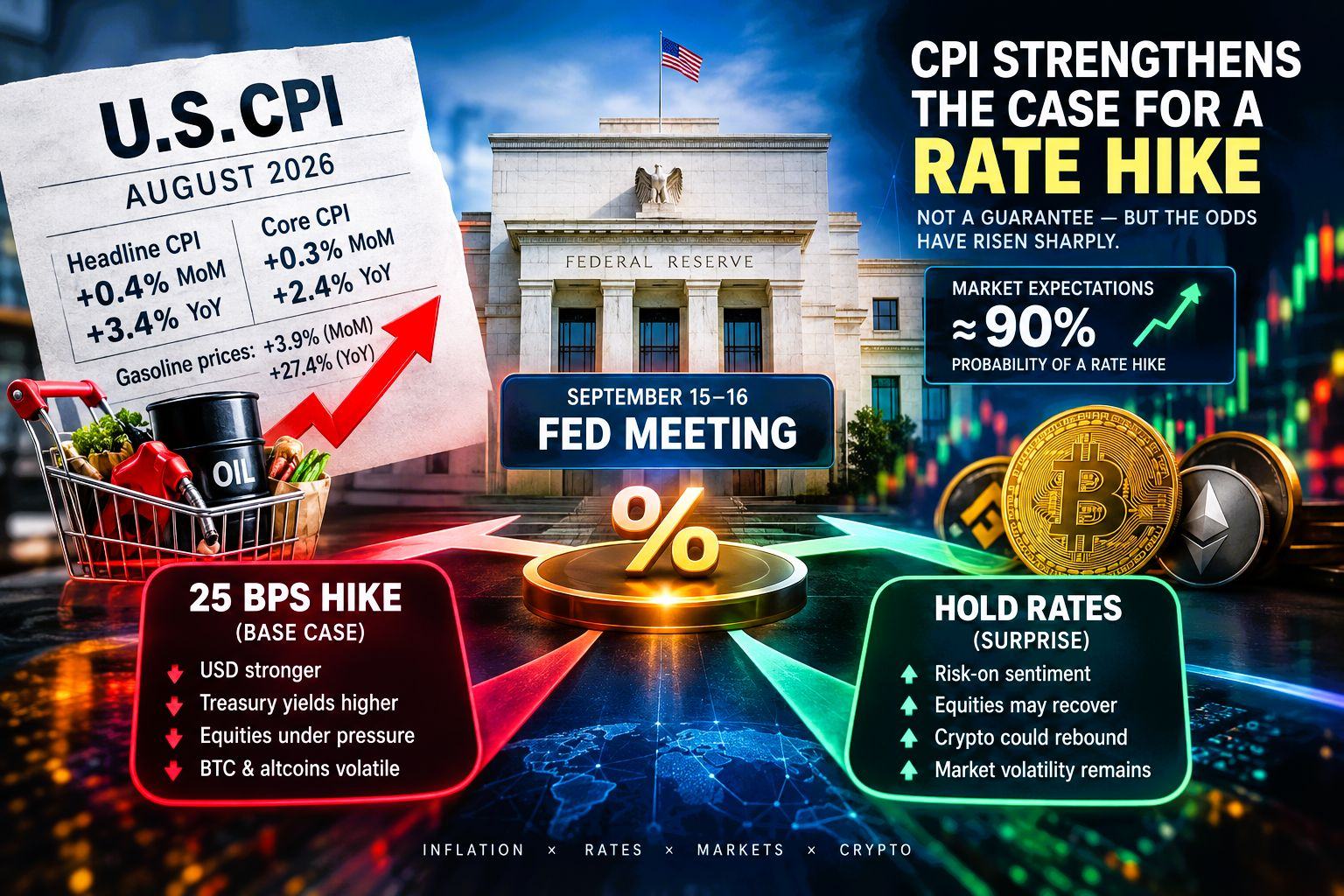
THE NUMBERS THAT MATTER
The August CPI report can be summarized as follows:
Headline CPI: +0.4% MoM
Headline CPI: +3.4% YoY
Core CPI: +0.3% MoM
Core CPI: +2.4% YoY
July headline CPI: +0.1% MoM
July core CPI: +0.2% MoM
U.S. gasoline prices: +3.9% in August
Gasoline prices: approximately +27.4% from a year earlier
Gasoline alone accounted for more than one-third of August's monthly CPI increase, according to the Labor Department data reported by CBS and Reuters.
At first glance, this could give the Fed an argument to look through part of the inflation increase because energy prices are volatile.
But there is a problem.
The increase was not limited entirely to energy.
Core inflation also accelerated.
That means policymakers cannot simply dismiss the entire CPI report as an oil-price story.
WHY CORE CPI MAY BE MORE IMPORTANT THAN HEADLINE CPI
Headline CPI includes food and energy.
Core CPI excludes both.
The reason economists pay close attention to core inflation is simple: energy prices can move dramatically because of geopolitical events, supply disruptions and commodity-market conditions.
Core inflation provides a better indication of whether price pressures are spreading through the broader economy.
August's 0.3% monthly core CPI increase was therefore significant.
It was higher than the 0.2% increase economists had expected and represented an acceleration from July.
The annual core rate, however, remained at 2.4%, which is the more encouraging part of the report.
This creates two competing narratives:
The bullish inflation argument
Core inflation is down to 2.4% year-over-year.
That is substantially lower than the inflation extremes experienced earlier in the decade and suggests the long-term disinflation process has not completely failed.
The bearish inflation argument
A 0.3% monthly increase is still uncomfortable when the Federal Reserve is trying to return inflation sustainably toward 2%.
If inflation continues increasing at roughly this monthly pace, annual inflation could remain above target for longer than policymakers want.
That is why the Fed faces a difficult decision.
THE FED'S 2% TARGET IS STILL THE BIG PROBLEM
The Federal Reserve's long-term inflation objective is approximately 2%.
Headline CPI at 3.4% remains substantially above that level.
Core CPI at 2.4% is closer, but still above the target.
And the Fed is not relying exclusively on CPI.
The central bank places particular importance on the Personal Consumption Expenditures price index, especially core PCE, when assessing underlying inflation.
Nevertheless, CPI remains an extremely important signal for markets because it provides a timely picture of consumer-price pressures.
The latest data therefore creates an uncomfortable situation:
Inflation has improved significantly from its previous highs, but it has not yet been defeated.
For the Fed, that distinction matters enormously.
WHY A RATE HIKE IS NOW BACK ON THE TABLE
The Federal Reserve has maintained its benchmark interest-rate target at approximately 3.5%–3.75% since December 2025.
A September increase would take the target range to approximately:
3.75%–4.00%
That would represent a 25-basis-point rate hike.
Following the CPI release, financial-market pricing moved sharply toward a September increase.
Market expectations rose to around 90% for a hike according to CME FedWatch-related reporting, compared with approximately 70% before the CPI release. Other market estimates put the probability somewhat lower, but all point toward a substantially higher probability than before the report.
This is important because financial markets do not wait for the Fed announcement.
They price expectations in advance.
If traders believe the Fed is likely to hike, Treasury yields, the U.S. dollar, equities, commodities and cryptocurrencies can begin adjusting before policymakers actually vote.
WHY OIL COULD MAKE THE FED'S JOB EVEN HARDER
The inflation story is becoming increasingly complicated because energy markets are adding another layer of pressure.
Oil prices have moved above $100 per barrel, with geopolitical tensions surrounding the Middle East creating significant uncertainty around energy supplies and transportation routes.
Higher crude prices can affect inflation through several channels:
Crude oil → gasoline → transportation → logistics → production costs → consumer prices
The impact therefore does not necessarily stop at the gas station.
Higher transportation costs can eventually affect food distribution, manufacturing, airline tickets, shipping, construction and a wide range of consumer services.
Reuters reported that gasoline prices rose 3.9% in August, while broader energy prices also increased.
The biggest risk for the Federal Reserve is therefore not necessarily a temporary increase in gasoline prices.
The real danger is second-round inflation.
If businesses begin passing higher energy and transportation costs to consumers, inflation could become more persistent.
THE FED'S BIGGEST FEAR: INFLATION EXPECTATIONS
Central banks worry about something more dangerous than a temporary price shock.
They worry about consumers and businesses beginning to expect permanently higher prices.
Imagine a situation where:
workers demand higher wages because they expect prices to rise;
businesses increase prices because they expect higher wages;
consumers accelerate purchases because they expect prices to rise further;
companies increase investment and inventories because they expect costs to rise.
That can create an inflationary feedback loop.
The Federal Reserve wants to prevent such expectations from becoming entrenched.
That is one reason policymakers may prefer to act early rather than wait until inflation becomes much harder to control.
THIS IS NOT NECESSARILY A "HAWKISH CPI" IN EVERY RESPECT
There is an important nuance that investors should not ignore.
The August report was not uniformly bad.
The annual core CPI rate actually declined to 2.4%, down from 2.5% in July.
That means underlying inflation has continued to improve over a longer time horizon.
The problem is the monthly acceleration.
Therefore, describing the report simply as "inflation exploded" would be inaccurate.
A better description is:
Inflation remains stubbornly above target, while the latest monthly core reading showed renewed momentum.
That is precisely the kind of data that can shift a central bank from "wait and see" toward "preventative tightening."
WHAT A 25-BASIS-POINT HIKE WOULD MEAN
If the Fed raises rates by 25 basis points, the immediate market reaction could be surprisingly complicated.
Why?
Because markets respond not only to the decision itself, but also to what the Fed says about future policy.
A 25-basis-point hike that was already priced into markets may produce a relatively limited reaction.
However, a hike accompanied by a strongly hawkish message could create a much larger move.
For example:
Fed hikes 25 bps + signals another hike → USD stronger, yields higher, risk assets pressured
But:
Fed hikes 25 bps + signals this may be a one-time adjustment → markets could stabilize
This distinction will be critical.
WHAT HAPPENS TO THE U.S. DOLLAR?
A rate hike generally supports the U.S. dollar because higher U.S. interest rates can make dollar-denominated assets more attractive.
A stronger dollar can have major global consequences.
For cryptocurrency markets, the relationship can become particularly important.
A stronger dollar can reduce the relative attractiveness of risk assets and tighten global financial conditions.
That does not mean:
Fed hike = Bitcoin automatically falls.
Markets are more complicated than that.
But if the rate hike produces:
Higher yields + stronger dollar + tighter liquidity + lower risk appetite
then the environment becomes more challenging for speculative assets.
WHAT HAPPENS TO TREASURY YIELDS?
Treasury yields could be one of the most important indicators to watch.
If investors believe inflation will remain elevated, they may demand higher yields to compensate for the erosion of purchasing power.
That can increase borrowing costs throughout the economy.
Higher Treasury yields can affect:
mortgages
corporate borrowing
government financing
equity valuations
technology stocks
emerging markets
cryptocurrency valuations
The 10-year Treasury yield is therefore particularly important.
If the 10-year yield rises aggressively following the Fed decision, risk assets could face additional pressure even if the Fed only raises rates by 25 basis points.
WHAT DOES THIS MEAN FOR STOCK MARKETS?
Equity markets face a difficult combination.
On one side, strong economic activity can support corporate earnings.
On the other side, higher interest rates can reduce the valuation investors are willing to pay for future earnings.
This is particularly relevant for high-growth technology companies.
When interest rates rise, future cash flows are discounted at a higher rate.
That can put pressure on high-valuation technology and growth stocks.
If Treasury yields rise sharply at the same time, investors may rotate toward defensive sectors, cash and fixed-income assets.
Therefore, the CPI report could influence not only the Fed but also the broader risk appetite across Wall Street.
AND THEN THERE IS CRYPTO
For cryptocurrency investors, the September Fed meeting could become one of the most important macroeconomic events of the month.
Bitcoin, Ethereum, BNB and other digital assets remain highly sensitive to changes in liquidity and investor risk appetite.
A hawkish Fed could create the following chain reaction:
Hot CPI
↓
Higher probability of rate hike
↓
Higher Treasury yields
↓
Stronger U.S. dollar
↓
Tighter financial conditions
↓
Lower risk appetite
↓
Pressure on BTC and altcoins
However, markets can also react in the opposite direction if the Fed's decision is already fully priced in.
That is why traders should not simply assume:
"Rate hike = crypto crash."
The real question is:
What did the market already price in?
BITCOIN: THE CRITICAL TEST
Bitcoin could become the first major indicator of whether markets interpret the Fed decision as aggressively hawkish or merely moderately restrictive.
If Bitcoin holds important technical support despite a 25-basis-point hike, investors could interpret that resilience as evidence that the tightening cycle is already largely priced into the market.
But if Bitcoin breaks major support while Treasury yields and the dollar rise simultaneously, the move could accelerate.
The most dangerous environment for crypto would be:
Hawkish Fed + rising oil + rising Treasury yields + stronger dollar + falling equities.
That combination could produce a broad risk-off move.
BNB AND ALTCOINS COULD EXPERIENCE GREATER VOLATILITY
BNB and other large-cap altcoins can be more sensitive to changes in risk appetite than Bitcoin.
When liquidity conditions deteriorate, capital often moves first toward cash and defensive assets.
Within crypto, investors may then reduce exposure to smaller or higher-beta assets before Bitcoin.
This creates a potential sequence:
Altcoins weaken → BNB/Ethereum weaken → Bitcoin tests support → market seeks liquidity
But the opposite can also occur if the Fed's decision removes uncertainty.
If investors conclude that the September hike represents the peak of the tightening cycle, risk assets could recover rapidly.
THREE POSSIBLE FED SCENARIOS
SCENARIO 1 — 25-BPS HIKE + HAWKISH MESSAGE
Probability: Elevated
The Fed raises rates to approximately 3.75%–4.00% and signals that inflation remains too high to declare victory.
This would likely be the most challenging scenario for risk assets.
Potential market reaction:
USD ↑
Treasury yields ↑
Equities ↓
BTC pressure ↓
Altcoin volatility ↑
Gold potentially supported by inflation/geopolitical concerns
If policymakers signal another hike could follow, markets could price additional tightening into late 2026 or early 2027.
SCENARIO 2 — 25-BPS HIKE + DOVISH GUIDANCE
The Fed raises rates but communicates that policymakers believe inflation will gradually decline.
This could produce an entirely different market reaction.
The initial headline may look bearish:
"Fed hikes rates."
But traders could focus on the forward guidance.
If the Fed suggests that September represents a final adjustment rather than the beginning of another tightening cycle, markets could interpret the decision as manageable.
Under this scenario:
Dollar: potentially mixed
Treasury yields: could stabilize
Equities: potentially recover
Bitcoin: could rebound
BNB and altcoins: potentially outperform if liquidity expectations improve
SCENARIO 3 — FED HOLDS RATES
This would likely surprise markets given the sharp increase in rate-hike expectations following the CPI release.
A hold could initially trigger a relief rally in risk assets.
But there is another side to the story.
If the Fed refuses to hike despite persistent inflation, Treasury markets could react negatively if investors believe policymakers are falling behind the inflation curve.
That could create an unusual situation where:
Fed holds → stocks initially rise → Treasury yields rise → dollar strengthens → risk assets reverse
Therefore, even a rate hold would not automatically guarantee a crypto rally.
THE MOST IMPORTANT WORD: "EXPECTATIONS"
Markets move on expectations.
If investors expected a 25-basis-point hike and the Fed delivers exactly that, the move may already be priced in.
The bigger reaction could come from the dot plot, economic projections, press conference and forward guidance.
Investors will want answers to several questions:
Does the Fed expect inflation to decline?
Does the Fed expect another hike later in 2026?
How does the committee assess oil-price inflation?
Is the labor market deteriorating?
Has the neutral interest-rate estimate changed?
How concerned are policymakers about inflation expectations?
Does the Fed believe the economy can withstand tighter financial conditions?
Those answers could matter more than the 25-basis-point decision itself.
WHY THE SEPTEMBER DECISION IS DIFFERENT
This could become an especially important policy meeting because a September hike would represent the first Federal Reserve rate increase since July 2023.
That makes the decision psychologically important for markets.
For more than three years, investors have largely operated under the assumption that the long-term direction of monetary policy would eventually become easier.
A renewed hiking cycle would challenge that assumption.
It would tell investors:
The Fed is willing to tighten again if inflation does not cooperate.
That message could influence markets far beyond September.
THE OIL-INFLATION-FED CONNECTION
One of the most important macroeconomic relationships to monitor now is:
Oil → Inflation → Fed → Dollar → Yields → Risk Assets
If crude oil remains above $100 per barrel for an extended period, inflation could remain elevated.
If inflation remains elevated, the Fed could maintain or increase interest rates.
Higher rates could support the dollar and Treasury yields.
Higher yields and a stronger dollar could tighten global financial conditions.
And tighter financial conditions could pressure cryptocurrencies and other risk assets.
This is why the oil market is becoming increasingly important for crypto investors.
Bitcoin may be a digital asset, but it does not exist outside the global macroeconomic system.
COULD HIGH OIL EVENTUALLY FORCE A FED PAUSE?
Yes.
There is an important paradox here.
Higher oil prices increase inflation.
But they can also reduce consumer purchasing power.
If gasoline, diesel, transportation and other essential costs rise sharply, households have less money available for discretionary spending.
That can weaken economic growth.
Therefore, the Fed must balance two competing risks:
Inflation too high
versus
Economic growth too weak
Aggressive tightening could reduce inflation but also increase recession risks.
Holding rates too low for too long could support growth but allow inflation to become entrenched.
This is the difficult balancing act facing policymakers.
WHAT INVESTORS SHOULD WATCH NEXT
The market's attention should now move beyond CPI.
1. Federal Reserve decision
The September 15–16 meeting will be the immediate catalyst.
2. Fed statement
Small changes in language can produce large market reactions.
3. Economic projections
These can reveal whether policymakers expect additional hikes.
4. Treasury yields
Especially the 2-year and 10-year yields.
5. U.S. Dollar Index
A sustained dollar rally could increase pressure on global risk assets.
6. Crude oil
If oil continues climbing, inflation expectations could remain elevated.
7. Labor-market data
The Fed cannot focus exclusively on inflation.
Employment conditions remain critical to monetary policy.
8. Core PCE
This remains particularly important for understanding the Fed's preferred inflation framework.
THE BIGGER PICTURE
The August CPI report does not mean the Federal Reserve has suddenly lost control of inflation.
Nor does it prove that a long series of rate hikes is inevitable.
Instead, it shows that the final stage of disinflation could be considerably more difficult than investors had hoped.
The United States has moved a long way from the extraordinary inflation levels seen earlier in the decade.
But getting inflation from approximately 3% toward 2% can be much harder than getting it from extremely high levels down toward 3%.
This is often called the "last mile" problem.
The latest CPI report suggests the last mile may be particularly difficult.
MARKET VERDICT
The August inflation report has clearly strengthened the case for a 25-basis-point Federal Reserve rate hike in September.
The headline CPI increase to 3.4% year-over-year, combined with a 0.3% monthly increase in core CPI, gives policymakers a strong reason to remain concerned about inflation.
Markets have consequently moved toward pricing a September hike as the base case, with some measures putting the probability near 90%.
But the real market story is bigger than one interest-rate decision.
The crucial question is whether September's hike would be:
A single inflation-control adjustment
or
the beginning of another tightening cycle.
That distinction could determine the direction of the U.S. dollar, Treasury yields, equities, Bitcoin, BNB and the wider cryptocurrency market over the coming weeks.
FINAL TAKEAWAY
CPI has not guaranteed a Fed rate hike — but it has significantly strengthened the case for one.
The headline inflation rate remains far above the Fed's 2% objective.
Core inflation is closer to target but still above it.
Monthly core inflation accelerated.
Energy prices are rising sharply.
Oil remains above $100 per barrel.
And markets are increasingly preparing for a return to tighter monetary policy.
For investors, the September Fed meeting is therefore not simply about 25 basis points.
It is about the direction of global liquidity.
If the Fed signals that inflation requires further tightening, risk assets could face another difficult period.
If the Fed delivers a hike but signals that the tightening cycle is close to an end, markets could interpret the decision very differently.
The rate decision will make the headline.
The Fed's forward guidance may make the market move.
ThinkPositiveGlobal | PositiveMindsGlobalResults
This article is for educational and informational purposes only. It is not financial, investment, trading, or tax advice. Cryptocurrency and financial markets are highly volatile. Always conduct your own research (DYOR), manage risk carefully, and consider your own financial circumstances before making any investment decision.
$
