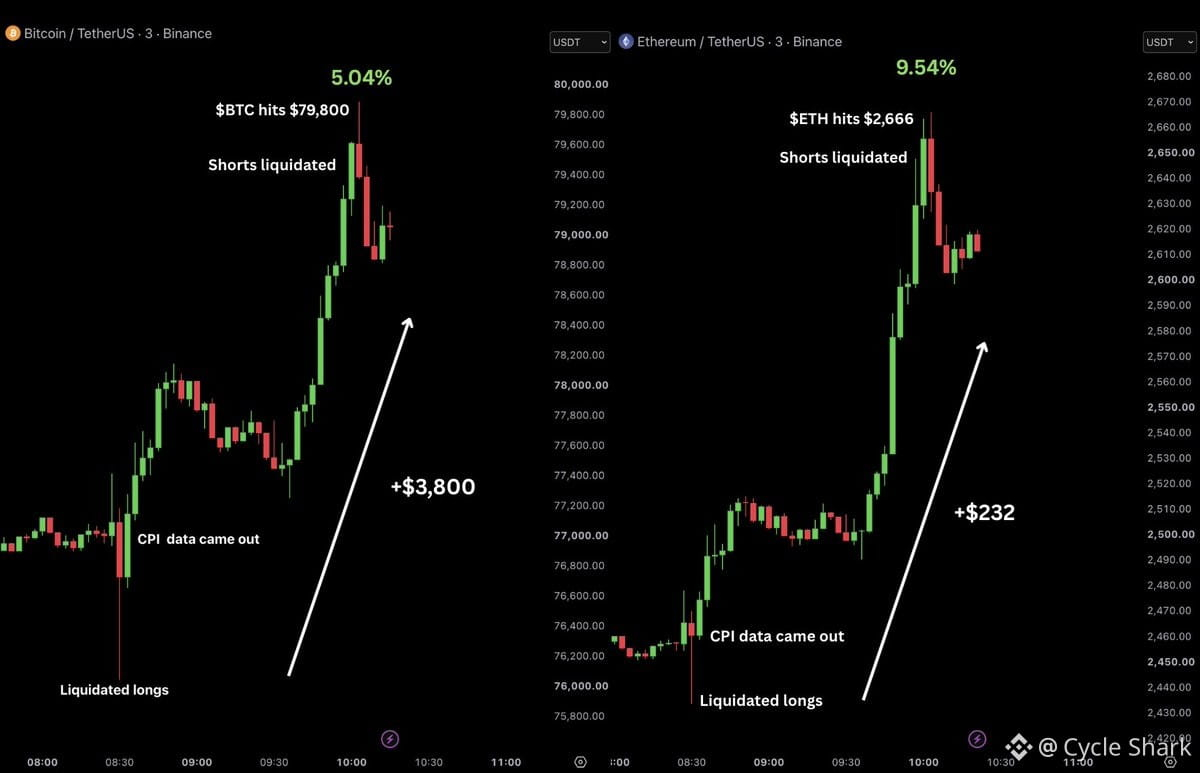
Wild price action just unfolded. $BTC dropped to $76k, $ETH hit $2,430. That move wiped out $51M in longs and $40M in shorts simultaneously — classic cascade liquidation.
Then, within an hour, complete reversal. $BTC ripped back to $79,800, $ETH bounced to $2,666. Another $188M in shorts got liquidated on the way up.
The trigger? Core CPI printed at a 5-year low. Lower inflation usually signals potential Fed rate cuts ahead, which tends to boost risk assets. But the initial dump suggests traders were positioned wrong or algos front-ran the data.
This kind of volatility isn't random — it's liquidity hunting. Market makers know where leverage sits. They push price to trigger stops, collect liquidity, then reverse. Retail gets chopped both ways.
If you're trading spot and holding through cycles, this noise doesn't matter much. But if you're levered, days like this are why position sizing and stop discipline actually matter. The macro backdrop (lower CPI) is constructive for crypto medium-term, but short-term price discovery is brutal and mechanical.
Then, within an hour, complete reversal. $BTC ripped back to $79,800, $ETH bounced to $2,666. Another $188M in shorts got liquidated on the way up.
The trigger? Core CPI printed at a 5-year low. Lower inflation usually signals potential Fed rate cuts ahead, which tends to boost risk assets. But the initial dump suggests traders were positioned wrong or algos front-ran the data.
This kind of volatility isn't random — it's liquidity hunting. Market makers know where leverage sits. They push price to trigger stops, collect liquidity, then reverse. Retail gets chopped both ways.
If you're trading spot and holding through cycles, this noise doesn't matter much. But if you're levered, days like this are why position sizing and stop discipline actually matter. The macro backdrop (lower CPI) is constructive for crypto medium-term, but short-term price discovery is brutal and mechanical.