STON.fi Pool Types Explained: Why Capital Efficiency Beats Raw TVL
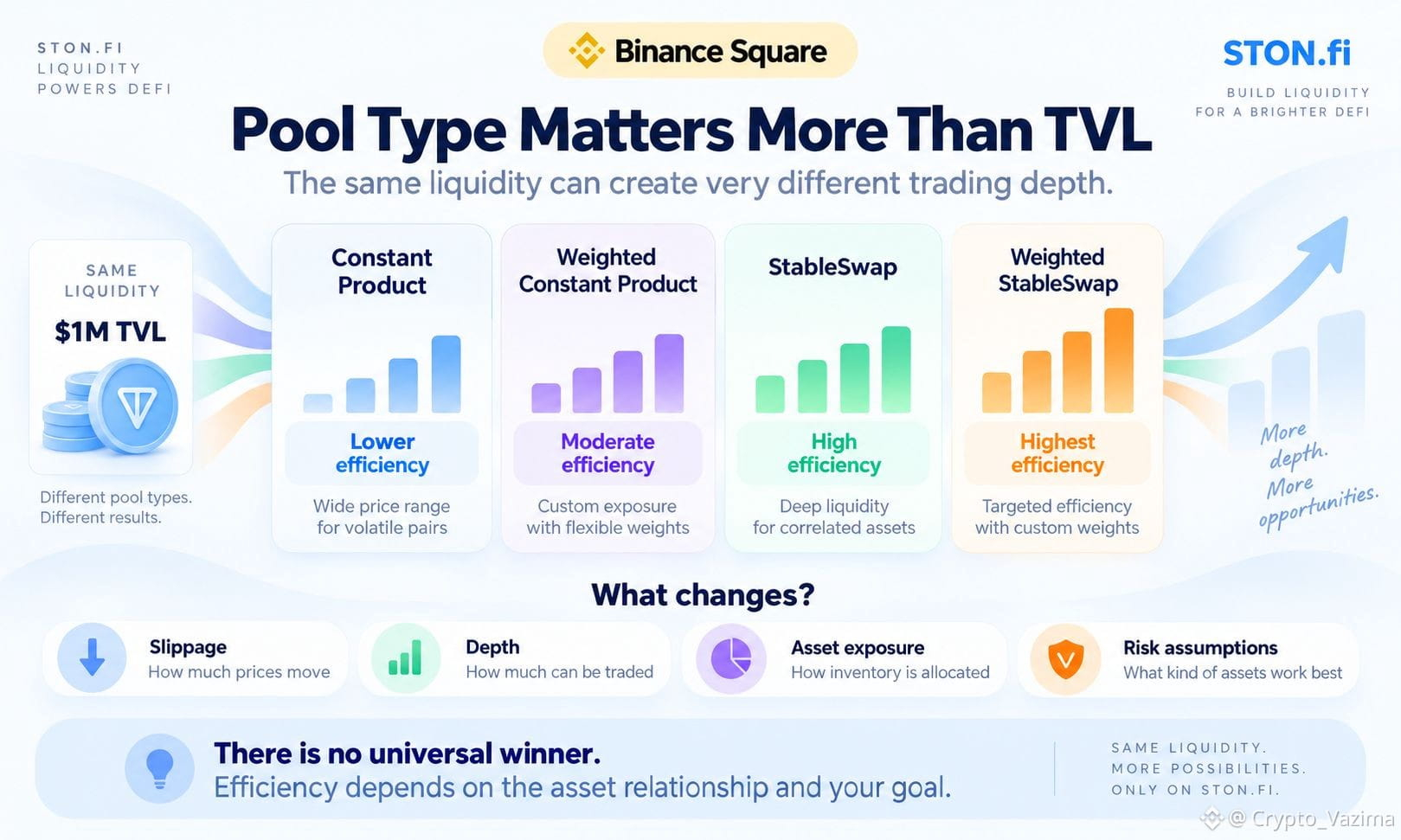
On STON.fi, capital efficiency is the usable trading capacity created by deposited liquidity, especially around prices traders actually use. Two pools with the same TVL can still give very different execution because constant product, weighted constant product, StableSwap, and weighted StableSwap place capital differently.
🔥 What Changes Across STON.fi Pool Types
- Constant product spreads reserves across a broad price range
- Weighted constant product reshapes exposure with mixes such as 75/25
- StableSwap concentrates usefulness around a stable relationship through amp
- Weighted StableSwap adds weight, rate, and a rate-setter
🚀 Why the Same Million Dollars Is Not Equal
If a $50,000 swap moves price much more in one STON.fi pool than another, the second pool is working harder at that price. StableSwap can look far deeper near a peg, while constant product looks less efficient near today because it still has to cover much wider moves.
🧠 The LP Side of Efficiency
- Weighted pools can keep more of the position in the preferred asset
- Stable designs reduce ordinary divergence only while correlation holds
- A depeg or sharp rebalance can erase the apparent depth advantage
- Fee income still needs volume, so efficiency is not a return forecast
💬 How I Would Compare STON.fi Liquidity
1. Start with the pair: volatile, pegged, or structurally linked.
2. Read the pool type before trusting the TVL headline.
3. Test expected output and impact on a realistic trade size.
4. Check amp, weights, and rate if the pool is specialized.
STON.fi v2 single-sided deposits improve deposit UX, but they do not turn a constant product curve into StableSwap depth. Judge STON.fi pools by the price region they serve.
Would a StableSwap STON.fi pool change how you read TVL on correlated pairs? 👇
Drop the STON.fi pool type you think people overrate by TVL alone.
Not investment advice - research on your own! 🚀
$GRAM @STONfi DEX
On STON.fi, capital efficiency is the usable trading capacity created by deposited liquidity, especially around prices traders actually use. Two pools with the same TVL can still give very different execution because constant product, weighted constant product, StableSwap, and weighted StableSwap place capital differently.
🔥 What Changes Across STON.fi Pool Types
- Constant product spreads reserves across a broad price range
- Weighted constant product reshapes exposure with mixes such as 75/25
- StableSwap concentrates usefulness around a stable relationship through amp
- Weighted StableSwap adds weight, rate, and a rate-setter
🚀 Why the Same Million Dollars Is Not Equal
If a $50,000 swap moves price much more in one STON.fi pool than another, the second pool is working harder at that price. StableSwap can look far deeper near a peg, while constant product looks less efficient near today because it still has to cover much wider moves.
🧠 The LP Side of Efficiency
- Weighted pools can keep more of the position in the preferred asset
- Stable designs reduce ordinary divergence only while correlation holds
- A depeg or sharp rebalance can erase the apparent depth advantage
- Fee income still needs volume, so efficiency is not a return forecast
💬 How I Would Compare STON.fi Liquidity
1. Start with the pair: volatile, pegged, or structurally linked.
2. Read the pool type before trusting the TVL headline.
3. Test expected output and impact on a realistic trade size.
4. Check amp, weights, and rate if the pool is specialized.
STON.fi v2 single-sided deposits improve deposit UX, but they do not turn a constant product curve into StableSwap depth. Judge STON.fi pools by the price region they serve.
Would a StableSwap STON.fi pool change how you read TVL on correlated pairs? 👇
Drop the STON.fi pool type you think people overrate by TVL alone.
Not investment advice - research on your own! 🚀
$GRAM @STONfi DEX