


AI agents are becoming much more than chatbots.
They can browse the web, use tools, execute workflows, interact with applications and operate continuously on our behalf. But as their capabilities grow, so does the risk of giving an AI too much access to our digital lives.
That is what made @NEAR Protocol 's IronClaw 1.0 interesting to me.
Why Build IronClaw?
One of the motivations came from the security concerns surrounding OpenClaw.
NEAR co-founder Illia Polosukhin publicly warned about users losing funds and credentials while using OpenClaw and explained that the team started building a security-focused version.
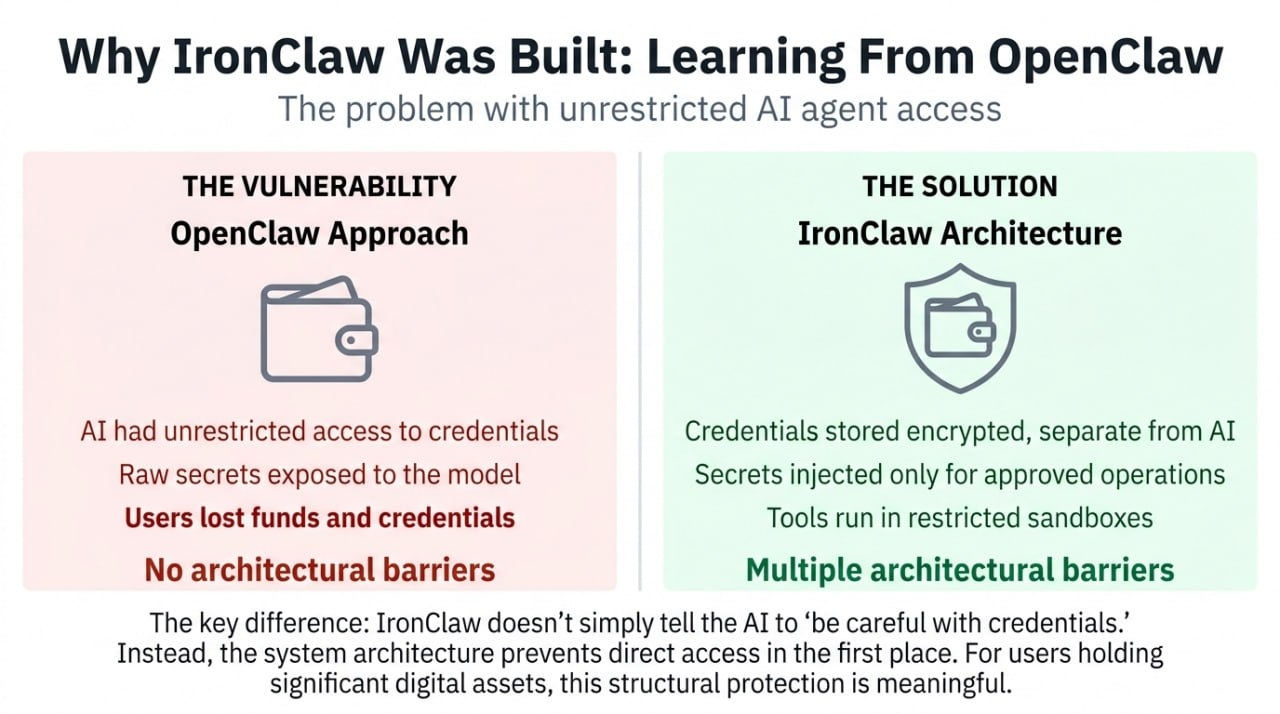
The philosophy behind IronClaw is therefore different from simply telling an AI model to behave responsibly.
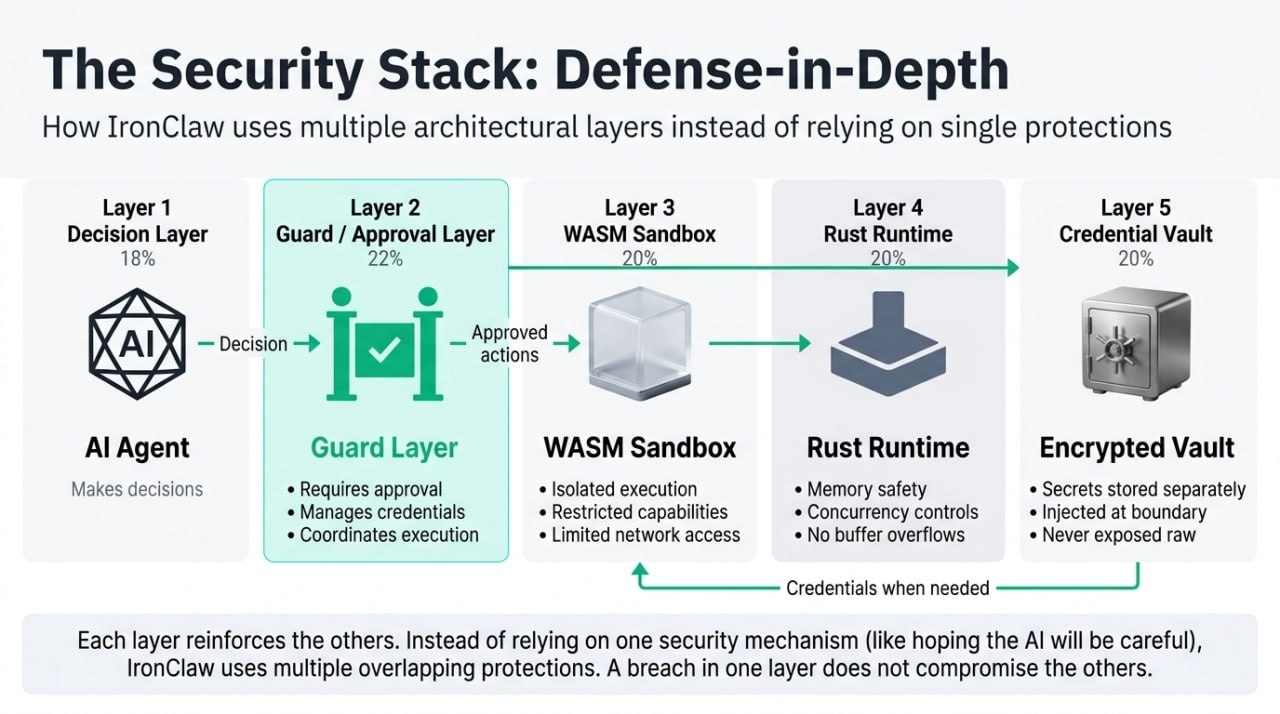
The system separates decision-making from execution.
A security and coordination layer—the guard—sits between the AI and the tools it wants to use. Sensitive operations can require approval, while tools operate inside restricted environments instead of receiving unrestricted access to the host system.
That distinction is important.
An instruction saying “don't leak my credentials” is only a request.
A system architecture that prevents the AI from directly accessing those credentials is an actual security boundary.
The Numbers Are Interesting Too
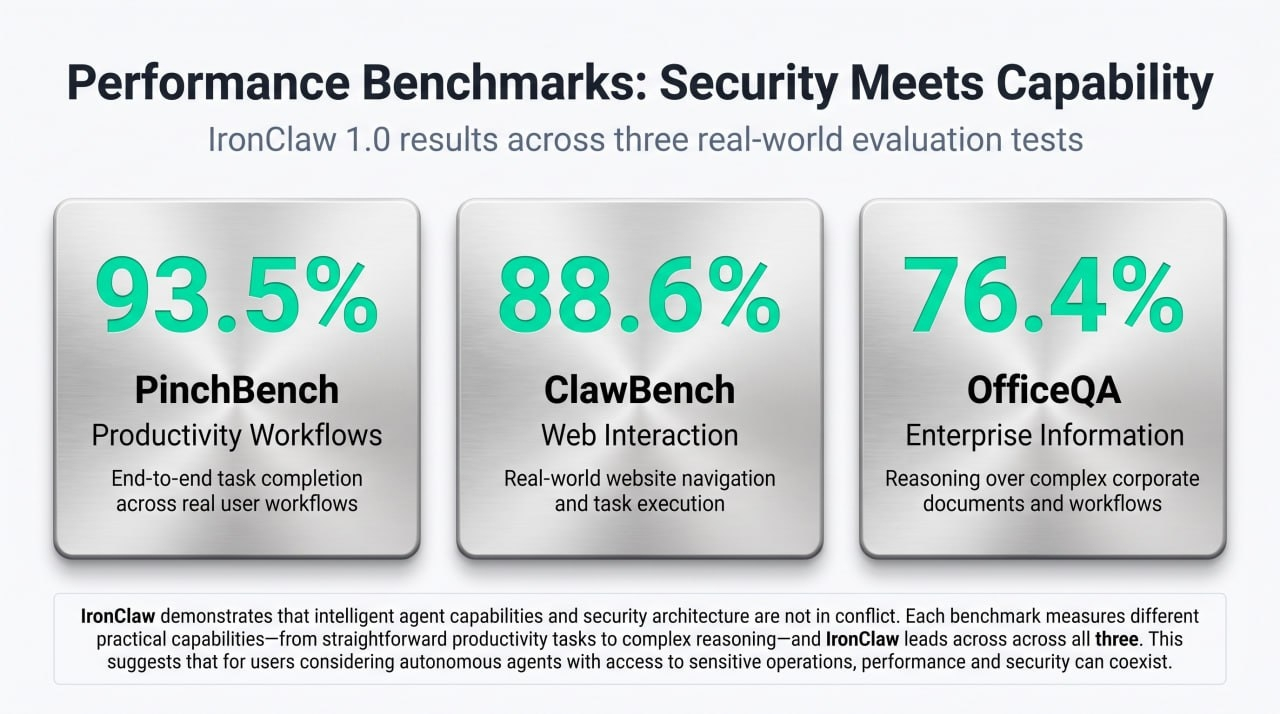
IronClaw 1.0 reported strong results using the same DeepSeek-V4-Flash base model in its benchmark comparisons:
93.5% on PinchBench
88.6% on ClawBench
76.4% on OfficeQA
These benchmarks test different aspects of real agent performance, including productivity workflows, web interaction and complex enterprise information.
So the question isn't simply whether the model can produce an intelligent response.
It is whether the agent can actually complete useful work.
How Does It Protect Users?
While researching IronClaw, one detail particularly caught my attention: the AI doesn't simply receive your raw credentials whenever it needs to use a service.
IronClaw uses encrypted credential storage and can inject credentials at the host boundary for approved operations, reducing the need to expose the actual secret to the model or sandboxed tool.
Its tools can also operate inside isolated WebAssembly environments with restricted capabilities and network access.
IronClaw was built in Rust, which adds another important layer. Rust's memory-safety guarantees help prevent entire classes of vulnerabilities, while its concurrency model is useful for a system handling multiple tools and tasks.
Cointelegraph also noted that the relatively less familiar Rust implementation could have a smaller familiarity-based attack surface compared with heavily targeted JavaScript environments.
Rust doesn't make software impossible to hack.
The important point is that IronClaw combines several defenses rather than relying on one feature.
It Doesn't Forget the Work
Another feature I found practical is continuous checkpointing.
If a long-running task is interrupted, IronClaw can resume from saved progress rather than starting everything again from zero.
It also supports multiple interfaces including CLI, Web, Slack and Telegram, while maintaining shared state and memory.
That makes it feel less like a chatbot and more like infrastructure for an always-on digital worker.
Where NEAR AI and Staking Come In
This is where the broader NEAR AI vision becomes interesting.
NEAR AI is building infrastructure around private and user-oriented AI, including confidential computing environments designed to protect sensitive workloads.
Its staking model now allows users to stake NEAR to access confidential AI inference and IronClaw agent hosting, while the underlying stake remains owned by the user.
For me, this connects two ideas that are often discussed separately:
ownership and AI infrastructure.
Instead of AI simply being another centralized service you pay for, NEAR AI is experimenting with an economic model where your on-chain stake can become the basis for accessing the AI infrastructure you use.
That doesn't eliminate every risk, but it represents an interesting direction for decentralized #Aİ .
The bigger question now is not only:
“How intelligent can AI become?”
It is:
“How safely can AI act on our behalf?”
And that may be the question that ultimately determines which autonomous AI systems we are willing to trust.
What would you allow an AI agent to control today, and what would still be completely off limits?
For more breakdowns, follow my X thread and view my LinkedIn article link in the thread. https://x.com/Damola_020/status/2093992179358142590
References
NEAR AI — Introducing IronClaw 1.0 (https://near.ai/blog/introducing-ironclaw-1-0)
NEAR AI — Staking for NEAR AI (https://www.near.ai/blog/staking-for-near-ai)
IronClaw — Official GitHub Repository (https://github.com/nearai/ironclaw)
Cointelegraph — IronClaw and the OpenClaw security problem (https://magazine.cointelegraph.com/ironclaw-secure-private-sounds-cooler-openclaw-ai-eye/)
Illia Polosukhin — LinkedIn (https://www.linkedin.com/in/illia-polosukhin-77b6538/)