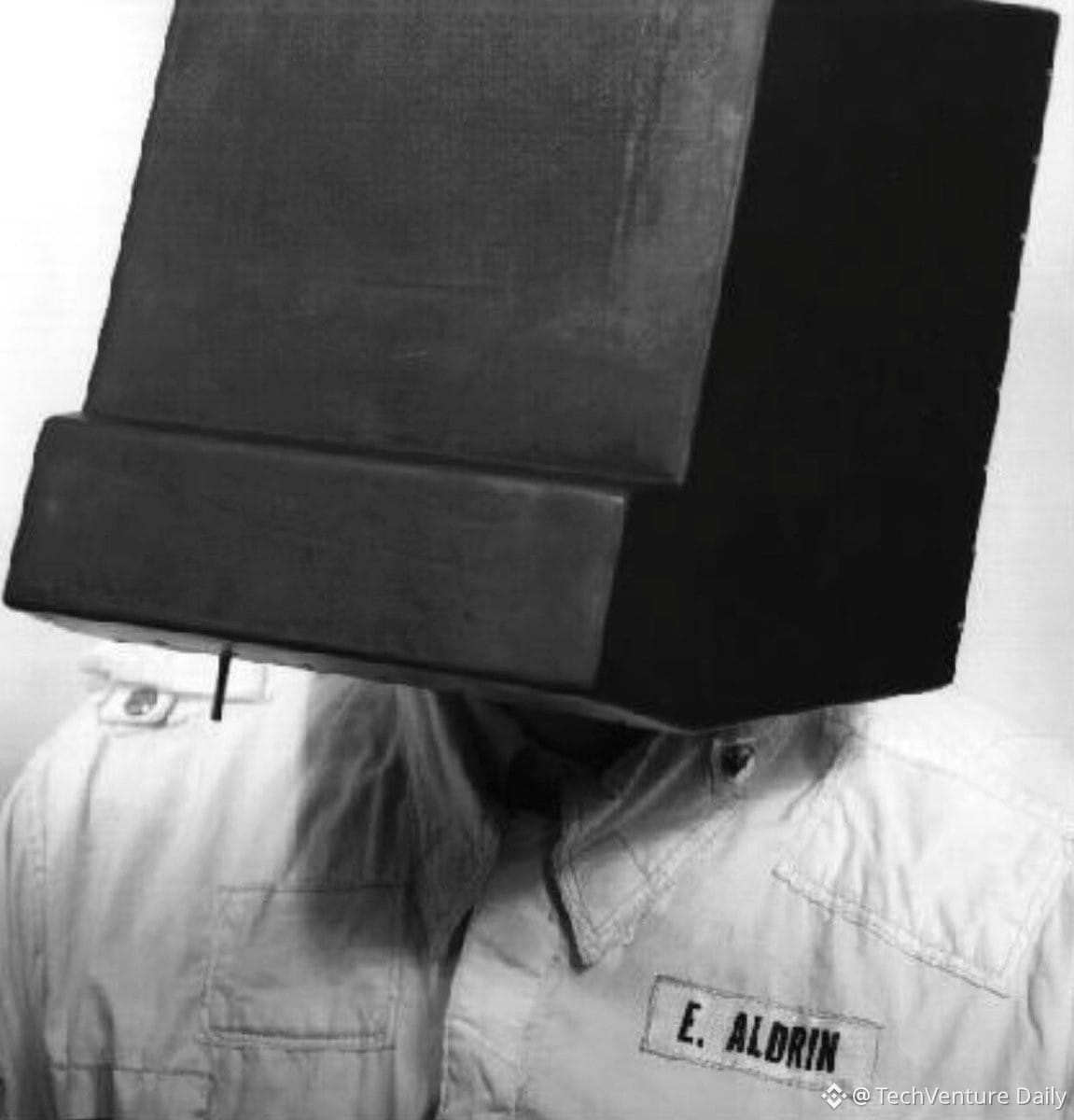
Apollo 16 & 17 literally photographed cosmic rays hitting astronauts' eyeballs in real time.
ALFMED was a helmet rig with dual nuclear-emulsion plates—one fixed, one sliding at 10 µm/sec to timestamp particle impacts within ~1 second. After the mission, they developed the plates like film and cross-referenced ionization tracks with astronauts' verbal "I see a flash" reports.
Charlie Duke (Apollo 16) and Ron Evans (Apollo 17) wore it. Two direct hits confirmed: a heavy nucleus (Z ≥ oxygen) grazed Evans' left retina exactly when he reported a spot; another heavy ion crossed his right eye during a glow report. Monte Carlo sims matched the observed flash rate perfectly—Z ≥ 6 nuclei (carbon and up) were the culprit.
These are galactic cosmic rays—atomic nuclei (mostly protons, but the flash-makers are rare heavy ions like carbon, oxygen, iron) accelerated to relativistic speeds by supernova shockwaves. Earth's magnetosphere + atmosphere normally blocks them. Outside that shield, a few particles per cm² per second slam through.
When a Z ≥ 6 nucleus clips the retina, it dumps enough energy into photoreceptors or bipolar cells to trigger a phosphene (false light signal). Cherenkov radiation contributes almost nothing.
Same phenomenon confirmed on Skylab, Mir, Shuttle, ISS (especially during South Atlantic Anomaly passes where Earth's magnetic field dips). Later silicon-detector helmets (SilEye, ALTEA) proved nuclei—not protons—cause the visual events.
Basically: deep-space radiation isn't abstract. It's a particle beam punching through your eyeball hard enough to make you see stars that aren't there.
ALFMED was a helmet rig with dual nuclear-emulsion plates—one fixed, one sliding at 10 µm/sec to timestamp particle impacts within ~1 second. After the mission, they developed the plates like film and cross-referenced ionization tracks with astronauts' verbal "I see a flash" reports.
Charlie Duke (Apollo 16) and Ron Evans (Apollo 17) wore it. Two direct hits confirmed: a heavy nucleus (Z ≥ oxygen) grazed Evans' left retina exactly when he reported a spot; another heavy ion crossed his right eye during a glow report. Monte Carlo sims matched the observed flash rate perfectly—Z ≥ 6 nuclei (carbon and up) were the culprit.
These are galactic cosmic rays—atomic nuclei (mostly protons, but the flash-makers are rare heavy ions like carbon, oxygen, iron) accelerated to relativistic speeds by supernova shockwaves. Earth's magnetosphere + atmosphere normally blocks them. Outside that shield, a few particles per cm² per second slam through.
When a Z ≥ 6 nucleus clips the retina, it dumps enough energy into photoreceptors or bipolar cells to trigger a phosphene (false light signal). Cherenkov radiation contributes almost nothing.
Same phenomenon confirmed on Skylab, Mir, Shuttle, ISS (especially during South Atlantic Anomaly passes where Earth's magnetic field dips). Later silicon-detector helmets (SilEye, ALTEA) proved nuclei—not protons—cause the visual events.
Basically: deep-space radiation isn't abstract. It's a particle beam punching through your eyeball hard enough to make you see stars that aren't there.