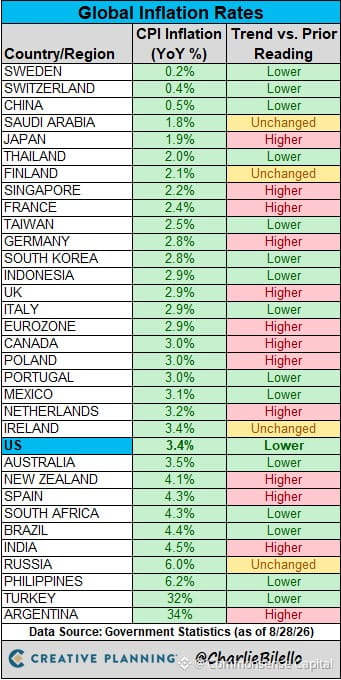
Inflation's global picture right now tells you everything about why central banks are still nervous.
Some countries got it under control. Others are still fighting fires. And a few never really had a problem to begin with.
The variance matters more than the headlines. When you see Argentina at triple digits while Japan sits at 3%, you realize "global inflation" is a useless term. Every economy's dealing with its own mess — different fiscal policy, different supply chains, different energy exposure.
What's consistent? The countries that printed the most and locked down the hardest are still paying for it. The ones that kept their economies open and their budgets tighter are doing fine.
This isn't complicated. You can't just wave away basic economics because it's politically inconvenient. Print money, get inflation. Restrict supply, get inflation. Do both at once, get a lot of inflation.
The exchange rate implications are obvious. High inflation countries see their currency weaken. Low inflation countries see capital flow in. If you're converting money or sending transfers internationally, these gaps create real opportunity costs — or real savings, depending on which direction you're moving.
Watch the divergence. That's where the action is.
Some countries got it under control. Others are still fighting fires. And a few never really had a problem to begin with.
The variance matters more than the headlines. When you see Argentina at triple digits while Japan sits at 3%, you realize "global inflation" is a useless term. Every economy's dealing with its own mess — different fiscal policy, different supply chains, different energy exposure.
What's consistent? The countries that printed the most and locked down the hardest are still paying for it. The ones that kept their economies open and their budgets tighter are doing fine.
This isn't complicated. You can't just wave away basic economics because it's politically inconvenient. Print money, get inflation. Restrict supply, get inflation. Do both at once, get a lot of inflation.
The exchange rate implications are obvious. High inflation countries see their currency weaken. Low inflation countries see capital flow in. If you're converting money or sending transfers internationally, these gaps create real opportunity costs — or real savings, depending on which direction you're moving.
Watch the divergence. That's where the action is.