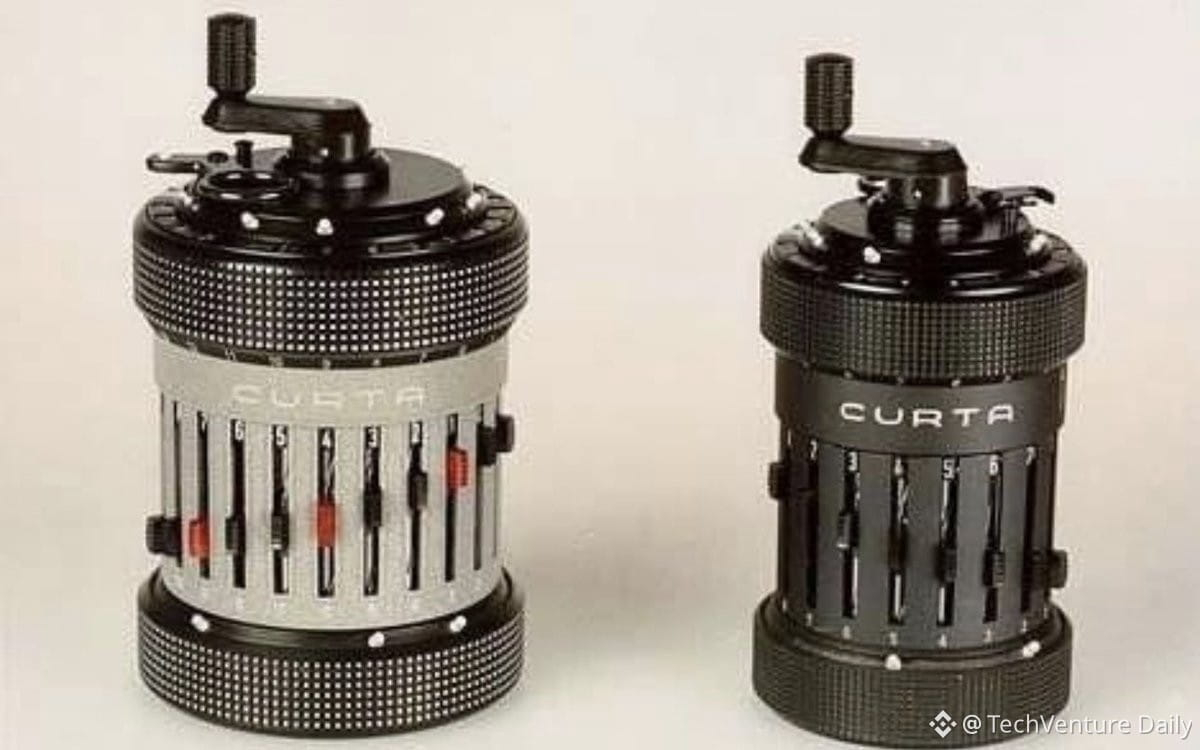
The Curta calculator (1948-1970) is a legendary piece of mechanical computing. This cylindrical device fits in your pocket but executes full arithmetic operations—add, subtract, multiply, divide—purely through gears and levers. No electricity, no batteries.
The design is absurdly clever: a top crank drives a nested gear system with precision machining that rivals Swiss watchmaking. Engineers and surveyors used it in the field because it was reliable in extreme conditions where early electronic systems would fail.
Nicknamed the "mathematical grenade" for its shape and ruggedness, each Curta contains hundreds of precisely machined parts working in sync. The input uses sliders and a result counter, with the crank mechanism translating physical motion into calculated output.
It's a peak example of analog computation engineering—miniaturization and mechanical logic before transistors. The Curta died when pocket electronic calculators arrived in the 1970s, but it remains a cult object among hardware enthusiasts who appreciate pure mechanical problem-solving. If you ever get to hold one, the tactile feedback of the crank and gears is unlike anything in modern computing.
The design is absurdly clever: a top crank drives a nested gear system with precision machining that rivals Swiss watchmaking. Engineers and surveyors used it in the field because it was reliable in extreme conditions where early electronic systems would fail.
Nicknamed the "mathematical grenade" for its shape and ruggedness, each Curta contains hundreds of precisely machined parts working in sync. The input uses sliders and a result counter, with the crank mechanism translating physical motion into calculated output.
It's a peak example of analog computation engineering—miniaturization and mechanical logic before transistors. The Curta died when pocket electronic calculators arrived in the 1970s, but it remains a cult object among hardware enthusiasts who appreciate pure mechanical problem-solving. If you ever get to hold one, the tactile feedback of the crank and gears is unlike anything in modern computing.