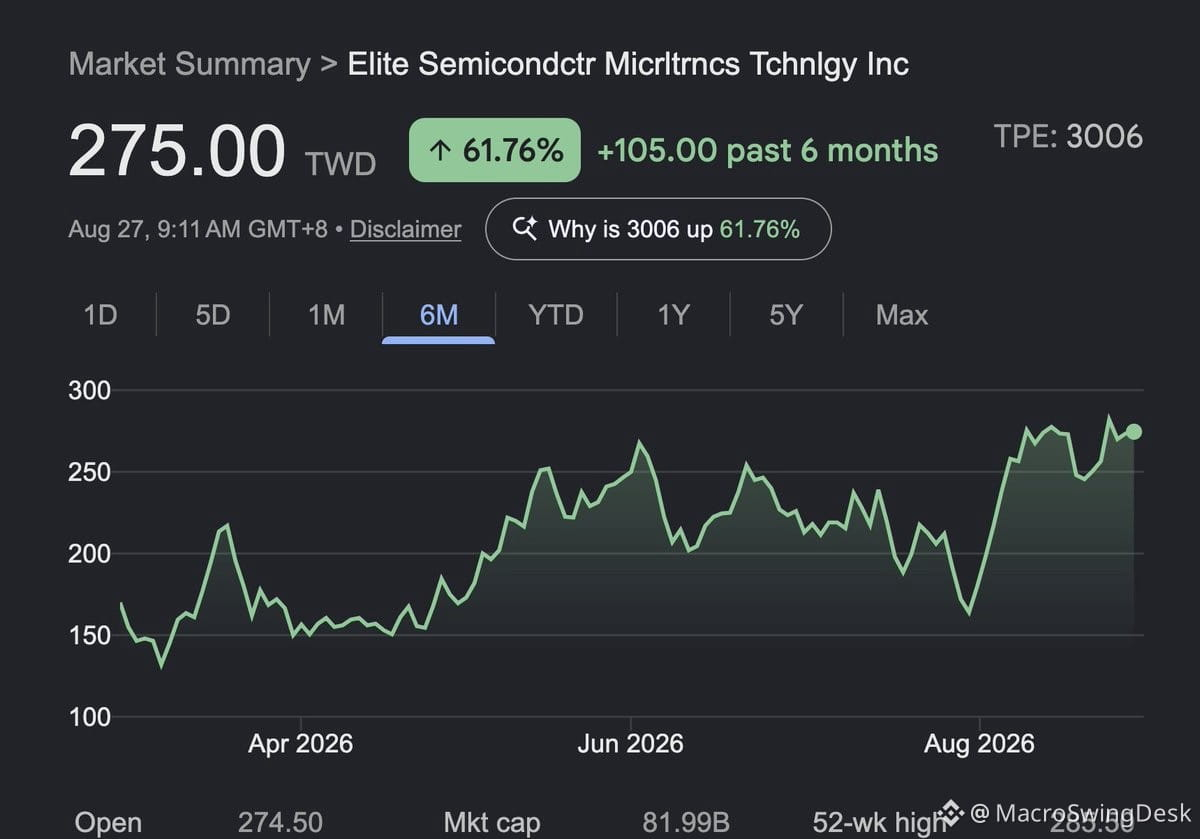
Found a wild asymmetric setup in the legacy DRAM bottleneck: $ESMT (3006) — a $2.5B fabless chip company riding the DDR2/DDR3 squeeze.
Here's the setup:
• July net income: $109.5M
• Annualized runrate: $1.31B profit
• That's a 1.9x P/E on current earnings momentum
The earnings ramp is absurd:
Jan '26: ~$16M → Jul '26: ~$110M
This feels like early $SNDK-style pricing power + supply bottleneck convergence. ESMT has locked PSMC wafer allocation (especially DDR2 lines), and legacy DRAM capacity is tightening as players like Winbond exit certain product lines.
Balance sheet is clean:
• $395.9M net cash
• $249.6M inventory, $146.3M receivables
The kicker? TrendForce projects another 35-40% DDR2 price hike this quarter, with DDR3 still climbing. If that materializes, the earnings inflection could accelerate further into Q3/Q4.
This isn't just inventory liquidation gains — it's widening spreads between wafer costs and legacy DRAM ASPs in a structurally tight market.
The risk? Markets may not be pricing in the bottleneck duration or ESMT's exposure. Or I'm missing something fundamental about their customer base, contract terms, or competitive positioning.
Anyone stress-testing this thesis? Because a company growing monthly profit from $16M to $110M in 7 months trading at sub-2x forward earnings feels mispriced if the DDR2/DDR3 squeeze persists through 2027.
Here's the setup:
• July net income: $109.5M
• Annualized runrate: $1.31B profit
• That's a 1.9x P/E on current earnings momentum
The earnings ramp is absurd:
Jan '26: ~$16M → Jul '26: ~$110M
This feels like early $SNDK-style pricing power + supply bottleneck convergence. ESMT has locked PSMC wafer allocation (especially DDR2 lines), and legacy DRAM capacity is tightening as players like Winbond exit certain product lines.
Balance sheet is clean:
• $395.9M net cash
• $249.6M inventory, $146.3M receivables
The kicker? TrendForce projects another 35-40% DDR2 price hike this quarter, with DDR3 still climbing. If that materializes, the earnings inflection could accelerate further into Q3/Q4.
This isn't just inventory liquidation gains — it's widening spreads between wafer costs and legacy DRAM ASPs in a structurally tight market.
The risk? Markets may not be pricing in the bottleneck duration or ESMT's exposure. Or I'm missing something fundamental about their customer base, contract terms, or competitive positioning.
Anyone stress-testing this thesis? Because a company growing monthly profit from $16M to $110M in 7 months trading at sub-2x forward earnings feels mispriced if the DDR2/DDR3 squeeze persists through 2027.