
@Dusk #Dusk $DUSK
A private transaction on a phone can feel simple: tap, sign, send.
The cryptography underneath is not.
For ZK systems, proof generation can become expensive because the prover has to satisfy a large arithmetic circuit. On weaker devices, that cost appears as latency before the transaction is broadcast.
This is where Plonkup becomes interesting.
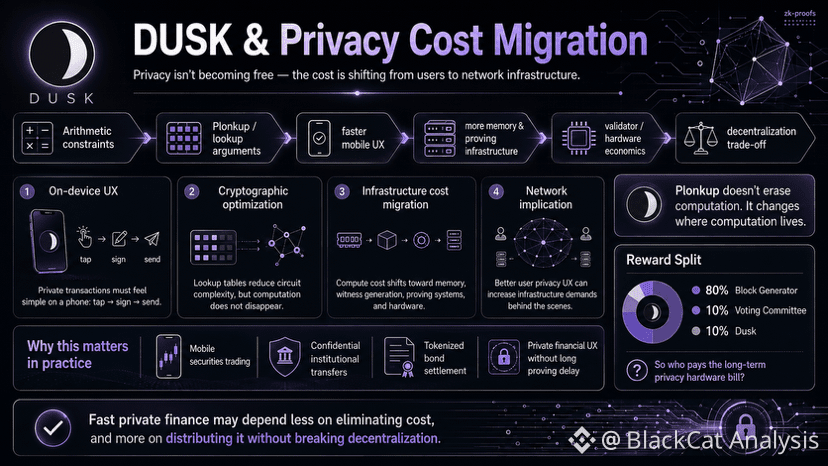
Instead of expressing every relation as arithmetic constraints, lookup arguments can let the prover show that certain values belong to a valid precomputed table. Part of the work shifts from “recompute everything” toward “prove this relation matches an allowed lookup.”
That can reduce circuit complexity and make private execution more practical.
But the cost does not disappear.
Lookup tables need memory. Witness generation still needs computation. Proving systems still depend on implementation quality, memory access and hardware.
I think of this as Privacy Cost Migration.
Dusk may be reducing the computation visible to the user while moving more of the burden into proving infrastructure.
That matters for finance.
Imagine an investor buying a tokenized security from a phone. If privacy adds minutes of proving delay, the experience fails before settlement even matters. For a fund or broker, the same delay can affect execution timing and operations.
The second-order question is economic.
Dusk’s reward structure allocates 80% of block rewards to the generator, 10% to the voting committee and 10% to Dusk. Those numbers describe consensus incentives, not proof-hardware reimbursement.
So if private activity eventually demands more memory and proving capacity, who absorbs that infrastructure cost?
This is where cryptography meets decentralization.
Higher hardware requirements can improve UX while making some operators less economical to run.
Plonkup does not make privacy free.
It changes where the bill is paid.
Will private finance be won by faster proofs, or by networks that can distribute the cost of those proofs without concentrating the infrastructure behind them?
$TAC $BTR
A private transaction on a phone can feel simple: tap, sign, send.
The cryptography underneath is not.
For ZK systems, proof generation can become expensive because the prover has to satisfy a large arithmetic circuit. On weaker devices, that cost appears as latency before the transaction is broadcast.
This is where Plonkup becomes interesting.
Instead of expressing every relation as arithmetic constraints, lookup arguments can let the prover show that certain values belong to a valid precomputed table. Part of the work shifts from “recompute everything” toward “prove this relation matches an allowed lookup.”
That can reduce circuit complexity and make private execution more practical.
But the cost does not disappear.
Lookup tables need memory. Witness generation still needs computation. Proving systems still depend on implementation quality, memory access and hardware.
I think of this as Privacy Cost Migration.
Dusk may be reducing the computation visible to the user while moving more of the burden into proving infrastructure.
That matters for finance.
Imagine an investor buying a tokenized security from a phone. If privacy adds minutes of proving delay, the experience fails before settlement even matters. For a fund or broker, the same delay can affect execution timing and operations.
The second-order question is economic.
Dusk’s reward structure allocates 80% of block rewards to the generator, 10% to the voting committee and 10% to Dusk. Those numbers describe consensus incentives, not proof-hardware reimbursement.
So if private activity eventually demands more memory and proving capacity, who absorbs that infrastructure cost?
This is where cryptography meets decentralization.
Higher hardware requirements can improve UX while making some operators less economical to run.
Plonkup does not make privacy free.
It changes where the bill is paid.
Will private finance be won by faster proofs, or by networks that can distribute the cost of those proofs without concentrating the infrastructure behind them?
$TAC $BTR