

Bitcoin price is taking a breather today after its powerful recovery over the past week. BTC is down roughly 2% over the past 24 hours and trading around $79,000 at press time. The pullback comes after Bitcoin climbed more than 20% in a matter of days, so some profit-taking and cooling in the market should not be particularly surprising.
Despite today’s decline, BTC remains well above the levels seen before the latest breakout, and one closely watched on-chain indicator now suggests something much bigger may have changed.
CryptoQuant Founder Says the Bitcoin Bear Cycle Is Over
CryptoQuant founder Ki Young Ju made his view unusually clear this week, writing simply:
“The Bitcoin bear cycle is over.”
The statement is notable because Ju had maintained a much more cautious outlook earlier this year. In May, he argued that Bitcoin’s bear market could potentially continue into early 2027 based on historical profit-and-loss cycles. More recently, however, improving demand and on-chain data have pushed his outlook in a bullish direction.
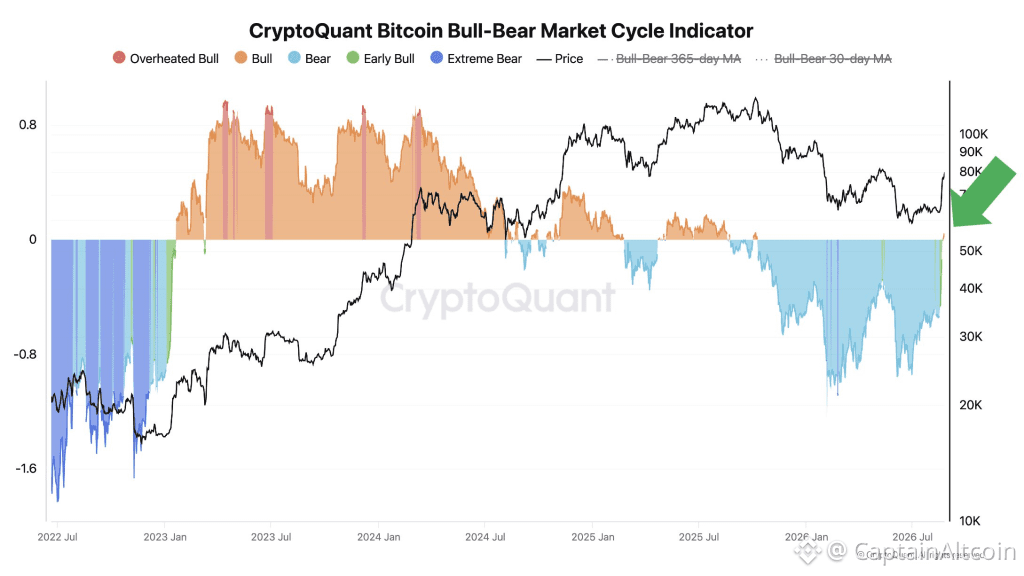
The chart shared by Ju helps explain why.
CryptoQuant’s Bitcoin Bull-Bear Market Cycle Indicator attempts to classify different phases of Bitcoin’s broader market cycle. Values above zero are associated with bullish conditions, while readings below zero indicate bearish conditions. The chart further separates those periods into stages such as extreme bear, bear, early bull, bull and overheated bull.
For much of 2026, the indicator remained decisively below zero. At its weakest point early this year, it fell deep into bear territory as Bitcoin’s price declined significantly from its 2025 highs.
The situation now looks very different.
The indicator has recovered rapidly from deeply negative readings and has returned to approximately the zero threshold, with the latest portion of the chart beginning to turn green. That green reading represents CryptoQuant’s “Early Bull” classification.
 Source: X/@ki_young_ju
That transition is important because the zero line has historically separated bearish and bullish market regimes on this particular model. The chart shows a comparable change around early 2023, when the indicator emerged from an extended period of extreme-bear readings and crossed into positive territory. Bitcoin subsequently entered a much larger advance.
Of course, one indicator cannot confirm that BTC will continue higher. A move back below zero would weaken the signal considerably. But the combination of Bitcoin’s recent price recovery and the Bull-Bear Cycle Indicator approaching positive territory provides the basis for Ju’s conclusion that the bearish phase has ended.
CryptoQuant researchers are expressing a similar view, although with some short-term caution. The firm’s analysts say improving spot demand, ETF flows and derivatives activity support the early-bull argument, while profit-taking and overbought conditions could still produce another pullback.
U.S. Treasury Starts Preparing for the Quantum Era
Away from price action, another important Bitcoin story is developing in Washington.
The U.S. Treasury announced its Quantum-Readiness Task Force on August 24. The public-private initiative is designed to help the financial sector transition toward quantum-safe technology as quantum computing advances.
This matters for Bitcoin and other digital assets because their security depends heavily on cryptography. A sufficiently powerful future quantum computer could theoretically threaten some of the cryptographic systems used across digital assets and traditional finance.
The development should not be interpreted as evidence that Bitcoin’s cryptography is about to be broken. The practical threat from cryptographically relevant quantum computers remains a longer-term issue. The more important takeaway is that the U.S. government is formally preparing for that possibility rather than waiting for quantum computing to become an immediate problem.
For Bitcoin, eventual migration toward quantum-resistant cryptography could become one of the network’s major long-term technical challenges.
Read also: We Asked 3 AI Models If Bitcoin Price Can Reach $100,000 by September
Bitcoin Miners Are Increasingly Looking Toward AI
Another major change is happening inside the Bitcoin mining industry.
Some of the industry’s biggest public companies are converting parts of their enormous power and data-center footprints toward artificial intelligence and high-performance computing.
Riot Platforms recently disclosed a 20-year data-center agreement for 191 MW of critical IT capacity at its Rockdale campus. The initial contract is expected to generate approximately $9.1 billion over its term, with extension options potentially increasing the value to $16.1 billion. Riot has now contracted 241 MW of capacity across its AI-related agreements.
Bitdeer is making a similar move. The company announced a 16-year AI/HPC data-center lease for its Tydal campus in Norway worth approximately $4.7 billion in contracted revenue, potentially rising to $8 billion if an extension is exercised.
There is a straightforward economic reason for this transition. Bitcoin mining revenue depends on BTC prices, network difficulty, transaction fees and energy costs. Long-term AI infrastructure contracts can provide miners with another source of revenue that is less directly tied to Bitcoin’s market cycle.
That doesn’t necessarily mean these companies are abandoning Bitcoin mining. Instead, the enormous demand for AI computing has created another way to monetize something miners already control: large quantities of electricity and data-center infrastructure.
Where Could Bitcoin Price Go From Here?
The immediate question is whether Bitcoin price can turn its latest recovery into a sustained bullish trend.
Today’s move back toward $79,000 shows that the market is not going to move higher in a straight line. After such a large rally in a short period, periods of consolidation and additional corrections would be normal.
The bigger picture, however, has improved considerably.
Bitcoin recently broke out of the $60,000 area and moved through several resistance levels, while institutional and spot demand have improved. Recent reporting also points to the rally being supported by more than just forced short liquidations, with genuine spot buying becoming increasingly important.
From here, $80,000 is an obvious psychological level to watch. Establishing BTC above that area would strengthen the argument that the latest move represents more than a temporary relief rally. Beyond that, traders will begin looking toward the previous price structure and higher resistance zones.
On the downside, Bitcoin could still see a deeper retest after moving more than 20% in only a few days. That would not automatically invalidate the bullish thesis. The more important question is whether buyers continue stepping in at higher levels than they did during the first half of 2026.
Perhaps the biggest change is therefore not today’s Bitcoin price at all. Only weeks ago, the debate centered on how much longer the bear market could last. Now CryptoQuant’s own cycle indicator is moving out of bear territory, and its founder believes the bear cycle is already finished.
If the indicator remains above its critical threshold while Bitcoin establishes higher lows, Ju’s call could prove big. If it falls back into bear territory, the market may discover that the latest rally was another false start.
Subscribe to our YouTube channel for daily crypto updates, market insights, and expert analysis.
The post Bitcoin Price Warning: BTC Just Flashed a Major Cycle Signal, Here’s the Data appeared first on CaptainAltcoin.