@Dusk
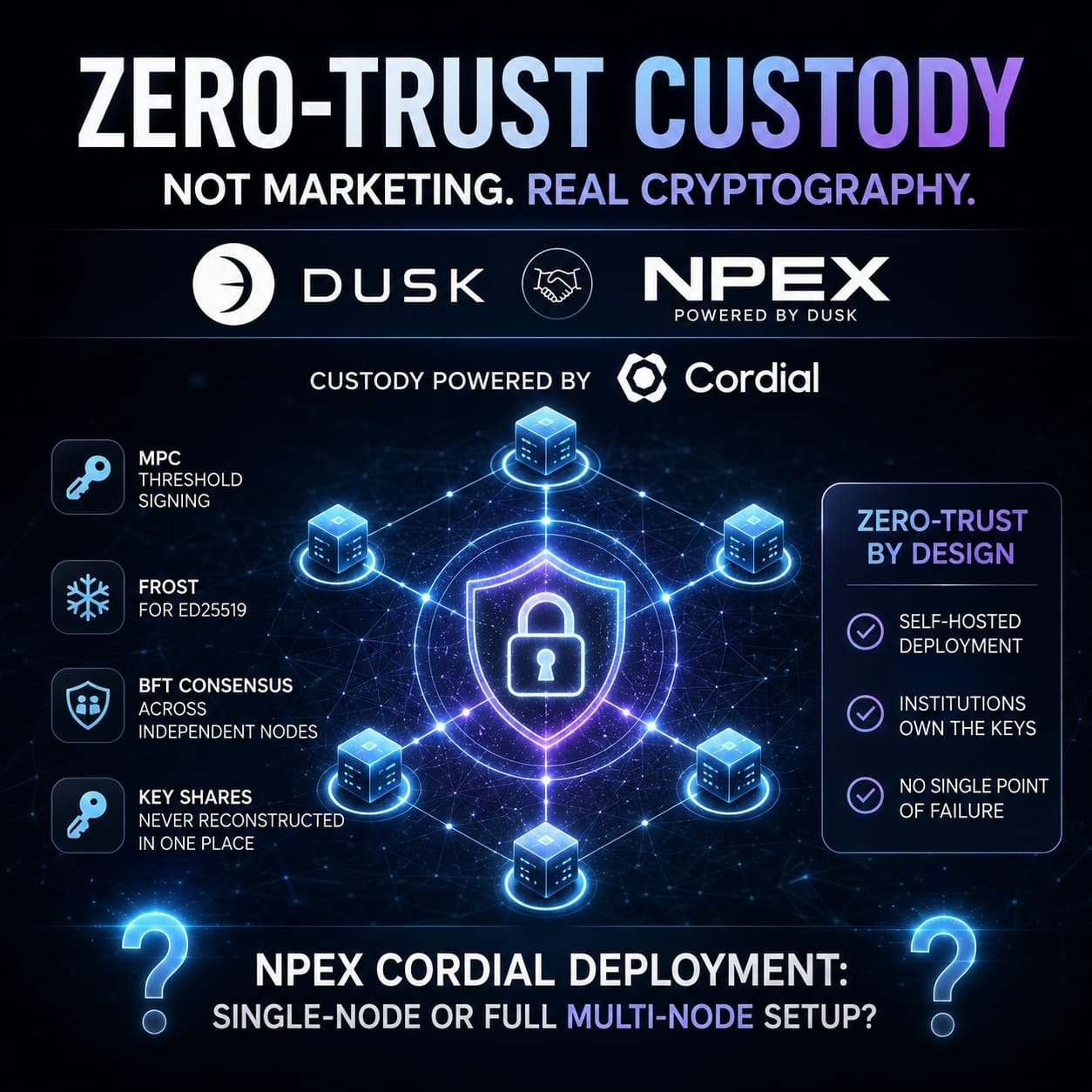
i went to check exactly what "zero-trust custody" means in the dusk-cordial-npex announcement, since that term usually implies a specific cryptographic architecture, and figured the press release was probably using it loosely for "self-hosted instead of third-party saas." i was wrong, and honestly i almost wrote this whole post around that wrong assumption before actually pulling cordial's own technical docs — their treasury product genuinely uses mpc threshold signing, frost for ed25519, a bft consensus layer across independent nodes, key shares that never get reconstructed in one place. that's real distributed-trust cryptography, not marketing dressed up as one.
so npex choosing self-hosted deployment and getting genuine zero-trust architecture aren't actually in tension the way i assumed going in, cordial's whole pitch is letting institutions run that architecture themselves instead of trusting a saas vendor's cloud.
what i still don't know is whether npex is running the full multi-node bft setup or something closer to a single-node deployment, since cordial's docs mention both are technically available. those aren't equally "zero-trust" in practice even on the same underlying software.
does anyone know if npex's actual cordial deployment is single-node or a genuine multi-node threshold setup? 🧐
#dusk $DUSK
i went to check exactly what "zero-trust custody" means in the dusk-cordial-npex announcement, since that term usually implies a specific cryptographic architecture, and figured the press release was probably using it loosely for "self-hosted instead of third-party saas." i was wrong, and honestly i almost wrote this whole post around that wrong assumption before actually pulling cordial's own technical docs — their treasury product genuinely uses mpc threshold signing, frost for ed25519, a bft consensus layer across independent nodes, key shares that never get reconstructed in one place. that's real distributed-trust cryptography, not marketing dressed up as one.
so npex choosing self-hosted deployment and getting genuine zero-trust architecture aren't actually in tension the way i assumed going in, cordial's whole pitch is letting institutions run that architecture themselves instead of trusting a saas vendor's cloud.
what i still don't know is whether npex is running the full multi-node bft setup or something closer to a single-node deployment, since cordial's docs mention both are technically available. those aren't equally "zero-trust" in practice even on the same underlying software.
does anyone know if npex's actual cordial deployment is single-node or a genuine multi-node threshold setup? 🧐
#dusk $DUSK