#dusk $DUSK @Dusk
pulled up Dusk's incident notice expecting the usual vague "we're investigating" language. What I found instead was a distinction worth sitting with.
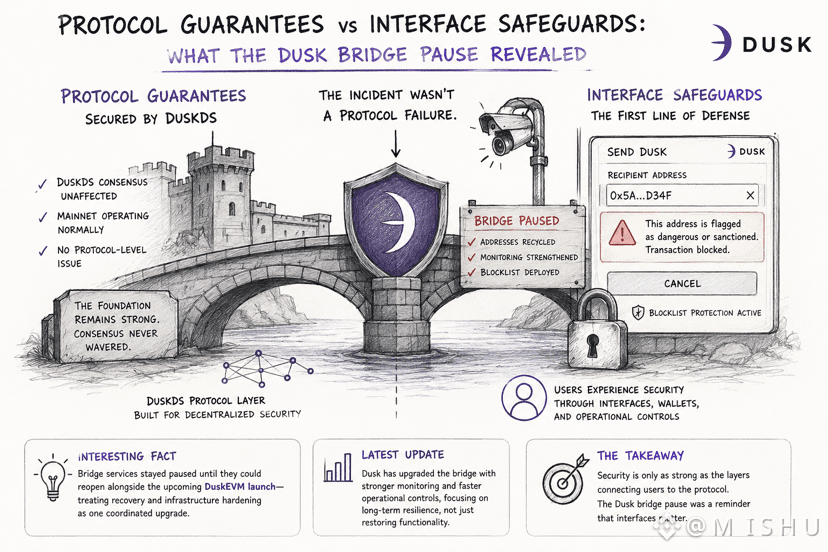
When Dusk detected abnormal bridge activity tied to a team managed operational wallet, it paused bridge services, recycled affected addresses, and deployed a Web Wallet blocklist that warns users before sending funds to known malicious or sanctioned destinations.
That's the interesting part.
A blocklist is an interface safeguard. It protects users before a transaction is signed. It isn't something DuskDS enforces at the protocol layer.
The team was equally explicit that the incident was not a protocol level failure. Consensus continued operating normally; the compromise existed entirely within operational infrastructure surrounding the bridge.
One detail stood out: bridge services remained paused until they could be reintroduced alongside DuskEVM, turning recovery and infrastructure hardening into a single rollout rather than reopening first and patching later.
If the protocol never failed, yet the protection users actually interacted with was a wallet level warning system, what does that say about where security is really experienced, in the protocol, or at the interface between users and the protocol?
pulled up Dusk's incident notice expecting the usual vague "we're investigating" language. What I found instead was a distinction worth sitting with.
When Dusk detected abnormal bridge activity tied to a team managed operational wallet, it paused bridge services, recycled affected addresses, and deployed a Web Wallet blocklist that warns users before sending funds to known malicious or sanctioned destinations.
That's the interesting part.
A blocklist is an interface safeguard. It protects users before a transaction is signed. It isn't something DuskDS enforces at the protocol layer.
The team was equally explicit that the incident was not a protocol level failure. Consensus continued operating normally; the compromise existed entirely within operational infrastructure surrounding the bridge.
One detail stood out: bridge services remained paused until they could be reintroduced alongside DuskEVM, turning recovery and infrastructure hardening into a single rollout rather than reopening first and patching later.
If the protocol never failed, yet the protection users actually interacted with was a wallet level warning system, what does that say about where security is really experienced, in the protocol, or at the interface between users and the protocol?