
I’ve watched enough crypto cycles to know that the word “privacy” gets thrown around way too easily.
That’s not what made me look twice at @Dusk .
What stuck with me was something much less flashy: state.
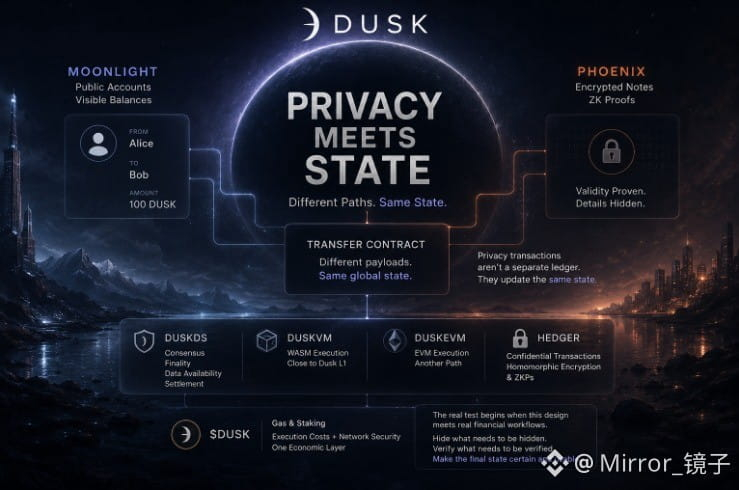
Moonlight keeps things familiar with public accounts and visible balances. Phoenix takes the opposite route with encrypted notes and ZK proofs. Different approach, same problem in the end: once a transaction happens, what exactly changes on-chain?
That’s where the Transfer Contract got interesting to me. Different transaction types can go through different checks, but they still end up feeding into the same global state. I keep noticing how important that is. Privacy shouldn’t mean creating a completely separate world.
Then you have DuskDS handling consensus and finality, DuskVM and DuskEVM covering execution, while Hedger adds confidential transactions with homomorphic encryption and ZKPs.
I’m not fully convinced yet. I’ve seen plenty of elegant crypto designs fall apart when real users show up.
But $DUSK feels worth watching.
Not because it sounds futuristic, but because it’s trying to make privacy, execution and settlement work together without pretending the hard parts don’t exist.
@Dusk #dusk
That’s not what made me look twice at @Dusk .
What stuck with me was something much less flashy: state.
Moonlight keeps things familiar with public accounts and visible balances. Phoenix takes the opposite route with encrypted notes and ZK proofs. Different approach, same problem in the end: once a transaction happens, what exactly changes on-chain?
That’s where the Transfer Contract got interesting to me. Different transaction types can go through different checks, but they still end up feeding into the same global state. I keep noticing how important that is. Privacy shouldn’t mean creating a completely separate world.
Then you have DuskDS handling consensus and finality, DuskVM and DuskEVM covering execution, while Hedger adds confidential transactions with homomorphic encryption and ZKPs.
I’m not fully convinced yet. I’ve seen plenty of elegant crypto designs fall apart when real users show up.
But $DUSK feels worth watching.
Not because it sounds futuristic, but because it’s trying to make privacy, execution and settlement work together without pretending the hard parts don’t exist.
@Dusk #dusk