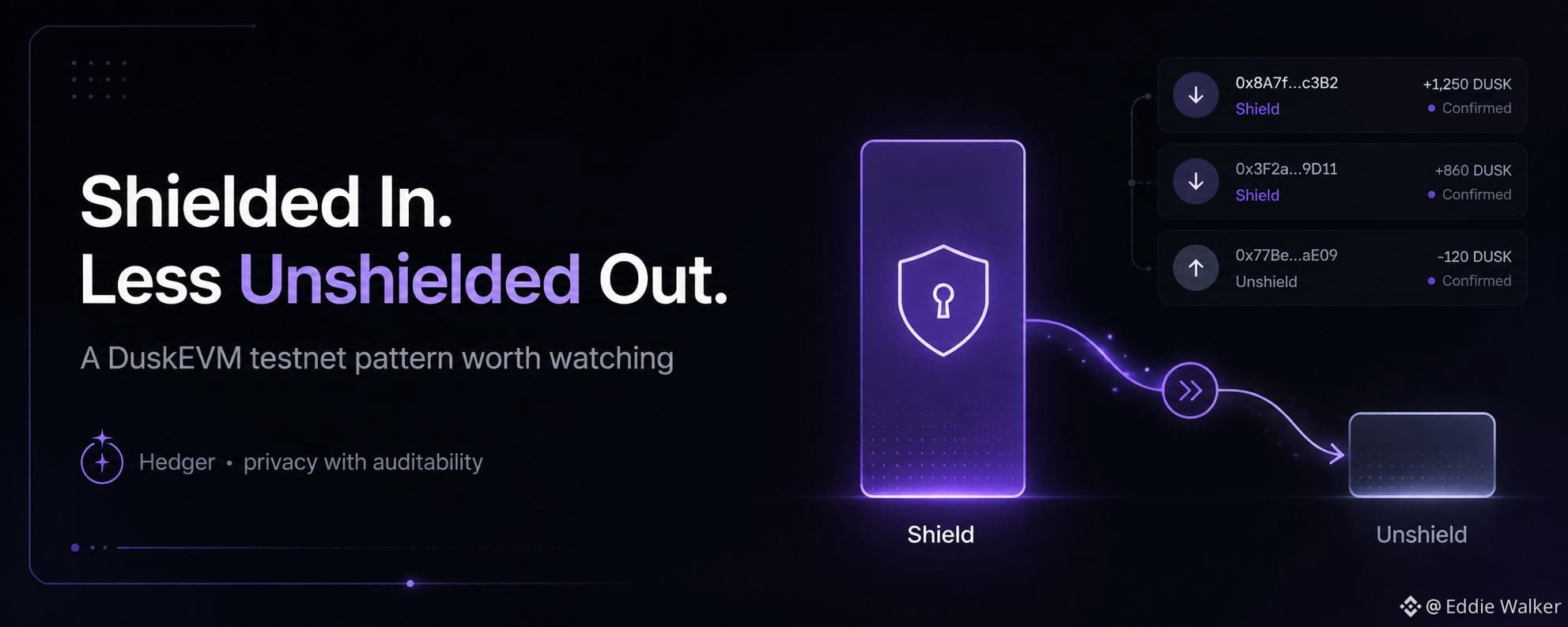

Spent a chunk of this week poking through the DuskEVM testnet explorer for Project @Dusk instead of just skimming the docs, and one small thing stuck with me more than the Hedger writeup itself.
Dusk markets Hedger as privacy with auditability homomorphic encryption plus ZK proofs, letting you shield and unshield balances on the EVM side. Reads clean on paper. But watching actual test wallets move through it, the pattern looked lopsided: plenty of shield transactions, noticeably fewer unshields. People fund the encrypted balance, poke around, and then largely stop there. The private-transfer leg that’s supposed to be the whole point barely shows up.
I don’t read that as a red flag necessarily it’s a testnet, people are curious rather than committed, and shielding is the easier half of the flow. But it did make me wonder if the friction sits more on the “spend privately” side than the “go private” side. That’s the opposite of what I expected walking in I assumed the ZK proving step for a full private transfer would be the bottleneck, not user follow-through.
Could just be normal testnet behavior: mint, tinker, move on. Or it might hint at something about how confidential balances actually get used once compliance and auditability are designed in from day one, rather than bolted on later. Hard to say with any confidence off a small sample of wallets.
Anyone else tracking shield vs. unshield ratios on the DuskEVM testnet, or is it too early to read anything into it?
$DUSK #dusk
Dusk markets Hedger as privacy with auditability homomorphic encryption plus ZK proofs, letting you shield and unshield balances on the EVM side. Reads clean on paper. But watching actual test wallets move through it, the pattern looked lopsided: plenty of shield transactions, noticeably fewer unshields. People fund the encrypted balance, poke around, and then largely stop there. The private-transfer leg that’s supposed to be the whole point barely shows up.
I don’t read that as a red flag necessarily it’s a testnet, people are curious rather than committed, and shielding is the easier half of the flow. But it did make me wonder if the friction sits more on the “spend privately” side than the “go private” side. That’s the opposite of what I expected walking in I assumed the ZK proving step for a full private transfer would be the bottleneck, not user follow-through.
Could just be normal testnet behavior: mint, tinker, move on. Or it might hint at something about how confidential balances actually get used once compliance and auditability are designed in from day one, rather than bolted on later. Hard to say with any confidence off a small sample of wallets.
Anyone else tracking shield vs. unshield ratios on the DuskEVM testnet, or is it too early to read anything into it?
$DUSK #dusk