
@Dusk
Ran into a part of a project's docs today that I hadn't noticed before: a whole contract dedicated just to licenses. Not tokens, not staking, licenses. That's an odd thing to build into a chain, and it stuck with me.
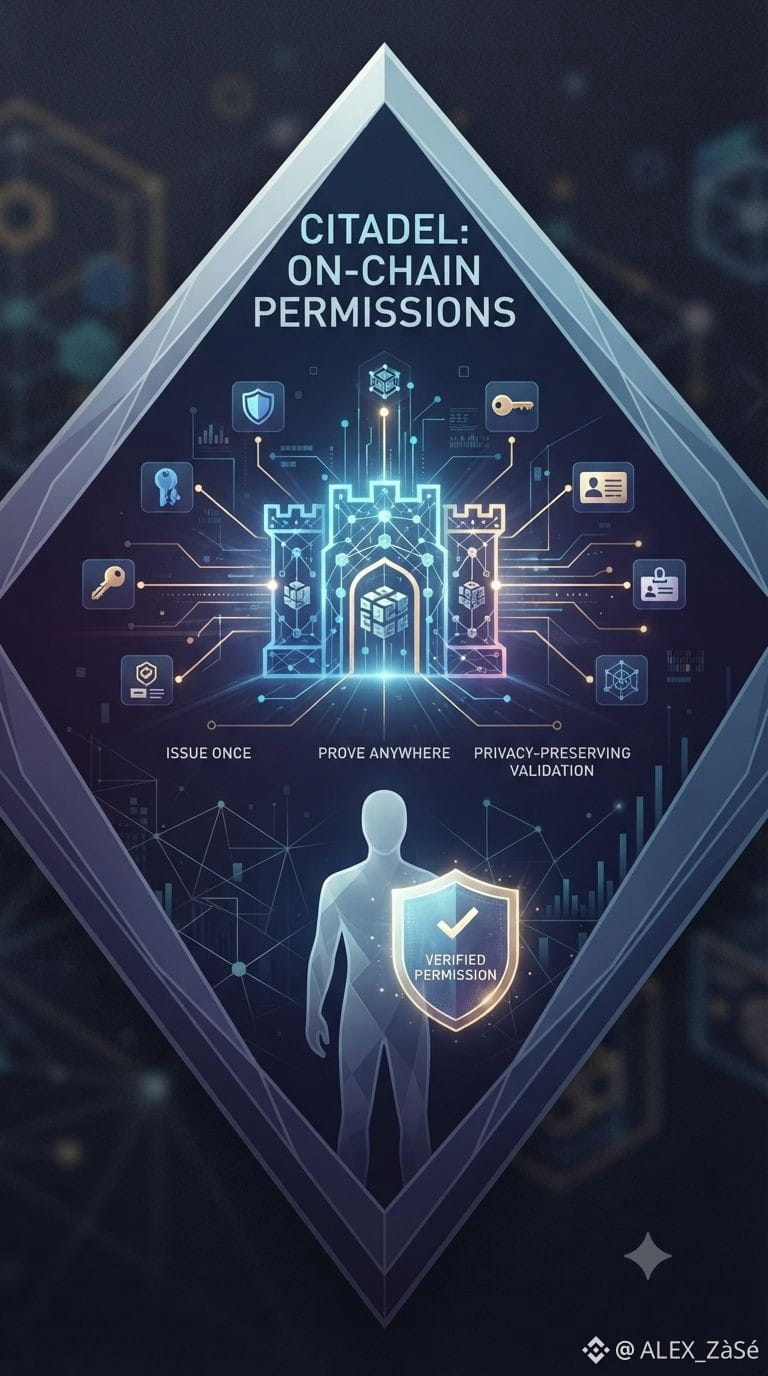
The idea behind it is called Citadel. Instead of proving who you are by handing over your full identity every time, a person gets issued a license once, then uses it to prove they're allowed to do something, like meeting an age requirement or holding a permit, without revealing anything extra. The chain tracks whether that license is still valid, expired, or revoked, but not the person's whole file.
That's what pulled me in. Most identity talk in crypto stays abstract, "self-sovereign" this, "own your data" that. Here it's tied to something concrete: an actual permission, checked and enforced on-chain, the same way a bouncer checks an ID without needing your home address.
But I keep coming back to one question: who decides what counts as a valid license in the first place? A government agency? A private issuer? If the source granting the license isn't legally recognized somewhere, the whole on-chain proof means very little outside that network. Revocation is another open thread, canceling a license in real life doesn't always update instantly on a ledger.
I don't think that kills the concept. It just means the hard part isn't the cryptography, it's getting institutions to actually agree on who's allowed to issue these things.
Reading this stuff slowly, asking where the trust really sits, feels like the better habit to build than getting excited too fast.
@Dusk $DUSK #dusk
Ran into a part of a project's docs today that I hadn't noticed before: a whole contract dedicated just to licenses. Not tokens, not staking, licenses. That's an odd thing to build into a chain, and it stuck with me.
The idea behind it is called Citadel. Instead of proving who you are by handing over your full identity every time, a person gets issued a license once, then uses it to prove they're allowed to do something, like meeting an age requirement or holding a permit, without revealing anything extra. The chain tracks whether that license is still valid, expired, or revoked, but not the person's whole file.
That's what pulled me in. Most identity talk in crypto stays abstract, "self-sovereign" this, "own your data" that. Here it's tied to something concrete: an actual permission, checked and enforced on-chain, the same way a bouncer checks an ID without needing your home address.
But I keep coming back to one question: who decides what counts as a valid license in the first place? A government agency? A private issuer? If the source granting the license isn't legally recognized somewhere, the whole on-chain proof means very little outside that network. Revocation is another open thread, canceling a license in real life doesn't always update instantly on a ledger.
I don't think that kills the concept. It just means the hard part isn't the cryptography, it's getting institutions to actually agree on who's allowed to issue these things.
Reading this stuff slowly, asking where the trust really sits, feels like the better habit to build than getting excited too fast.
@Dusk $DUSK #dusk