#dusk $SPK $KII $DUSK @Dusk
A document can carry every signature and still have no force without the seal that makes it official. Writing something, checking it, and giving it final authority are different powers.
That’s the lens I use to look at Dusk’s Succinct Attestation.
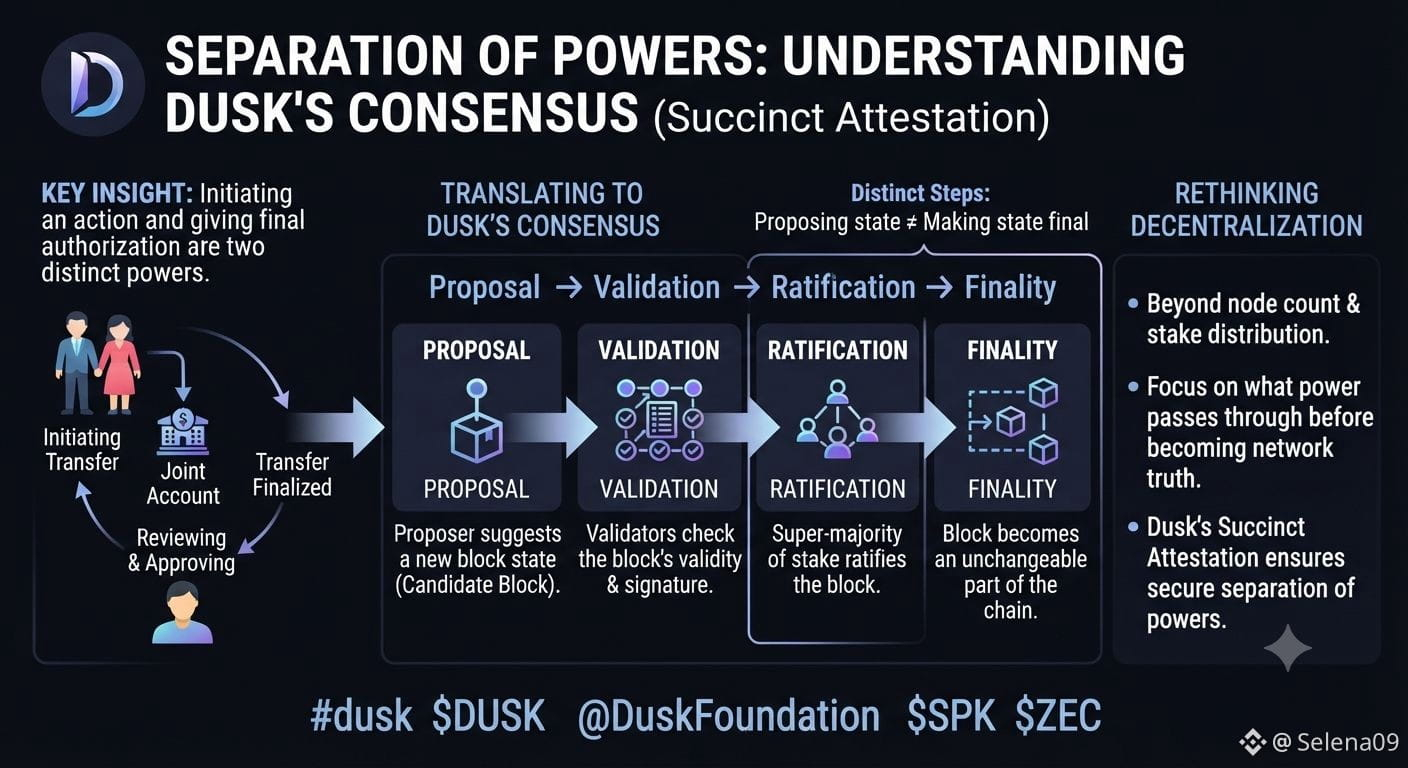
A proposed block is not yet the network’s truth. It has to move through Proposal - Validation - Ratification before finality. What matters here isn’t simply that consensus has multiple stages. It’s that introducing the next state and making that state final are not the same power.
That distinction adds another way to think about decentralization.
Node count tells us how widely participation is distributed. Stake distribution tells us where economic weight sits. But consensus design reveals something different: how far one participant’s authority can travel before it depends on others.
That may be the more interesting boundary.
Because decentralization isn’t only about asking: “How many people hold power?”
It’s also asking:“Where must one person’s power stop?”
Distributing the seals is the visible part. The deeper design problem is making sure no one can write their own version of truth, stamp it themselves, and make the entire network accept it as final.
A document can carry every signature and still have no force without the seal that makes it official. Writing something, checking it, and giving it final authority are different powers.
That’s the lens I use to look at Dusk’s Succinct Attestation.
A proposed block is not yet the network’s truth. It has to move through Proposal - Validation - Ratification before finality. What matters here isn’t simply that consensus has multiple stages. It’s that introducing the next state and making that state final are not the same power.
That distinction adds another way to think about decentralization.
Node count tells us how widely participation is distributed. Stake distribution tells us where economic weight sits. But consensus design reveals something different: how far one participant’s authority can travel before it depends on others.
That may be the more interesting boundary.
Because decentralization isn’t only about asking: “How many people hold power?”
It’s also asking:“Where must one person’s power stop?”
Distributing the seals is the visible part. The deeper design problem is making sure no one can write their own version of truth, stamp it themselves, and make the entire network accept it as final.