
I’ve watched enough blockchain cycles to know that TPS is one of the easiest numbers to impress people with and one of the hardest numbers to judge properly.
A network can look incredibly fast on paper. The more interesting question is what happens when thousands of transactions have to be executed, stored, distributed, and synchronized under real-world conditions.
That’s what made me look more closely at Dusk.
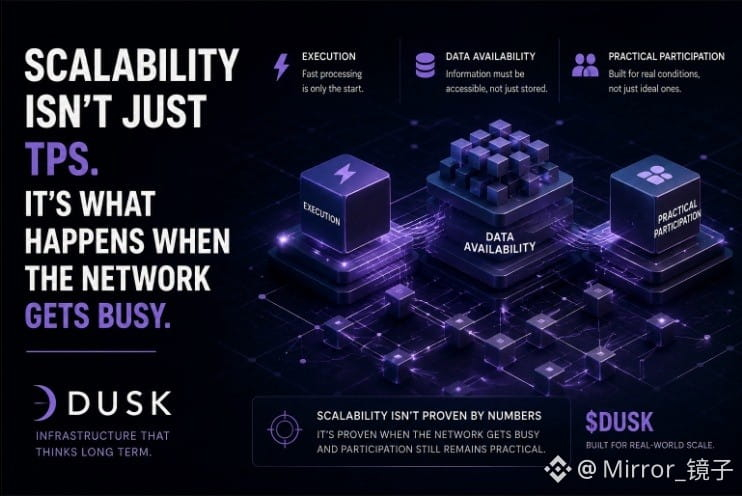
One detail that stood out to me is the separation between execution and data availability. Efficient execution is only part of the problem. The network also has to make sure participants can access the information they need without turning validation into a hardware race.
That matters more as a blockchain grows.
Storage requirements, data distribution, validator hardware, and synchronization can all shape how practical network participation becomes over time.
That’s why I find DUSK interesting from an infrastructure perspective.
I’m less interested in whether a blockchain can post an impressive TPS number and more interested in whether its architecture can keep that performance practical as usage increases.
Because scalability isn’t really proven when the network is small and everything works smoothly.
It’s proven when the network gets busy, the data gets heavy, and participation still remains practical.
That’s the test I’d be watching.
@Dusk #dusk $DUSK
$TUT
A network can look incredibly fast on paper. The more interesting question is what happens when thousands of transactions have to be executed, stored, distributed, and synchronized under real-world conditions.
That’s what made me look more closely at Dusk.
One detail that stood out to me is the separation between execution and data availability. Efficient execution is only part of the problem. The network also has to make sure participants can access the information they need without turning validation into a hardware race.
That matters more as a blockchain grows.
Storage requirements, data distribution, validator hardware, and synchronization can all shape how practical network participation becomes over time.
That’s why I find DUSK interesting from an infrastructure perspective.
I’m less interested in whether a blockchain can post an impressive TPS number and more interested in whether its architecture can keep that performance practical as usage increases.
Because scalability isn’t really proven when the network is small and everything works smoothly.
It’s proven when the network gets busy, the data gets heavy, and participation still remains practical.
That’s the test I’d be watching.
@Dusk #dusk $DUSK
$TUT