


Not only storing files, but Walrus is attempting to repair the missing trust gap in the data.
In the majority of crypto storage projects, one idea is being sold: put your files somewhere decentralized. Walrus addresses an even larger, more agonizing issue, which is that current applications operate on data they cannot verify. It is hard to check the origin of the AI training set, whether it was modified, or even whether it is complete. That uncertainty is costly. Walrus himself research is scathing: poor data kills AI projects, and advertising is losing colossal value as records are not end-to-end verifiable.
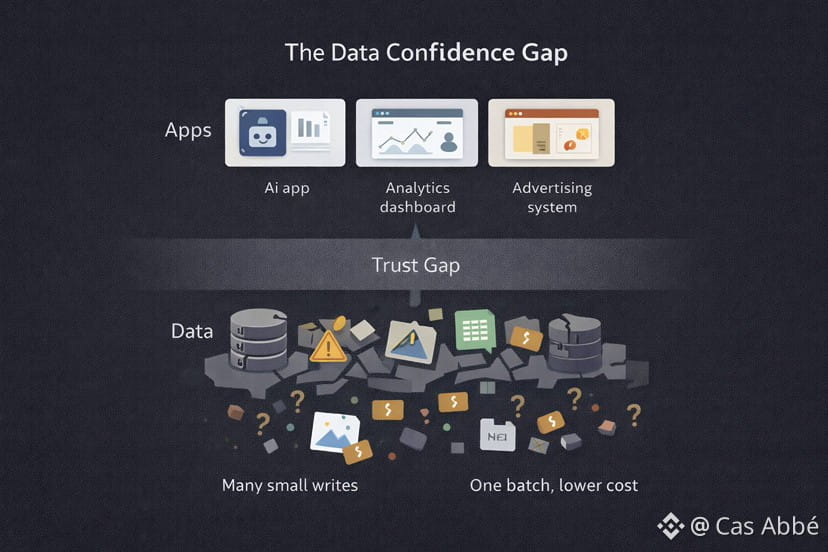
It can be boiled down to my personal opinion: it is not an AI problem or an ad fraud problem. It is one of those data trust issues. Walrus is interested in data acting as financial infrastructure: you are expected to be able to audit it, reference it, and write automation over it without relying on any centralized database being honest.
The fresh perspective is that Walrus is creating verifiable data workflows which can be actually used by real businesses.
Among the most interesting changes at Walrus is not concerned with encoding or tokens. It is getting out of storage and into workflow. Within the Team Liquid migration, it is not 250 TB that matters. It is what the data turns into after migration: data that is on-chain-compatible, but is flexible enough that it can be used to generate new applications and monetization in the future without migrating once more. That is the workflow promise: put it in store and use it over and over again, and add permissions and products at some later point.
The importance of that partnership is that it demonstrates Walrus is establishing itself as long-lived data infrastructure to organizations that do not require replatforming each time the business model undergoes some change. The first point is the storage layer. The actual bet is that the same data can be used to operate different products with time.
Developer reality test: This is a mobile internet and too many requests is a deal killer.
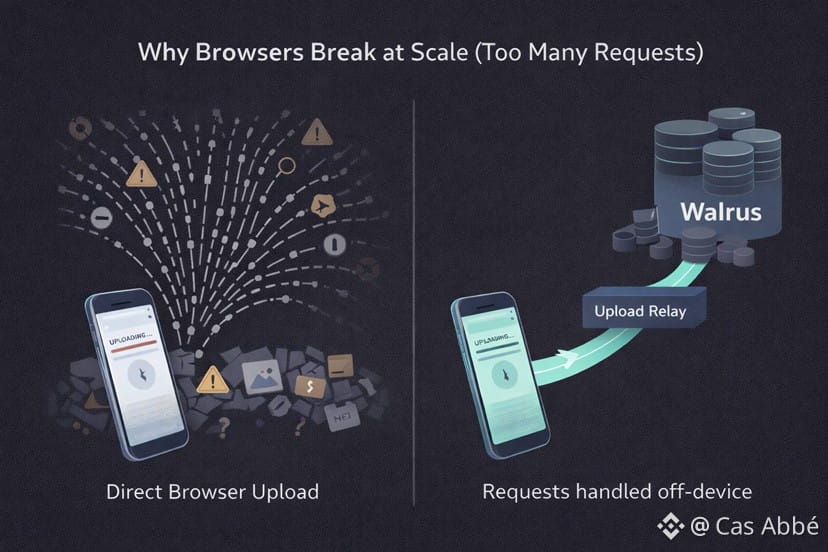
This is where most articles fail to fit as it is not glamorous. When your storage system is dictating a browser to open thousands of connections, real phone users and those with weak Wi-Fi will despise it. The Walrus TypeScript SDK documentation openly admits that it may take approximately 2,200 requests to write a blob and anywhere hundreds of requests to read a blob.
That one fact justifies the fact that Walrus presented Upload Relay as a first-class concept. Upload Relay is Walrus saying, “We want apps to be natural. The reason why it has a relay is that browser-based uploads which communicate to numerous storage nodes are not practical because of the number of connections made on the network.
And this is no minor product modification. It is Walrus paying attention to the fact that the user experience of infrastructure is the infrastructure itself. In cases when upload on mobile fails, the protocol does not count.
Upload Relay is not a helper only. It is a financial and confidence structure decision.
Walrus did not end with the easy creation of uploads. It expressed the relay operator model clearly as well. The documentation provides information on free and paid relays, with an operator potentially asking to be tipped, a flat amount or based on the size of data.
I like this frankness of the trade in that you can run your own relay should you not wish to have dependencies, and that a public relay market may exist as well. The Walrus team positions the relay as minimal trust since the client is able to determine when a relay is compromised or malicious. This is a very indirect but effective design message, which states: do not trust a middlebox blindly, make it replaceable and verifiable.
In case Walrus works, Upload Relay will be a new type: a competitive marketplace of upload performance that does not compromise decentralization since the client is able to check correctness.
Quilt transforms the weakness of small files into strength.
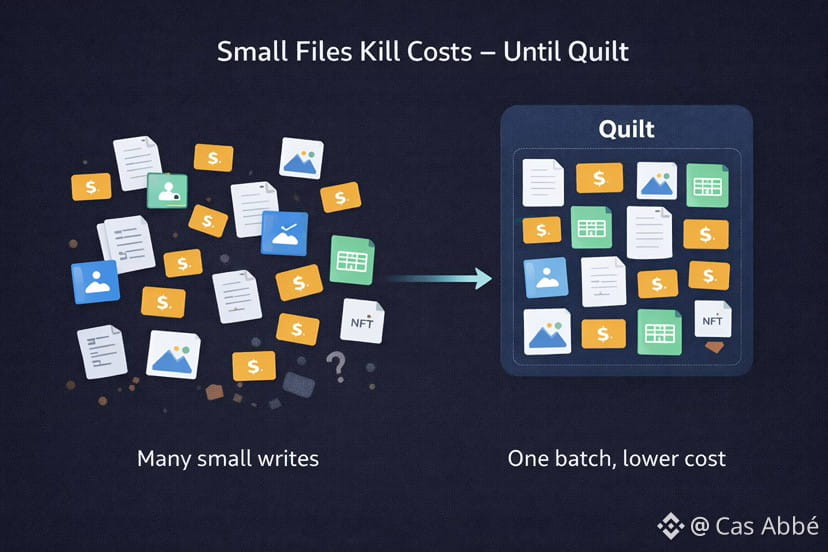
Decentralized storage is fine in large blobs but does not scale to millions of small items such as metadata, chat messages, logs or small AI objects. Walrus replied with Quilt: a batch storage system that wraps lots of small files into a single entity whilst preserving the feasibility of accessing individual files.
The figures are self-explanatory: Walrus estimates a 106x reduction in overhead and costs for 100 KB blobs and 420x reduction in 10 KB blobs; it also minimizes SUI-denominated overheads on storage transactions.
It is a novel point of view, which should be mentioned: Quilt is not only cheaper. It alters the apps that are realistic to decentralized storage. Messaging-style applications, dynamically generated NFTs, and logs of an AI agent are not a large file. They are thousands of small scribbles. Quilt transforms that pattern into something that Walrus can reasonably deal with without developers having to write their own batching hacks.
Privacy is feasible when access control is built in, and not added on.
Numerous Web3 storage presentations become stagnant stuck in the public by default thinking. Walrus went a more definite route with Seal: it would like to be included in the infrastructure of the people. Seal enables you to encrypt private data and control access to it completely using blockchain.
This is important as this opens up normal business cases that otherwise would not access decentralized storage: subscriber content, confidential datasets, rights-managed distribution of media and controlled sharing within companies. Other real adoption indicators described by Walrus include Alkimi handling 25 million ad impressions per day with the help of the Seal to store confidential client information.
I am personally confident that this is the next phase of crypto infrastructure winning: not by fully de-privatizing it, but by once again programmable privacy.
Decentralization does not perpetuate itself. Walrus is using it as an engineering problem.
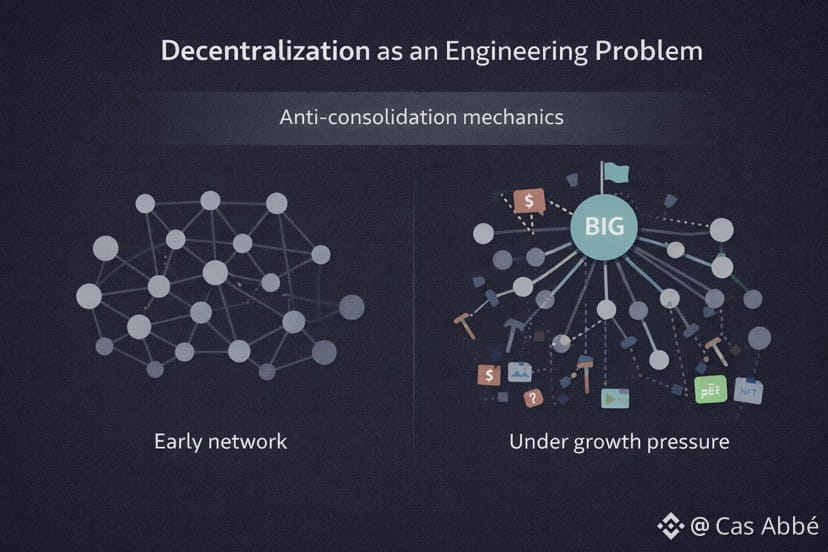
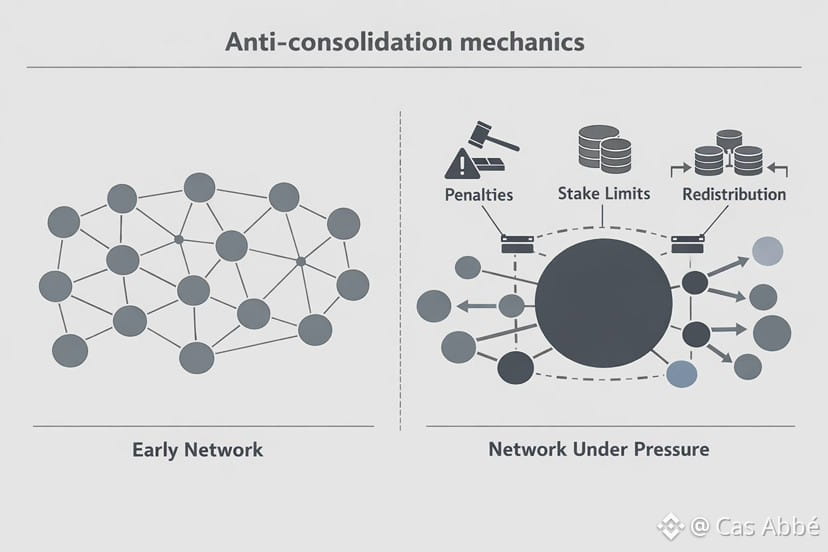
The concept of decentralization is discussed as a moral value in most projects. Walrus defines it as a phenomenon that is capable of breaking silently as networks grow larger as larger nodes are able to amass more stake and power.
The interesting part is that complex of counter-pressures that Walrus outlines: Rewarding nodes on verifiable uptime and reliability instead of reputation, punishing poor performance with loss of stake, introducing penalties to encourage the stake to flow too fast to organize into a game, and maintain key parameters as controlled by token-holders.
It is a new perspective of the narration: decentralization as anti-consolidation mechanisms. Simply stated, Walrus claims that to have a decentralized network tomorrow, you must devise incentives such that it is costly today to centralize the network.
How to add many pictures in order to get them to actually load.
In case you are publishing in Medium or Substack, the easiest solution will be to add images in the editor rather than an external link. External hosts are prone to failure or blockage in the mobile. The size of each image must be a PNG or JPG that does not exceed about 1200-1800 MB, which should be exported at 1600-2000 pixels of width with clear text, and with a transparency layer should not be too heavy as it can increase the size of the files. Assign each image a brief file name (with no special characters) and place a one sentence caption above it to ensure that even in cases where lazy-loading images are used, it will be consistently displayed by the platform.
Immediately after the Upload Relay part, insert your traditional web3 Upload vs Walrus Upload Relay split graphic since that is where the reader should have the immediate why this is important on real phones instant. Right after the Quilt part, insert your visual of your Quilt: small files cheap at scale, since the cost multipliers are more readily acceptable when viewing the before and after images.
Once the Seal section is finished, insert a Programmable Access Control diagram to ensure that the reader realizes that privacy is not a vibe. Towards the end, put a Decentralization at Scale diagram in such a way that your conclusion is delivered as engineering reasoning, but not ideology.
Walrus is developing a data layer that will act like infrastructure; verifiable, reusable, and programmable. The project is not prevailing by screaming decentralized storage. It is winning through repairing the tedious blockers which prevent adoption: mobile uploads, small-file economics, on-chain privacy and anti-consolidation incentives. Once you connect those pieces, you find out what the actual structure of Walrus would be: a system, with which you can trust, manage, and reuse data over time, across a wide variety of products, without having to do the same construction each year.


